The 60/40 split between the commercial aerospace and defense backlogs at RTX (RTX -0.17%) has benefited the company significantly, and not just from a strong recovery in commercial aerospace. There's a strong case for arguing that the commercial aerospace business and backlog have improved the defense business and backlog.
Commercial aerospace and defense are working together
Historically, the commercial aerospace industry was seen as cyclical, characterized by alternating growth spurts and slowdowns. In contrast, the defense industry was seen as steady and low-growth, with the U.S. government as its primary customer.

NYSE: RTX
Key Data Points
This combination was one reason for the merger of the former United Technologies' heavy commercial aerospace business and the defense-focused Raytheon Company, which ultimately produced RTX. Earnings and cash flow from the defense business would support the commercial aerospace business through any cyclical downturn, enabling it to continue investing in its long-cycle solutions and prosper when the cycle turned up again.
Indeed, the defense business did support RTX during a costly (multibillion-dollar charge) issue with powder metal coating on the geared turbofan (GTF) engine.
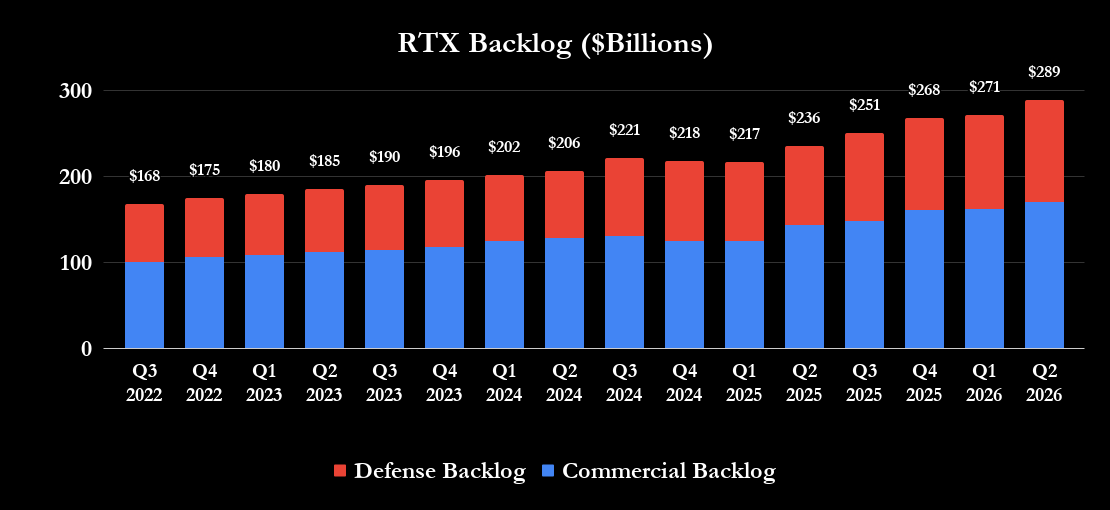
Data source: RTX presentations. Chart by the author.
Why the commercial aerospace backlog also supports the defense business
Aside from the strong profitability of the commercial aerospace business, it helps the defense business avoid overstretching in an era when peers like Boeing and Lockheed Martin have come under pressure to take on difficult, and at times loss-making, fixed-price development programs to satisfy a U.S. government that appears to be negotiating much harder over complex and technically demanding contracts.
An example of this flexibility is RTX terminating a fixed-price contract for a classified program with a foreign customer in 2024 and taking a $575 million charge (a modest figure compared to Boeing's multibillion-dollar charges) in the second quarter of 2024. RTX walked away from the contract because it was "not within our core competency," according to CEO Chris Calio, and it had been taken on before RTX's formation.
Image source: Getty Images.
RTX can arguably take a more disciplined approach to procuring defense contracts (often focusing on non-novel solutions such as Patriot missiles) and walk away from unfavorable defense contracts, given its excellent commercial aerospace backlog.