The debate between Advanced Micro Device's (AMD -0.56%) and Nvidia's (NVDA +3.21%) stocks has been raging since the artificial intelligence (AI) arms race kicked off in 2023. For the first three years, Nvidia was the far better investment and outperformed AMD. That hasn't been the case in 2026, as Nvidia stock has risen a mere 15% while AMD's has soared about 115% so far.
But that's in the past. Which one will perform the better in the future?
I'm a firm believer that Nvidia will easily outperform AMD through 2028 (or really any reasonable time frame). There are several factors that push me toward Nvidia, and I think it's clearly the better of the two.
Image source: The Motley Fool.
Nvidia is growing faster than AMD
Both Nvidia and AMD are involved in the data center computing equipment industry, and also have consumer offerings. However, AMD has a lot more exposure than Nvidia does with its consumer hardware division, and with that industry not growing as fast as data centers, AMD's overall growth rate is far slower than Nvidia's.

NASDAQ: AMD
Key Data Points
Comparing their two quarters directly isn't possible, as AMD operates on the calendar year and Nvidia operates on a slightly shifted fiscal year, which ends in January of the next year. So, Nvidia's Q2 of fiscal year 2027 ended on July 26. While it isn't a direct comparison, it's the best we have.
In Q2, AMD's data center growth rate was an impressive 107% year over year, but its consumer division didn't grow nearly fast enough, and AMD's total revenue growth was 50%. Nvidia's data center growth was comparable, with revenue rising 117% year over year. But with data centers making up a vast majority of Nvidia's total revenue, its overall revenue rose by 106% year over year.

NASDAQ: NVDA
Key Data Points
In a blind comparison, if you were given the choice between two companies that are in the same industry, with one growing 50%, and the other growing at 106%, you would probably choose the fastest-growing stock every time.
That gives one point in favor of Nvidia, but there is another very important consideration: valuation.
Nvidia is cheaper than AMD
The market can balance out a company's faster growth rate by assigning it a higher valuation multiple. This can take away some of the upside of the stock because some of the growth is already priced in. However, this isn't true for these two.
AMD trades at a huge premium to Nvidia, which is odd given Nvidia's industry dominance and faster growth.
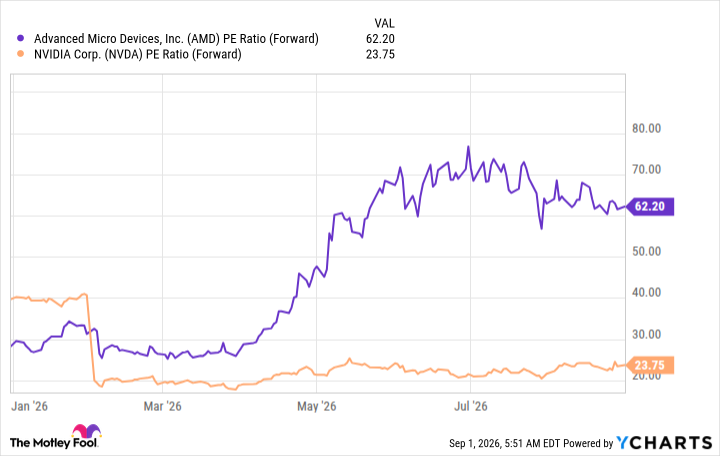
AMD PE Ratio (Forward) data by YCharts
At 62 times forward earnings, AMD is nearly three times more expensive than Nvidia. This could indicate that AMD's earnings will need to grow into its stock valuation, which may limit further upside for the shares. In the meantime, Nvidia's stock is valued near a market-average level, so any growth it puts up should directly convert into stock price appreciation.
If we stretch the time horizon out to look at next fiscal year, AMD's stock starts to look more reasonable, while Nvidia's stock looks greatly undervalued.
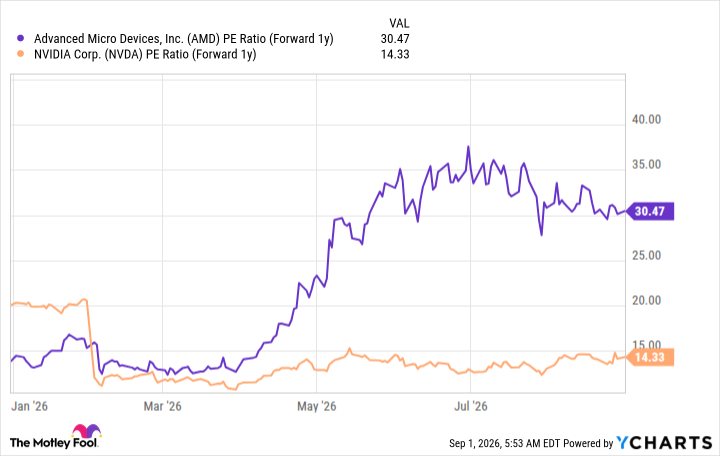
AMD PE Ratio (Forward 1y) data by YCharts
If AMD's stock is little changed from now until the end of 2027, it should grow into its current valuation and be reasonably priced. If Nvidia's stock is little changed as well, it will be deeply undervalued versus the market. The reality is Nvidia's stock will never get this cheap and will rise to stay at least a market-average stock.
That means there's actual upside available for Nvidia's stock, whereas AMD must grow into its valuation. As a result, I'm quite confident that Nvidia will outperform AMD through 2028.