Warren Buffett reportedly first came to recognize the appeal of iconic consumer tech giant Apple (AAPL +1.75%) in 2016 after seeing how distraught one of his close friends became when he thought he had lost his iPhone.
It certainly left an impression.
Over the next several years, Buffett would go all-in on Apple, making it Berkshire Hathaway's (BRKA +0.63%)(BRKB +0.67%) No. 1 equity position. At one point, the stock's impressive growth pushed the conglomerate's stake higher to such a degree that it accounted for 40% of the value of its stock portfolio.
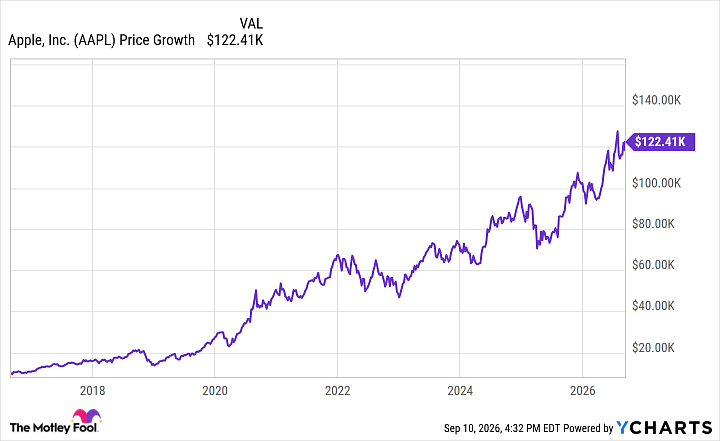
While Berkshire has sold a considerable amount of its Apple stock in recent years, it still accounts for 20% of Berkshire's roughly $360 billion stock portfolio. If you, as a retail investor, had bought $10,000 worth of Apple shares 10 years ago, not long after Buffett started accumulating them, your stake, with dividends reinvested, would be worth roughly $122,400 today.
Image source: The Motley Fool.
The best hardware and a share cannibal
Buffett has always had a knack for identifying companies that have the capacity to benefit consistently from incredible brands. Just look at some of Berkshire's longtime holdings: Coca-Cola, American Express, and Alphabet are positions he initiated.
A good brand is not just about marketing. Good brands help build competitive moats, which lead to pricing power. When it comes to consumer tech and hardware, few rivals can boast a brand as strong as Apple's.
The company has developed game-changing products from the iPhone to AirPods to the Apple Watch, each of which has captured impressive market share.
According to Counterpoint Research, in the second quarter, Apple controlled 54% of the U.S. smartphone market by original equipment manufacturer (OEM) share of shipments. That was flat year over year, although the numbers have been fairly volatile on a quarter-to-quarter basis.
Globally, Apple holds a smartphone market share of 21%, slightly behind Samsung's 23%.
Another interesting thing about Apple that I'm sure Buffett and the Berkshire team have absolutely loved over the years is how shareholder-friendly the company is.
Notably, under former CEO Tim Cook, Apple repurchased hundreds of billions of dollars' worth of its stock. Those buybacks reduced the number of outstanding shares, giving all of the remaining shareholders a bigger piece of the pie and increasing earnings per share.
Specifically, Apple repurchased roughly $755 billion worth of its stock between 2016 and the end of 2025, according to Motley Fool research.
Apple has been a superb investment over the past 20 years. What's next?
As mentioned, if you had invested $10,000 in Apple stock a decade ago, held on and reinvested your dividends, your stake would now be worth roughly $122,400 now, thanks to strong product innovation and tremendous capital returns to shareholders, among other factors.
The question is, can Apple replicate its success from the past decade and deliver similar growth over the next 10 years? It's unlikely, simply because as companies get bigger and control large slices of the industries in which they operate, they typically grow at lower percentage rates. And today, Apple is already the second-largest company in the world, boasting a market cap of $4.9 trillion.
That's not to say Apple isn't well positioned to grow. Recently installed CEO John Ternus brings a hint of the former Steve Jobs back into the mix because Ternus, like Jobs, is a hardware guy.
Another big question Apple will need to answer is whether it can find ways to better capitalize on the artificial intelligence revolution. Unlike many of its big tech peers, Apple is not spending hundreds of billions to build AI data centers.
However, Apple is likely to play a big part in bringing AI to consumers through its smartphones and other devices.
Recently, CNBC reported that many developers building AI applications using tools such as OpenClaw prefer to build on models such as Mac Mini and Mac Studio instead of the cloud because it can be cheaper in some instances, and these computers are easy to take on the go.
Apple recently rolled out new versions of the Mac Mini and Mac Studio with more powerful chips, specifically designed for developers working on AI applications. It's this kind of product development that will serve the company well. While I think investors want to see more moves like this from the company, it's evident that Apple has a role to play in the AI revolution.
Additionally, its choice not to invest hundreds of billions in data centers also makes it a more appealing play for investors who are worried that the massive investments being made by hyperscalers won't yield adequate returns.