Many people grew up hearing the phrase, "Don't put all your eggs in one basket." That applies to careers, skill sets, and your investments. Diversification is a pillar of investing because it minimizes risk and widens your investing net,
But what exactly does portfolio diversification look like? There's no single approach to diversification, but let's look at a straightforward one. It might not always be the coolest approach to investing, but it's time-tested and has been proven to work for the everyday investor.

Image source: Getty Images.
Diversification is needed for most investors
I look at diversification as a way to play both offense and defense. On one hand, exposure to many different companies lets you take advantage of the specific growth opportunities each presents. On the other hand, a diverse stock portfolio can help protect you when certain companies or industries are in down periods.
Ideally, your portfolio is diversified across three key areas: size, sector, and location. If you can check those three boxes, you're likely in good shape.
Size
Companies typically fall into one of three size categories: small-cap, mid-cap, or large-cap. Exceptions exist, but the general trade-off is that smaller companies carry more risk because they have fewer resources and are more likely to be affected by broader economic conditions. However, their small size also offers more upside and growth potential.
Larger companies generally have more resources and can weather economic storms, providing a sense of stability. However, their large size can reduce the chance for outsize gains.
Sector
The U.S. stock market has 11 major sectors:
- Communication Services
- Consumer Discretionary
- Consumer Staples
- Energy
- Financials
- Healthcare
- Industrials
- Information Technology (tech)
- Materials
- Real Estate
- Utilities
Different sectors perform well during different phases of the business cycle. For example, the energy sector typically benefits from rising commodity prices, while the tech sector tends to flourish when interest rates are low. The financials sector is the opposite, thriving when interest rates are high, while the consumer staples sector is resilient during rough economic times.
Exposure to different sectors helps keep your portfolio (relatively) steady regardless of economic conditions.
Location
This aspect of diversification is often overlooked because most portfolios do well with only holding U.S. stocks. However, investing in international stocks is a great way to hedge against local economic issues and geopolitical events.
I personally try to keep my exposure to international stocks around 10%, giving me enough exposure to capture global growth without relying on them too much.
Two ETFs can cover more ground than you can imagine
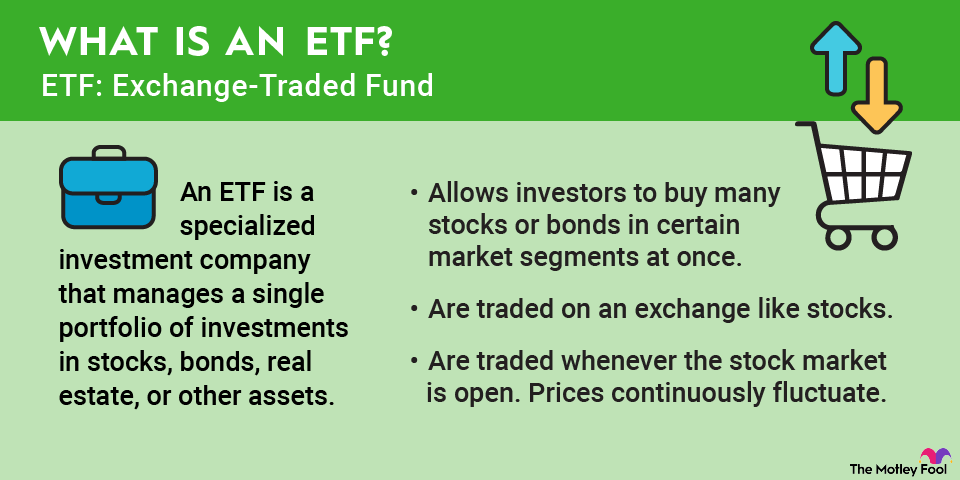
Achieving a truly diversified portfolio doesn't require handpicking dozens or hundreds of individual stocks. In fact, that can be counterproductive for many investors. Instead, you can do it with a few broad exchange-traded funds (ETFs) that cover a lot of ground. Two in particular are the Vanguard Morningstar Total Stock Market ETF (VTI +1.51%) and the Vanguard Total International Stock ETF (VXUS +1.48%).

NYSEMKT: VTI
Key Data Points
VTI holds virtually every U.S. stock on the market, covering all sizes, sectors, and stock types (growth, value, dividend, and everything in between). Larger companies account for more of the ETF than smaller ones, so it's top-heavy with major tech stocks, but it still covers as much ground as you could hope for from an ETF. Here are its top 10 holdings:
- Nvidia: 6.87%
- Apple: 6.30%
- Microsoft: 5.10%
- Amazon: 3.40%
- Alphabet (GOOGL): 2.69%
- Broadcom: 2.37%
- Alphabet (GOOG): 2.12%
- Meta Platforms: 1.70%
- Micron: 1.46%
- Tesla: 1.40%

NASDAQ: VXUS
Key Data Points
VXUS is the one-stop shop for international stocks, holding 8,790 stocks from almost all non-U.S. regions in the world. Here is how it's divided by region:
- Europe: 36.38%
- Pacific: 28.46%
- Emerging Markets: 26.21%
- North America: 8.11%
- Middle East: 0.83%
- Other: 0.01%
International stocks can sometimes be riskier because of geopolitical tensions, currency exchange differences, and differences in accounting standards. That's why VXUS is a great go-to. You don't have to research foreign companies; you can make one investment and get exposure to the entire international market, including stocks from developed and emerging markets.
By investing in both VTI and VXUS, you get diversification that's hard to match with so few investments. They're cheap, hands-off, and effective. For everyday investors, it's a route that has historically paid off over time.