Purchase | Share Price | Number of Shares |
|---|---|---|
1 | $150 | 25 |
2 | $250 | 15 |
3 | $300 | 10 |
4 | $400 | 10 |
Purchase | Share Price | Number of Shares | Share Price x Number of Shares |
|---|---|---|---|
1 | $150 | 25 | $3,750 |
2 | $250 | 15 | $3,750 |
3 | $300 | 10 | $3,000 |
4 | $400 | 10 | $4,000 |

Invest better with The Motley Fool. Get stock recommendations, portfolio guidance, and more from The Motley Fool's premium services.
If you've bought a certain stock over a series of transactions, then it can be useful to calculate the average price you paid. This information can help you track your gains and losses over time. If your brokerage statement doesn't give you the clarity you need, it may be the right to time to choose a new broker -- visit our broker center to compare options.
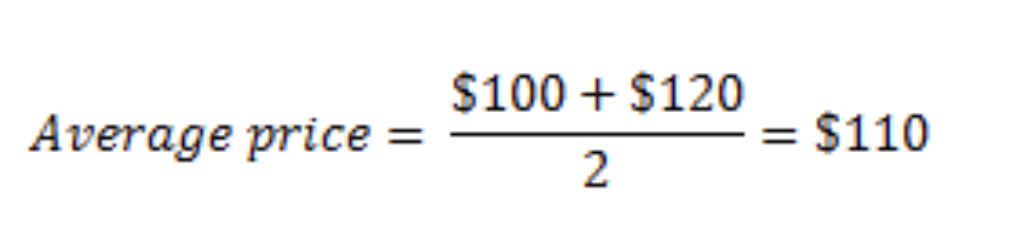
If you bought an equal number of shares with each trade, then the calculation of the average price is easy. Simply add up all of the prices and divide by the number of trades you made. For example, if you buy 50 shares of a stock at $100 and then another 50 shares at $120, your average price is:
However, if you didn't buy the same number of shares in each trade, then you'll need to take a weighted average. A weighted average takes into account the number of shares purchased with each trade. In other words, if you buy 100 more shares of the stock mentioned above, then the price you pay will affect the average more than it would if you bought another 50.
Here are the steps to calculate a weighted average trade price:
Putting these all together in a mathematical formula, we have:
Using the steps outlined above can be easier than using a formula, so let's take a look at an example to illustrate how this works.
Multiplying the share prices by the number of shares produces the following numbers:
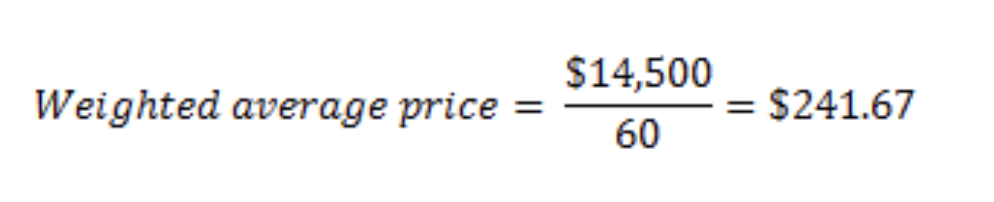
Adding the four numbers in the last column gives us a total of $14,500. Finally, dividing by the total number of shares purchased (60), we arrive at the weighted average price per share.