How much diversification is too much?
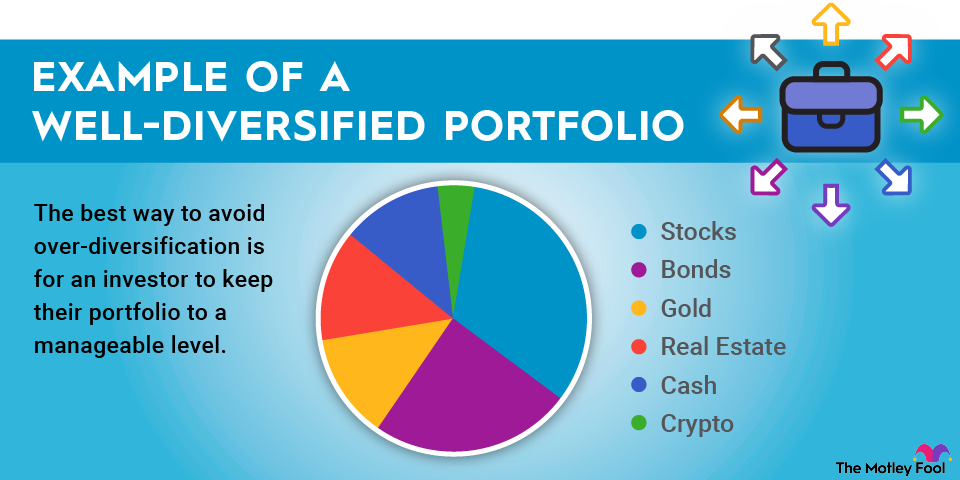
There's no absolute cutoff point that distinguishes an adequately diversified portfolio from an over-diversified one. As a general rule of thumb, most investors would peg a sufficiently diversified portfolio as one that holds 20 to 30 investments across various stock market sectors. However, others favor keeping a larger number of stocks, especially if they're riskier growth stocks. For example, some take a basket approach of investing in similar companies in an industry to make sure they don't end up being correct on the thesis that the sector will rebound or grow at an above-average rate but choose the wrong stock that underperforms its competitors.
Instead of being an absolute number, over-diversification is more a function of spreading a portfolio too thin by investing in lower-conviction ideas for the sake of diversification. For example, not all investors need to own oil stocks or tobacco stocks to have a diversified portfolio, especially if doing so would conflict with their values. Similarly, owning more than 100 stocks can make it difficult for an investor to keep up with their portfolio, which could cause them to hold on to losing stocks for too long.
What are the risks of over-diversification?
The biggest risk of over-diversification is that it reduces a portfolio's returns without meaningfully reducing its risk. Each new investment added to a portfolio lowers its overall risk profile. Simultaneously, these incremental additions also reduce the portfolio's expected return.
However, at some point, an investor will reach the number of investments where the benefit of risk reduction from each new addition is smaller than the decrease in expected gains. Thus, there's no incremental benefit to adding that investment. It would be better to sell a lower-conviction idea and replace it with this new one than add it to the portfolio since there's no incremental benefit.
The other danger of over-diversification is that it takes an investor's focus away from their highest-conviction ideas. They'll need to divert some of their time to stay up to date on all their holdings. That could cause them to focus too much on losing investments and not enough on the winners. It would be better to cultivate the winning ideas and add capital to those investments while weeding out bad ones that don't add an incremental benefit.