How to find value stocks
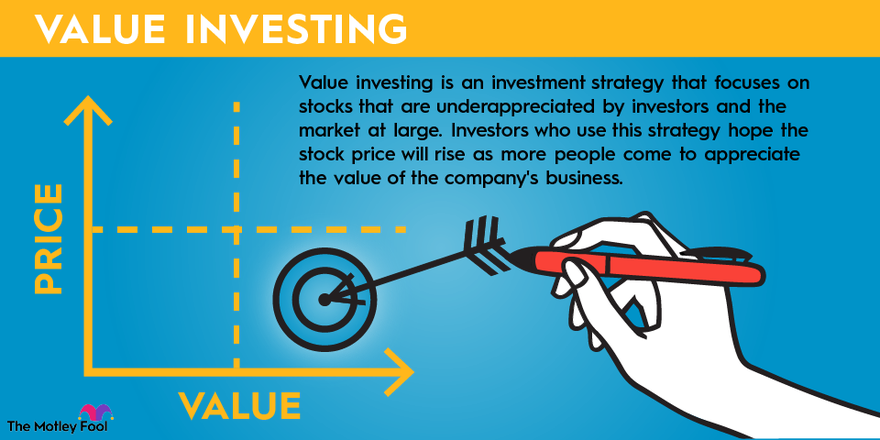
The point of value investing is to find companies trading at a discount to their intrinsic value, with the idea that they'll likely outperform the overall stock market over time. However, finding undervalued stocks is easier said than done. That said, here are three of the best metrics to keep in your toolkit as you search for a bargain:
- P/E ratio: This is the best-known stock valuation metric -- and for good reason. The P/E ratio can be a very useful tool for comparing the valuations of companies in the same industry. To calculate it, simply divide a company's price per share by its past 12 months of earnings per share.
- Price/earnings-to-growth (PEG) ratio: This is similar to the P/E ratio, but the PEG ratio adjusts to level the playing field between companies that might be growing at slightly different rates. By dividing a company's P/E ratio by its annualized earnings growth rate, you get a more apples-to-apples comparison between different businesses.
- Price-to-book value (P/B) ratio: Think of the book value as what would theoretically be left over if a company stopped operations and listed all its assets for sale. Calculating a company's share price as a multiple of its book value can help identify undervalued opportunities, and many value investors specifically look for opportunities to buy stocks trading for less than their book value. This is sometimes known as an asset play.
Why invest in value stocks?
There are a number of reasons why investing in value stocks can be a good strategy.
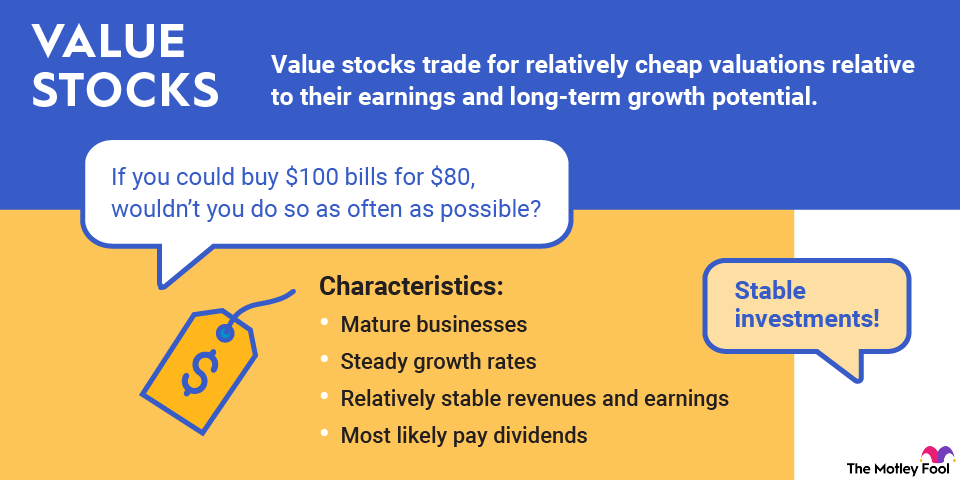
- Value investing tends to be more methodical than growth investing. It's typically easier to identify a stock that is a good value than to predict a business's long-term growth rate.
- Value stocks typically have less downside than growth stocks. Since their valuations are already low, they have less room to fall than growth stocks.
- Value stocks often pay dividends. Their yields can be high, as dividend yields are inversely correlated with valuations.
- Value investing can pay off when the market is expensive. When the market gets frothy, value stocks tend to be better long-term bets.
How to invest in value stocks
- Open your brokerage app: Log in to your brokerage account where you handle your investments.
- Search for the stock: Enter the ticker or company name into the search bar to bring up the stock's trading page.
- Decide how many shares to buy: Consider your investment goals and how much of your portfolio you want to allocate to this stock.
- Select order type: Choose between a market order to buy at the current price or a limit order to specify the maximum price you're willing to pay.
- Submit your order: Confirm the details and submit your buy order.
- Review your purchase: Check your portfolio to ensure your order was filled as expected and adjust your investment strategy accordingly.
Reasons for undervaluing a stock
There are a lot of reasons why investors might undervalue a stock. Let's take a look at a few of them.
- Recency bias: Stocks can plunge on a single bad earnings report, even though it might be just a result of one-time issues. Investors tend to pay more attention to recent events, meaning one piece of bad news can cause a stock to become oversold. Of course, a stock plunging isn't necessarily a signal that it's undervalued. You have to investigate it to see why it fell and whether it's still healthy.
- Short-term bias: Investors also have a tendency to pay more attention to what they can see in the short term. For example, the sell-off in April 2025 was arguably a result of short-term bias. Investors feared that tariffs would crush the economy. After some negotiations and adjustments, stocks quickly recovered to all-time highs.
- Cyclicality: Cyclical stocks rise and fall based on macro factors in the economy. Value investors can do well picking up these stocks when they're at a low point in the economic cycle. Currently, some consumer discretionary stocks, like fast-casual restaurants, have fallen sharply on weak consumer spending, and there could be some opportunities in this sector.
- Turnarounds: Turnarounds don't always turn as some investors say, but sometimes they do pay off. If there's evidence that a turnaround is starting to work, that can be a good opportunity to buy a value stock. Nike (NKE +1.84%), for example, has shown hints of a turnaround though the stock has continued to fall.
- Transitional business models: Sometimes, companies change their business models, and the stock plunges when the results initially disappoint. For example, Netflix (NFLX +0.44%) stock tumbled in the early stages of its streaming launch before going on to deliver huge returns. Similarly, RH (RH -0.20%), formerly Restoration Hardware, plummeted when it switched to a membership-based business model, though the stock surged after that move paid off.
- Temporary headwinds: Sometimes, business conditions are challenging, but they are temporary. Netflix reported two straight quarters of subscriber declines after the COVID-19 pandemic, but that was because consumers were reverting to pre-pandemic norms for how they spent their time. That headwind proved to be temporary.
Tax considerations for value investors
The tax implications for value investors are similar to what they are for any stock investor. You'll have to be mindful of short-term and long-term capital gains, investing in a retirement account vs. a taxable account, and paying taxes on dividends.
As a value investor, you're more likely to hold stocks for the long term, which will help save money on taxes since you need to hold a stock for at least a year to pay the lower, long-term rate. Additionally, since most value stocks pay dividends and dividends are part of a value-investing strategy, it's typically smart to keep value stocks in a retirement account so you don't have to pay taxes on the dividends.