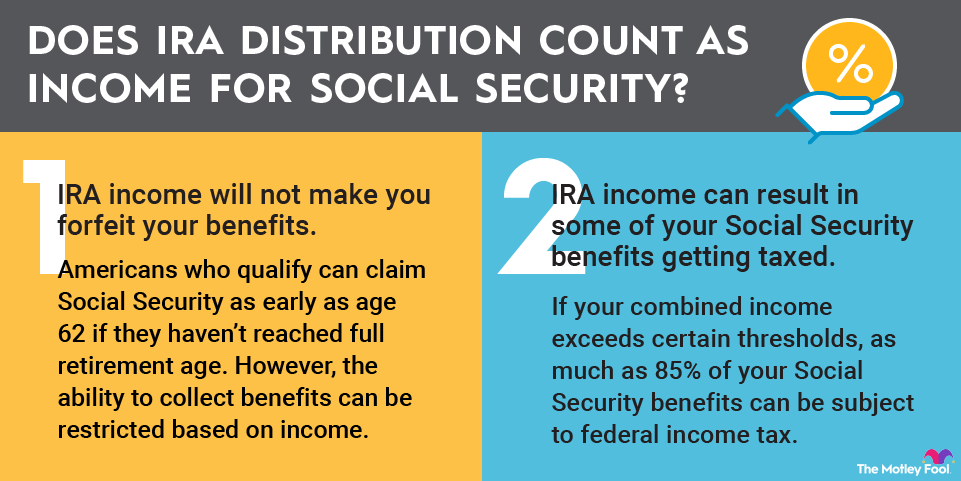
Situation 1: IRA income will not make you forfeit your benefits
Americans who qualify can claim Social Security as early as age 62 if they haven't reached their full retirement age. However, the ability to collect benefits can be restricted based on income.
This concept is known as the Social Security earnings test. In simple terms, the idea is that some or all of your Social Security benefits can be withheld if you earn more than a certain amount.
If you will reach your full retirement age (67 for people born in 1960 or later) after 2026, you can earn as much as $24,480 with no effect on your benefits. Beyond that threshold, $1 will be withheld for every $2 in additional earnings.
If you'll reach full retirement age in 2026, you can earn up to $65,160. After that, Social Security will withhold $1 for every $3 of earnings.
There are more details to know about the earnings test. However, for our purposes, the important point is that IRA distributions do not count as earned income. The Social Security earnings test only considers money you earn from a job or that you get from a business you own or actively participate in.
Situation 2: IRA income can result in some of your Social Security benefits getting taxed
Depending on your income, some of your Social Security benefits can be subject to federal income tax. To determine this, the IRS uses a figure known as your combined income.
Your combined income is equal to:
- Your adjusted gross income (AGI)
- Any nontaxable interest income, such as from municipal bonds
- Half of your Social Security benefits