Examples of nonqualified dividend stocks
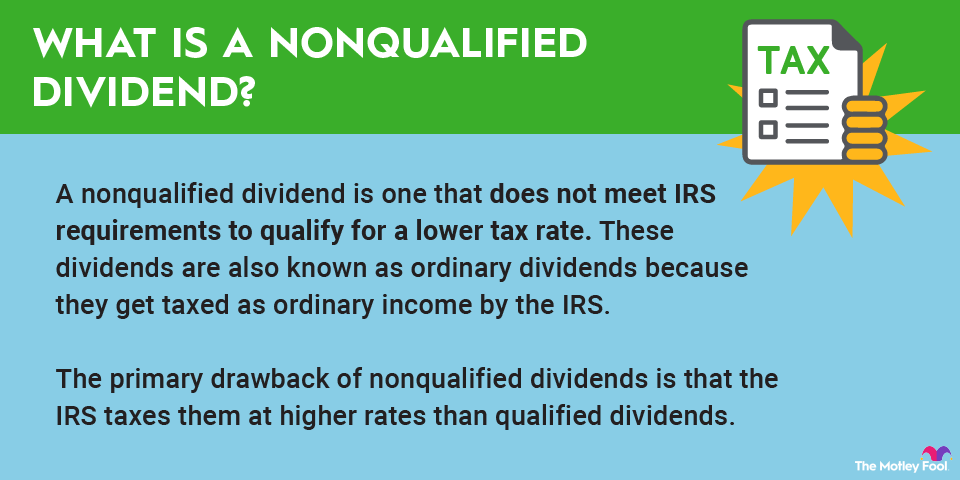
Most dividends paid by U.S. corporations are taxed as long-term capital gains and are called "regular" or "qualified" dividends. Depending on which tax bracket you fall in, regular dividends are taxed as low as 0% and no higher than 20% by the IRS. However, one of the qualifiers is the minimum holding period. If an investor doesn't meet that requirement, the first payment won't qualify for the lower tax rate.
Another factor that can disqualify a dividend from a lower tax rate are those paid on employee stock options. That's because stock options are typically a form of compensation. The IRS sees the dividend paid by that option as income, which it then taxes according to the recipient's tax bracket.
An important qualifier for a lower tax rate is the type of company paying a dividend. For example, REITs, certain foreign companies, and MLPs don't qualify for lower tax rates. For REITs and MLPs, this is because their corporate structure is such that they pay no federal income tax. Called "pass-through" entities -- so long as they meet certain qualifications -- they don't pay federal income tax, meaning they are able to reward investors with higher yields. The IRS treats those payouts differently and taxes them at a higher rate. U.S. investors should consider holding a REIT and foreign dividend stocks in a retirement account such as an IRA, avoiding most (or even all) of the taxes paid in a taxable account.
Unfortunately, that's sometimes not an option for an MLP because of something called unrelated business taxable income, or UBTI, that can leave investors owing tax on assets in a retirement account. To avoid this potential complication, many brokers don't allow investors to own MLPs in an IRA or a Roth IRA.
Finally, investors in higher tax brackets should be aware of companies that routinely pay special dividends since those are usually nonqualified payments. Because of that, high-wage earners might want to consider holding companies known for special dividends in an IRA instead of their regular brokerage account.
Related investing topics