Invest better with The Motley Fool. Get stock recommendations, portfolio guidance, and more from The Motley Fool's premium services.
Hedge funds are a way for wealthy individuals to pool their money together and try to beat average market returns. Managers often use aggressive strategies in an effort to produce positive returns for investors, and they typically get paid based on performance.
Hedge funds generally have similar legal structures, relatively comparable investment strategies, and charge about the same amount of fees to their investors. To really understand the definition of a hedge fund, though, we need to dig a little deeper.
Hedge funds limit their participants to accredited investors. An accredited investor is defined as someone with a liquid net worth of more than $1 million or an annual net income of more than $200,000 (or $300,000 with a spouse). The SEC allows accredited investors to invest in less-regulated securities offerings because it assumes investors with that much wealth will have a level of financial sophistication.
Hedge funds are structured as limited partnerships. The investors are limited partners, while the hedge fund company is a general partner. The hedge fund pools money from its limited partners and invests it on their behalf.
Restricting themselves to accredited investors allows hedge funds to take more aggressive approaches to investing since they're not heavily regulated by the SEC like mutual funds. Managers often use advanced strategies, including leverage, short positions, and derivatives such as options, and they can invest across a wide variety of markets, including stocks, bonds, commodities, real estate, cryptocurrency, and more. Virtually any opportunity to make money is on the table.
Investments in hedge funds are often relatively illiquid. You can only buy in or withdraw during certain periods, and there's often a lock-up period of several months to several years after the initial investment. Operating this way allows fund managers to take more aggressive positions without having to provide liquidity to investors at all times.
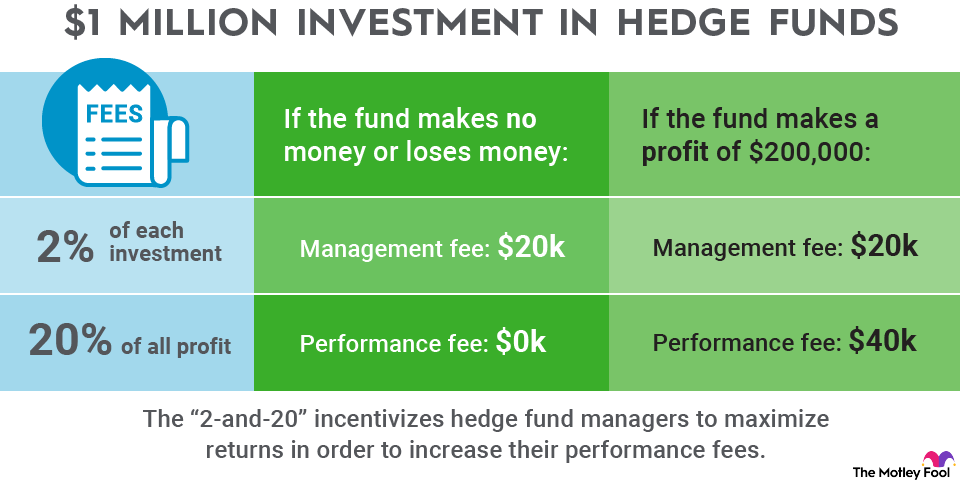
Hedge funds typically charge two fees: management fees and performance fees.
A hedge fund company typically charges a 2% management fee, but it will depend on the fund. This fee is based on the net asset value of each investor's shares. So, if you invest $1 million, you'll pay about $20,000 as a management fee that year. This fee goes toward covering the operations of the hedge fund and may be used to directly compensate the fund manager.
The fund manager's job is to develop the investment portfolio and manage inflows and outflows of cash into the fund. They're directly in charge of each investment decision and the strategies the fund will use. Often, the fund manager and hedge fund company owner are one and the same.
The performance fee is usually 20% of profits. So, if the hedge fund manager does well, and they increase your investment from $1 million to $1.2 million, they'll take another $40,000 (20% of $200,000). If the fund does poorly and loses money, there's no additional fee.
While "2-and-20" has been standard in the industry for some time, hedge funds' underperformance since the 2008 financial crisis has put pressure on hedge fund companies to lower their fees. Some funds have fees as low as 1.4%.
While both hedge funds and mutual funds pool investors' money and typically invest in diversified portfolios, there are many differences between the two investment vehicles.
The typical mutual fund has a benchmark index that the fund manager aims to outperform.
Hedge fund managers are incentivized to maximize returns in order to increase their performance fees. The asymmetry in the fee (e.g., the fund company can't owe investors for negative performance) leads to more volatile strategies and results on a year-to-year basis.
Mutual funds charge an expense ratio that usually falls between 0.5% and 1.5%. If you're interested in index funds, the fees can be much closer to 0%.
Hedge funds typically charge 2% in management fees and an additional performance fee of 20% of the profits. That makes hedge funds extremely expensive relative to mutual funds. However, this has changed since 2008; today, hedge funds have dropped their fees as low as 1.4% in management fees.
Anyone can invest in a mutual fund. Mutual funds may require a minimum investment of $100, $1,000, or more, but as long as you have the money, you can buy shares.
Hedge funds only accept accredited investors. On top of that, hedge funds usually have very high minimum investments, like $1 million. This puts a significant limit on the number of people who can invest in a hedge fund.
Investors can sell their shares in a mutual fund on any day. While their sell order won't execute until the end of the trading day, they can sell or buy more any day the stock market is open.
Hedge funds limit their investors to buying and selling during certain periods every quarter, half-year, or sometimes longer. Additionally, new investors must lock up their funds for a certain length of time, typically one year.
Mutual funds are registered with the SEC. As such, they're required to comply with all agency regulations, including regular financial reporting.
Hedge funds don't have to register with the SEC, and, therefore, there's a lot less transparency. However, the SEC can still sue nefarious hedge fund managers on its investors' behalf in the case of corruption or misleading investors, such as in a Ponzi scheme.
Mutual funds are limited in the strategies they can use to invest. For the most part, mutual funds stick to buying stocks, bonds, and other securities.
Hedge funds can invest in just about anything, and, therefore, can employ a wide variety of strategies. Managers can use derivatives to hedge or leverage positions, buy more illiquid assets such as art or private real estate, sell short, and use debt. These strategies are often more volatile than those available to mutual funds.

Hedge funds can employ a number of strategies to capitalize on various tactics:
Hedge funds offer access to a specific manager's investment strategy, but the price is very steep. Most individual investors are precluded from investing in hedge funds, and even those eligible to buy shares may be better off with a less expensive investing approach.