This divide suggests that firsthand exposure to AI companies, whether through semiconductors, software, or infrastructure, has reinforced confidence in the technology’s ability to generate strong market returns – or, at a minimum, that confidence in AI stocks among owners of them has not wavered.
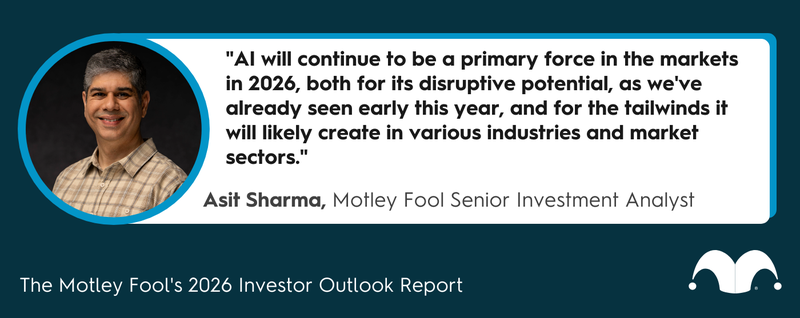
"AI has been a driving force in the market for the past three years, so those who have witnessed a cycle of success with AI-themed investments are drawing their optimism from experience," Sharma said. "AI will continue to be a primary force in the markets in 2026, both for its disruptive potential, as we've already seen early this year, and for the tailwinds it will likely create in various industries and market sectors."
The Motley Fool’s AI Investor Outlook Report similarly found that AI investors are more comfortable riding out potential short-term AI stock volatility because they’re confident the technology will deliver long-term, market-beating returns.
"But it's clear that AI's impact is somewhat diffuse, and revenue and earnings impacts are playing out over years, not quarters. So investors' desire to identify true long-term beneficiaries of this technology won't wane one bit in 2026," Sharma added.
Why investors feel bullish and what worries them
When individual investors explain why they’re optimistic about 2026, AI is at the top of the list. Forty percent cite advances in AI as a key reason for optimism, rising to 55% among AI stockholders. A quarter of respondents said capital expenditures in data centers and AI infrastructure are among their top three reasons for optimism in the market, reinforcing the view that AI is not just hype but a capital-intensive, long-duration growth cycle that will drive real productivity gains and broader economic growth.
That view isn’t limited to individual investors. Major investment firms see the same forces supporting AI investment optimism:
- Vanguard's 2026 outlook for financial markets: AI is driving a new wave of capital-intensive growth, similar to railroads or the internet. Investment in AI infrastructure could support U.S. GDP growth above most forecasts, even if the short-term labor market is soft.
- JPMorgan's (JPM +0.47%) 2026 market outlook: The AI supercycle should keep earnings growth above trend (13% to 15%) over the next two years, creating concentrated opportunities for long-term investors.
- Fidelity Viewpoints: Massive spending on the AI-driven infrastructure build-out is creating opportunities across chipmakers, utilities, energy, and other picks-and-shovels companies. While AI product monetization is in its infancy, the current infrastructure build-out lays the groundwork for future profitable applications.
- BlackRock's (BLK +1.60%) 2026 Global Outlook: AI spending is front-loaded and concentrated among a few companies, creating macro effects that could boost growth above the U.S.’s 2% trend if innovation accelerates.
Macroeconomic factors also underpin optimism. About one-third of investors cite lower inflation, potential interest rate cuts, and easing global trade tensions as reasons for confidence, signs that many expect a cooling inflation environment without a sharp economic downturn.
Optimism around AI is heavily generational. Nearly half of Gen Z (47%) and millennials (46%) see advances in AI as a reason to be bullish in 2026, compared with just 29% of Gen X and 28% of baby boomers.
That said, optimism is tempered by real concerns.
- The risk of recession (45%), inflation failing to come down (45%), and U.S. political uncertainty (41%) top the list of investor concerns.
- Other top investor worries are the labor market weakening (37%), interest rates remaining high (33%), and geopolitical uncertainty (30%), all of which could create stock market volatility.
AI investment itself is also a source of anxiety for some. While many investors expect continued upward momentum, some experts caution that elevated expectations for AI-related stocks may increase market volatility. If enthusiasm fades or innovation fails to deliver as quickly as hoped, stock prices could face sharper corrections, particularly among companies with the highest valuations.
Twenty-nine percent of survey respondents worry about AI overvaluation or hype, and notably, AI investors are more concerned about that than those who don’t own AI stocks. Vanguard's key risk for 2026 is AI optimism fading and the AI-related capex spending halting. BlackRock notes that U.S. stock valuations are near dot-com-bubble levels.
Given the potential for increased volatility, especially if AI-driven optimism fades or macroeconomic risks materialize, some investors are considering adding more defensive assets to their portfolios.
This can include increasing allocations to:
- Dividend-paying stocks
- Alternative assets that historically offer lower correlation to equities
- High-quality bonds
Portfolio rebalancing and regular risk assessment are other ways to ensure asset allocation remains aligned with long-term goals.
Beyond equities, some analysts see renewed value in fixed-income investments as a hedge against macro risks and a potential AI slowdown. For instance, Vanguard notes, "high-quality bonds (both taxable and municipal) offer compelling real returns given higher neutral rates," and the company expects bonds to provide diversification if AI-driven growth disappoints. Some investment managers are looking to international and value stocks as potential winners in a broadening tech cycle while remaining cautious on overvalued segments.
In short, long-term individual investors are optimistic about stock market growth, but they’re taking that view with an eye on short-term macro risks.
AI dominates long-term stock market optimism
Looking beyond 2026, 57% of individual investors expect artificial intelligence and AI-driven infrastructure build-out to be the dominant drivers of stock market growth over the next five years. That percentage holds essentially steady across generations, jumps to 61% among AI investors, and holds above 50% even among investors that don’t own AI stocks.
But investors aren’t solely focused on AI stocks. They're optimistic about the technologies and sectors that could benefit most from AI-driven innovation. Here's the bull case for other market sectors that investors think will deliver strong long-term returns.
- Robotics and automation (28%) as AI boosts productivity in manufacturing and logistics
- Healthcare and biotechnology (27%) through faster drug discovery and more targeted drug and gene therapies
- Cloud computing (19%) due to AI models that depend on massive compute and data storage, driving sustained cloud demand
- Quantum computing (19%) advances could potentially process certain problems exponentially faster, removing bottlenecks that cap AI progress
- Energy infrastructure and electrification (23%) as data centers, grid upgrades, and power generation scale to meet demand
- Cybersecurity (14%) as AI opens up a new vector for cyber vulnerabilities and a new tool to develop new methods to exploit vulnerabilities and new products to improve defenses
Sharma suggests that individual investors maintain a balanced view of AI's potential to disrupt established industries, with benefits or costs for shareholders.
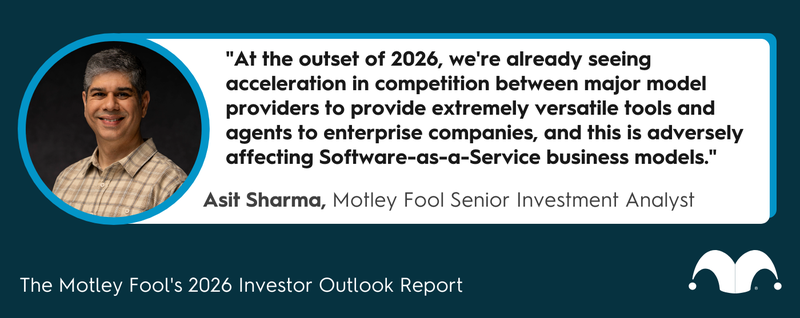
“At the outset of 2026, we're already seeing acceleration in competition between major model providers to provide extremely versatile tools and agents to enterprise companies, and this is adversely affecting Software-as-a-Service business models, " he said, referencing the volatility that rocked the industry in early February.
"This makes the search for manufacturing and industrial companies, which are less vulnerable to such disruption, all the more appealing. So for individual investors, themes like robotics and automation will likely loom large in the coming years," Sharma added. "I expect these themes to support market advances, and for those interested, investment either in providers of robotics and automation or companies that can benefit from them may make sense today over a five-year holding period."
Given how quickly AI breakthroughs can occur and how quickly valuations can shift, investors may consider a flexible, broad approach adaptable to changing market cycles. For example, keep in mind both sectors and asset classes that are poised to benefit from long-term trends, such as infrastructure, healthcare innovation, or clean energy, which may be supported by AI-driven demand. At the same time, maintaining exposure to high-quality companies with strong balance sheets, which can better withstand periods of volatility or economic uncertainty, could still yield strong returns.
Are AI data centers set to drive energy-sector returns?
With roughly a quarter of respondents (23%) eyeing the energy sector to deliver market-beating returns over the next five years, it's worth asking what drives their optimism. David Meier, Senior Investment Analyst at The Motley Fool, sees the AI-driven infrastructure build-out as a major driver.
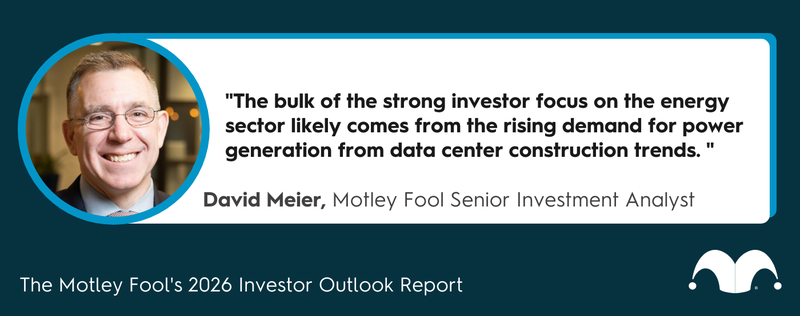
"The bulk of the strong investor focus on the energy sector likely comes from the rising demand for power generation from data center construction trends," Meier said. "The rest of the focus comes from the need to continue to upgrade our electrical grids, the need to replace older and 'dirtier' forms of power generation (e.g., converting coal-fired plants to natural gas-fired plants), and the continued advancement of newer, cleaner technologies (e.g., fuel cells becoming a more economically viable form of generation)."
Meier thinks three areas of the energy sector are poised for growth if the AI build-out continues:
- Gas turbines for delivering additional short-term demand
- Nuclear and small module reactors (SMRs) to build long-term, reliable, clean baseload
- Solar combined with energy storage as another affordable, relatively quick solution to meet rising demand
"The backlog for a natural gas-fired industrial gas turbine has stretched out to five to seven years. Essentially, gas turbines are sold out for that time period, benefitting companies like GE Vernova (GEV +0.54%), Siemens, and others," Meier said. "In addition, there has been a renewed emphasis on nuclear energy and small nuclear SMRs in particular. But the lead times for those sources are years also. As a result, solar plus energy storage has become a very popular stop-gap alternative."
In line with survey respondents' concerns about AI overhype and the slowing of the AI data center build-out, Meier warned, "should the demand for power generation from data centers decrease meaningfully from here, it would have a negative impact on all three areas."
Mixing AI stock optimism with Foolish investing principles
The Motley Fool’s 2026 Investor Outlook and Predictions Report paints a picture of individual investors confident in innovation, earnings growth, and long-term investment opportunities. Most expect gains, plan to stay invested, and see AI as a foundational force shaping markets for years to come.
But Foolish (with a capital "F") investors know optimism works best when paired with discipline. High expectations raise the stakes, especially in fast-moving areas like AI. Rather than concentrating portfolios around a single theme or chasing short-term momentum, long-term success has historically come from portfolio diversification, patience, and ownership of high-quality businesses with durable competitive advantages.
Historically, successful investment strategies in times of rapid technological change combined long-term discipline with adaptability. By staying focused on fundamental principles, such as diversification, quality, and risk management while remaining open to new opportunities created by innovation, individual investors can better navigate uncertainty and position themselves to take advantage of the companies that rise above the rest.
AI may lead the charge in 2026, but time, temperament, and thoughtful portfolio construction remain the most Foolish strategies of all.
Methodology
The Motley Fool surveyed 2,000 individual investors in the U.S. on January 19, 2026, via Pollfish. Results were post-stratified to generate nationally representative data based on age and gender. Pollfish employs organic random device engagement sampling, a method that recruits respondents through a randomized invitation process across various digital platforms. This technique helps to minimize selection bias and ensure a diverse participant pool.
Sources