It's hard to overstate how important the Social Security program has been to Americans over the decades it has been in place. Many people view it as a de facto retirement account: You spend your career paying Social Security payroll taxes, expecting to receive benefits on the back end in retirement.
Unfortunately, not everyone has a consistent or long enough work history to be eligible for a decent enough benefit in retirement because they didn't pay much into the Social Security system via taxes. Luckily, there's a workaround that works out in many people's favor: Social Security spousal benefits.
Spousal benefits allow you to claim benefits based on your partner's work history, and in many cases, it's the best route for people with a spotty work history. Not everyone is eligible, though. To find out if you are, read on to see the qualifications.

Image source: Getty Images.
How does someone qualify for spousal benefits?
There are three boxes you must check to be eligible for spousal benefits:
- The primary claiming spouse must currently be receiving benefits.
- You must be married for at least one year.
- You must be at least 62 years old, caring for a child under age 16, or caring for a child with a disability that began before age 22.
However, there are a couple of important factors to note. First, if you're currently divorced but were married for at least 10 years, you can still claim spousal benefits. If you remarry, you're no longer eligible for spousal benefits, but you'll still receive them if your ex-spouse remarries and you don't.
Secondly, if you're receiving spousal benefits and your spouse suspends their benefits -- which some people do to gain delayed retirement credits -- your spousal benefits will also be suspended.
How much can you receive in spousal benefits?
Claiming spousal benefits makes you eligible to receive up to 50% of your spouse's primary insurance amount (PIA). For example, if your spouse's PIA is $2,000, you could receive up to $1,000. However, to receive up to 50%, you must claim spousal benefits at your full retirement age, even though you can begin claiming at 62. Here are full retirement ages by birth year:
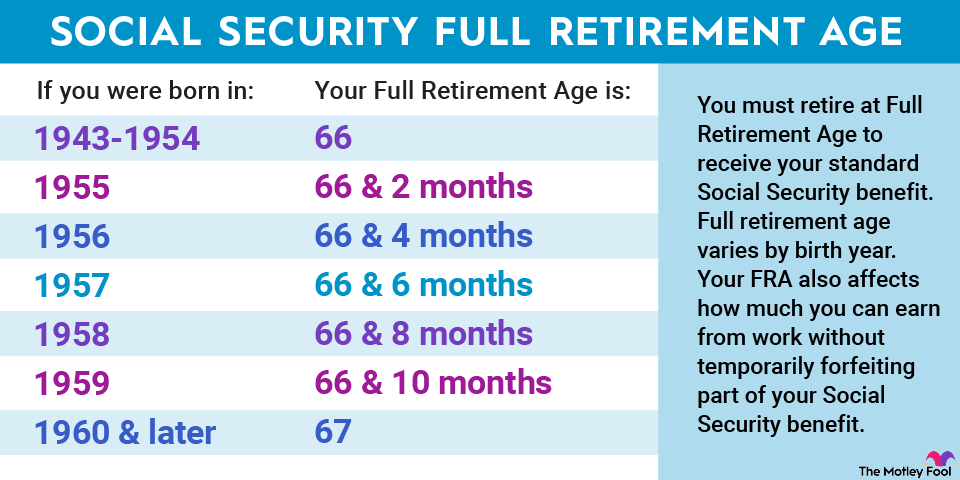
Image source: The Motley Fool.
Remember: It's up to 50% of your spouse's PIA, not their monthly benefit. If they delay claiming benefits, they'll receive more than their PIA, but you won't be eligible to receive more than half of the PIA.
Benefit reductions also apply to spousal benefits
When you claim standard benefits before your full retirement age, your monthly benefit is reduced based on how far away you are from your full retirement age. Monthly benefits are reduced by 5/9 of 1% monthly, up to 36 months. Each additional month further reduces benefits by 5/12 of 1% monthly. At those percentages, here is how much monthly standard benefits will be reduced based on your claiming age:
| Claiming Age | Benefits Reduction |
|---|---|
| 66 | 6.7% |
| 65 | 13.33% |
| 64 | 20% |
| 63 | 25% |
| 62 | 30% |
Data source: Social Security Administration.
Claiming spousal benefits before your full retirement age also reduces monthly benefits, but by a greater amount. Monthly benefits are reduced by 25/36 of 1% monthly, up to 36 months. Each additional month further reduces benefits by 5/12 of 1% monthly. At those percentages, here is how much monthly spousal benefits will be reduced based on your claiming age:
| Claiming Age | Benefits Reduction |
|---|---|
| 66 | 8.3% |
| 65 | 16.7% |
| 64 | 25% |
| 63 | 30% |
| 62 | 35% |
Data source: Social Security Administration.
An important difference between standard and spousal benefits is that delaying claiming standard benefits past your full retirement age will increase your monthly benefit until you reach age 70. With spousal benefits, there is no increase by delaying past your full retirement age, so that's realistically the last age you should claim them.