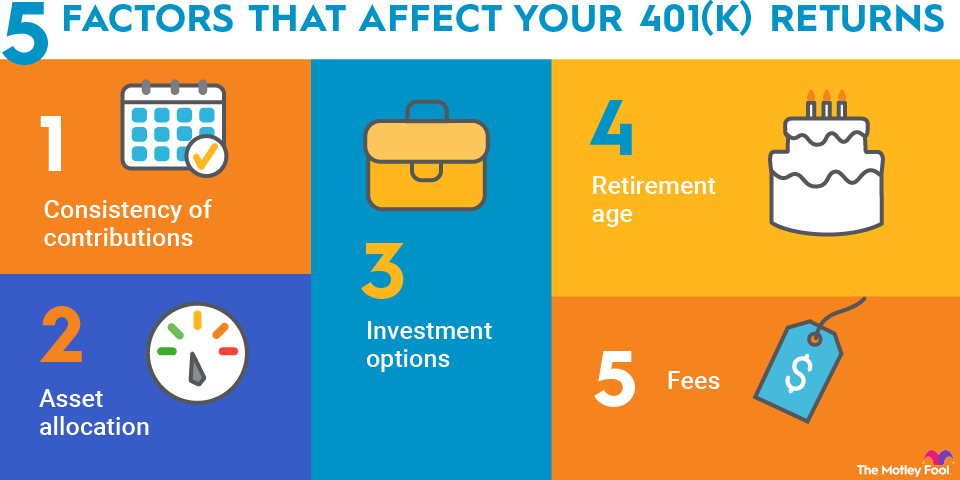
4. Retirement age
Another common type of mutual fund you'll find in 401(k) plans is target-date funds. You choose a target retirement date, and the fund automatically rebalances to bonds and cash equivalents, such as money market funds, as that date approaches. You get greater stability, but that translates to lower average returns the closer you get to retirement.
5. Fees
Higher fees mean that less of your money is actually invested, resulting in lower returns. Even seemingly small fees can have a big impact. Suppose you invested $5,000 annually in your 401(k) and earned 7% average annual returns. Paying a 0.5% fee vs. a 0.25% fee would reduce your returns by over $20,000 after 30 years.
How to calculate a 401(k) annual return
Here's how to calculate your 401(k) return for a one-year period:
- Take the ending balance and subtract contributions made over the past year.
- Divide by the starting balance from one year ago.
- Subtract 1 and multiply the result by 100. That will tell you the percentage of the total return.
If you've used a period other than a year, there's more math involved. Take the number you got from dividing the adjusted ending balance by the starting balance, and then use an exponential calculation as follows:
- For a two-year period, you'll need to take the square root. On a calculator, use the power key to raise the number to the 1/2 power. For a three-year period, you'd raise it to the 1/3 power, and so on.
- Then, take the final answer, subtract 1, and multiply the result by 100 to get the average annual return.
The longer the period you're measuring and the more contributions you've made, the less accurate this simple calculation will be. A more appropriate calculation is the time-weighted return, which measures actual investment portfolio performance regardless of deposits or withdrawals.
For most situations, both methods will yield results that are reasonably close to each other and accurately reflect your performance. Regardless of which measurement you choose, ensure that you regularly review your 401(k) returns to verify that your investment decisions align with your goals.