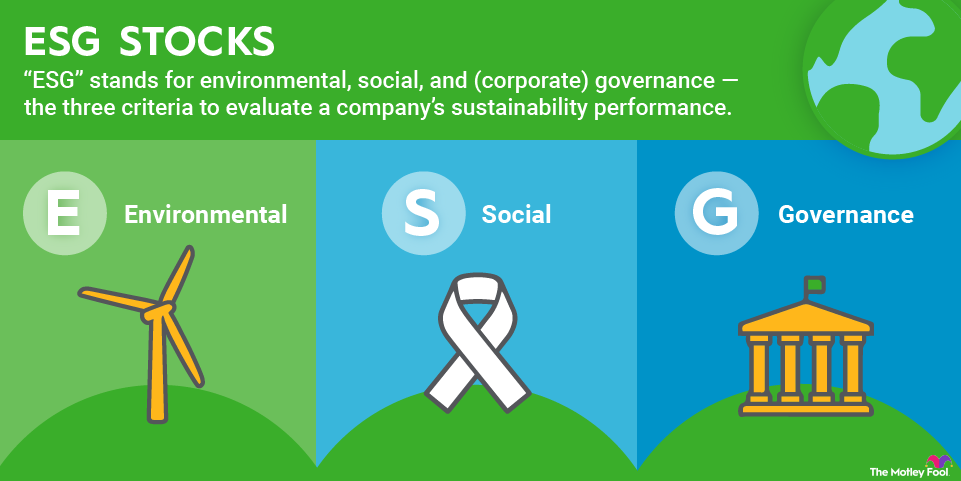
What does ESG stand for?
"ESG" stands for environmental, social, and (corporate) governance -- the three lenses investors use to evaluate corporate sustainability.
Invest better with The Motley Fool. Get stock recommendations, portfolio guidance, and more from The Motley Fool's premium services.
ESG investing combines financial returns with social responsibility, evaluating companies on their environmental impact, treatment of stakeholders, and corporate governance practices.
During the COVID-19 market turbulence, this approach gained serious credibility. Companies with strong ESG track records showed lower volatility than their peers, validating the premise that good corporate behavior translates to better business results.
The approach has also caught the SEC's attention. In March 2024, the agency finalized rules standardizing climate disclosures for public companies. However, legal challenges prevented implementation, and by March 2025, the SEC ended its defense of those rules.

Companies committed to ESG initiatives should publish measurable goals, plus the progress against those goals, in periodic sustainability reports.
Some sustainability reports are better than others, however. Look for reporting that follows ESG standards established by the Global Reporting Initiative (GRI) and/or the United Nations Principles for Responsible Investment (PRI).
You can also use third-party sources to validate sustainability reports, such as:
For employee-related issues specifically, see:
To research corporate governance attributes, access proxy statements on the SEC's website by searching for the filing type DEF 14A.
Environmental, social, and governance failures can devastate operations and profits. Companies addressing these risks proactively face fewer disruptions and deliver more reliable results. Consider what could have been avoided:
Research increasingly shows ESG companies match or outperform their peers financially. Arabesque found that top-quintile ESG companies in the S&P 500 beat bottom-quintile performers by over 25% between 2014 and 2018, with lower volatility. Academic research in The Journal of Applied Corporate Finance concluded that companies with strong non-financial quality indicators "perform significantly better on market and accounting-based metrics."
One theory for ESG outperformance: these initiatives require exceptional leadership. Managing long-term ESG programs while running day-to-day operations well is a competitive advantage that benefits the entire business.
If you want competitive financial returns while supporting companies building sustainable, future-oriented businesses, ESG investing may fit your goals. It's designed for investors who believe corporate responsibility and profitability can work together, and increasingly, the data backs that up.