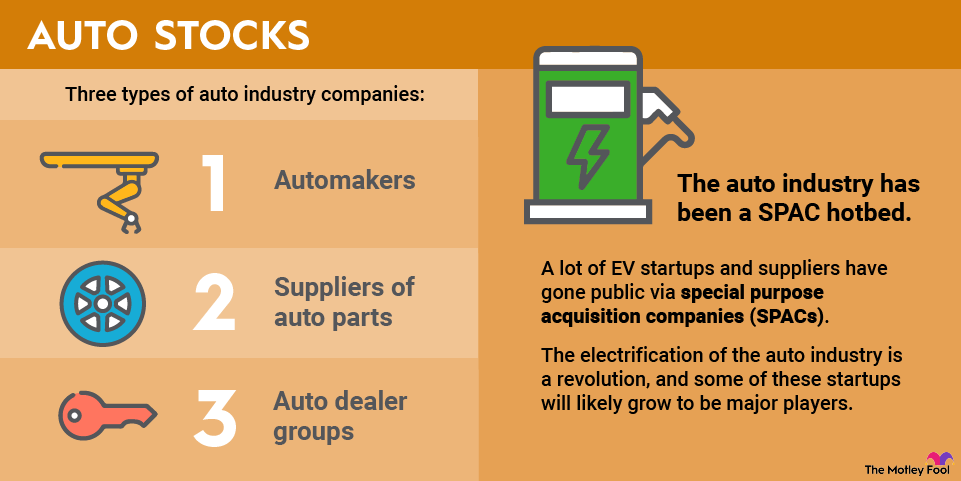
Automotive stocks include companies that design, manufacture, and distribute automotive vehicles and their components. This includes automakers, component markets, dealers, and auto parts retailers.
The industry is undergoing several transformative changes, including electric vehicles (EVs) and hybrids taking market share from internal combustion engine vehicles, giving investors plenty of thematic ways to play the market.

Top car stocks of 2026
Some of the best-known automotive stocks are:
| Name and ticker | Current price | Market cap | Dividend yield |
|---|---|---|---|
| Ford Motor Company (NYSE:F) | $14.56 | $54.1 billion | 4.42% |
| Tesla (NASDAQ:TSLA) | $443.33 | $1.7 trillion | 0.00% |
| Stellantis (NYSE:STLA) | $7.81 | $22.0 billion | 0.00% |
| General Motors (NYSE:GM) | $77.31 | $68.4 billion | 0.83% |
Ford
The key to the investment case for Ford is the belief that it can sustain its market position in its core Ford Pro (commercial vehicles and solutions) segment, while maintaining competitiveness in Ford Blue (Gas and hybrid vehicles), and, over the long term, turn around its loss-making Ford Model e (EVs).
The stock is a perennial value candidate because the market doubts its ability to do the latter and remain relevant as the market shifts toward EVs. The company wrote off $19.5 billion in 2025 on its EV investments, and there's no guarantee its $5 billion "bet" on developing a universal EV platform will pay off. Management expects its latest EV investment initiative to result in a $30,000 midsize electric pickup in 2027. That's something for investors to keep a close eye out for, particularly if it raises confidence that Ford will be a player in the EV transition while maintaining its leadership in commercial vehicles.

NYSE: F
Key Data Points
Tesla
The leading EV company is leading the charge toward a commercially viable robotaxi company. While it's easy to dismiss robotaxis as an adjacent or add-on market, the reality is that CEO Elon Musk sees them as the inevitable evolution of the automotive industry and transportation in general.
EVs offer a significant cost-per-mile advantage over internal combustion engines but an initial cost disadvantage. As such, their best use is as a frequently used vehicle, such as a taxi. That cost advantage is even greater if the taxi is autonomously "driven." That simple argument is why companies like Ford and General Motors also invested heavily in autonomous driving. They have since pulled back, butTesla has not. If the company can scale a cost-effective robotaxi service, using its Cybercab, then it could revolutionize transportation.

NASDAQ: TSLA
Key Data Points
Stellantis
If Ford is a value pick, then Stellantis is a deep value choice for investors. Like Ford, Stellantis misjudged the pace of EV adoption, and it also took a massive write-down ($26 billion) on its EV and battery investments. Stellantis also suspended its dividend in 2026 and announced a reset of its business to "to once again make our customers and their preferences our guiding star," according to CEO Antonio Filosa.
Clearly, the EV transition did not go as planned for automakers. Still, with EV sales growth continuing to outpace traditional auto sales, it's definitely not a market Stellantis and others can ignore. For now, Stellantis will focus on its core brands of Jeep, Ram, Peugeot, and Fiat while undertaking a massive $13 billion investment to try to drive growth in the U.S.
If the plan works, then Stellantis will turn out to be an excellent value. But with Wall Street analysts expecting net debt to approach $10 billion over the next couple of years, the stock carries significant risk.

NYSE: STLA
Key Data Points
General Motors
Stop me if you think you've heard this one before. Like Ford and Stellantis, General Motors overinvested in anticipation of EV adoption rates that didn't materialize. The company took a $6 billion charge on its EV business in early 2026. While Tesla is stepping up investment in EVs, General Motors is scaling back its EV manufacturing footprint amid market conditions.
It's a somewhat complicated picture: the near- to medium-term conditions favor focusing on generating earnings and cash flow from the company's strengths in internal combustion engine trucks and sports utility vehicles (SUVs), but the industry's long-term future lies in EVs. Indeed, the company's mission statement refers to moving "to an all-electric future."
General Motors is relatively well-positioned to manage the transition to EVs due to its robust cash generation, and the stock offers a relatively safer way to invest in a legacy automaker.

NYSE: GM
Key Data Points
How to invest in automotive stocks
- Open your brokerage account: Log in to your brokerage account, where you manage your investments. If you don't have one yet, take a look at our favorite brokers and trading platforms to find the right one for you.
- Search for the stock: Enter the ticker or company name into the search bar to bring up the stock's trading page.
- Decide how many shares to buy: Consider your investment goals and how much of your portfolio you want to allocate to this stock.
- Select order type: Choose between a market order to buy at the current price or a limit order to specify the maximum price you're willing to pay.
- Submit your order: Confirm the details and submit your buy order.
- Review your purchase: Check your portfolio to ensure your order was filled as expected and adjust your investment strategy accordingly.
Benefits and risks of investing in automotive stocks
- It's an industry in the throes of transformation. If Tesla, in particular, can revolutionize it with cost-effective robotaxis, investors can enjoy the fruits of the shift from relatively low-margin, capital-intensive manufacturing to recurring software and ride-share revenue.
- Automakers operate in an industry that's an essential part of the global economy.
- Growing services and software revenue can lead to rising profit margins and cash flow for the industry.
Should you invest in automotive stocks?
Automotive stocks can be important contributors to your investment portfolio. And because they rise and fall with consumer confidence, they can be useful indicators that economic trouble -- or a recovery -- may be on the way.
In addition, investing in an automotive manufacturer means taking a positive view of the company's long-term hybrid and electric vehicle strategy. That's become harder to judge as relatively high interest rates have slowed the growth rate of EV unit sales, dropped pricing, and intensified competition.
Related investing topics
FAQ
Automotive Stocks FAQ
About the Author
Lee Samaha has no position in any of the stocks mentioned. The Motley Fool has positions in and recommends Tesla. The Motley Fool recommends General Motors, Stellantis, and Volkswagen Ag and recommends the following options: long January 2025 $25 calls on General Motors. The Motley Fool has a disclosure policy.