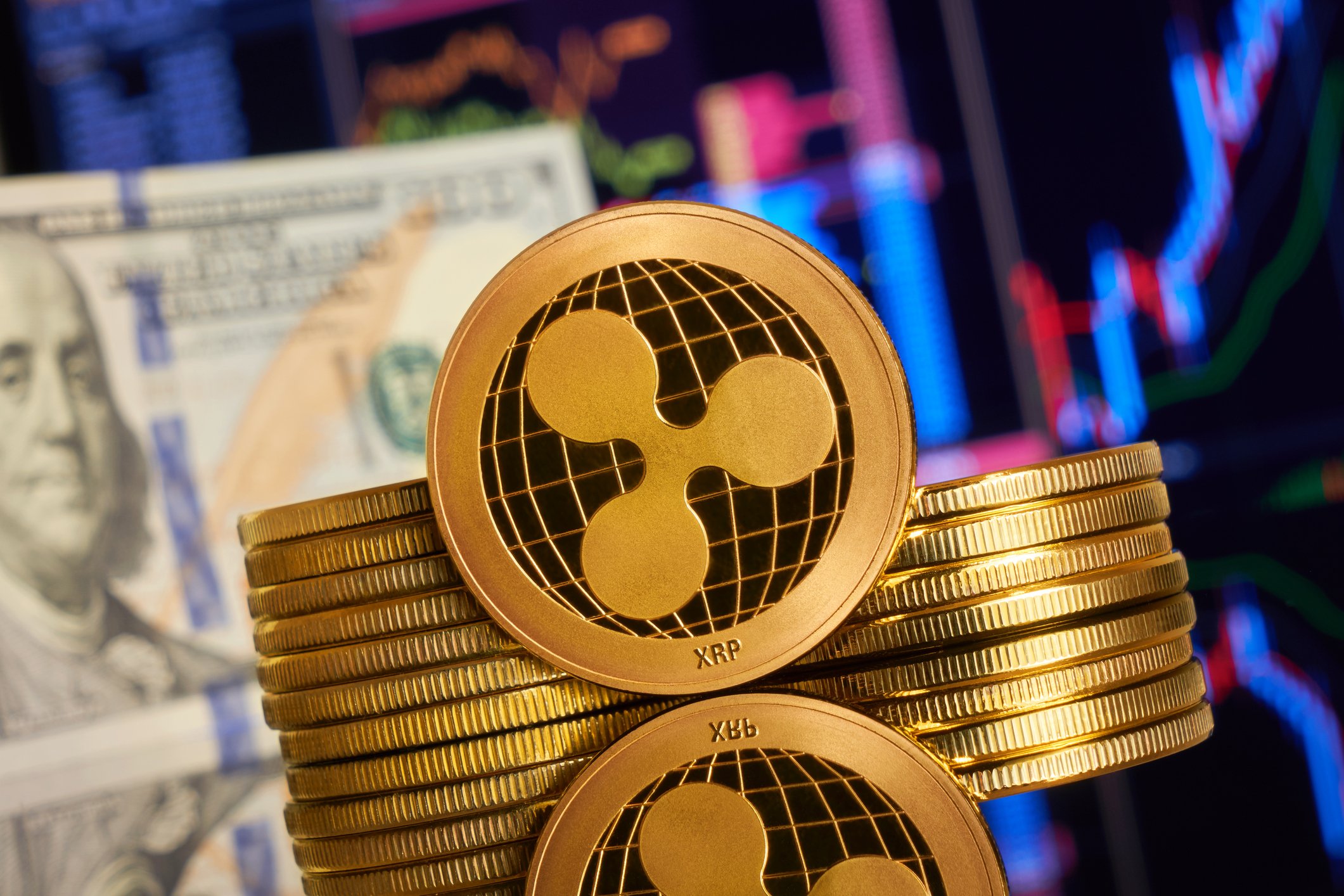
Geoffrey Kendrick at Standard Chartered Bank estimates XRP (XRP 0.86%) will reach $8 in 2026. His forecast, which implies 315% upside from the current price of $1.90, is based on the idea that increased regulatory clarity and the recent approval of spot XRP ETFs will boost adoption.
While I agree in principle -- those tailwinds could certainly drive XRP's price higher -- the forecast itself seems overly optimistic, especially when XRP has actually fallen 7% year to date despite the Trump administration's support for the broader cryptocurrency industry. I think a more reasonable target is $3 in 2026, which implies about 58% upside.
Here's what investors should know about XRP.
Image source: Getty Images.
Favorable developments in legal and regulatory matters
In 2020, the Securities and Exchange Commission (SEC) filed a lawsuit against Ripple for allegedly selling XRP as an unregistered security. In 2023, a U.S. district court issued a split ruling, determining direct sales to institutional investors were illegal, but programmatic sales (through exchanges) to retail investors were not.
The SEC initially appealed the ruling, but more recently dropped the appeal. The situation reflects the Trump administration's broader push to support the cryptocurrency industry. For instance, President Trump earlier this year signed an executive order that created a national digital asset stockpile. He also nominated cryptocurrency advocate Paul Atkins as SEC chairman.
Here's the big picture: The SEC's decision to drop its appeal against Ripple may encourage XRP adoption among investors and financial institutions because a legal headwind has been eliminated. Additionally, the Trump administration's policies could reinforce the trend by treating digital assets as a legitimate component of the U.S. financial system.
XRP supports faster and cheaper cross-border transactions
XRP is the native digital asset on the XRP Ledger, a blockchain designed to support fast and cheap cross-border transactions. The SWIFT messaging system is currently the industry standard in wire transfers, but settlement times are longer and transaction fees are higher. In short, XRP is a bridge currency that resolves those pain points.
Like any asset, XRP's price will rise as demand rises. One potential catalyst is that fintech company Ripple uses XRP to provide payment services to financial institutions, and Ripple CEO Brad Garlinghouse recently predicted the XRP blockchain would capture 14% of SWIFT's payment volume (equivalent to $20+ trillion) within five years.
In that scenario, demand for XRP could push its price much higher. But Garlinghouse's prediction seems too optimistic. It makes no sense to use a volatile cryptocurrency to move money when stablecoins exist. And while Ripple has addressed that problem by introducing the stablecoin Ripple USD (RLUSD 0.01%), it competes with better established options like Circle's USDC.
Here's the big picture: Despite legal headwinds clearing and the regulatory environment improving, XRP monthly transaction volume has steadily declined over the last two years. That suggests neither XRP nor RLUSD is gaining significant traction as a bridge currency, and I doubt that will change in the future.
Spot XRP ETFs could unlock demand among institutional and retail investors
In November, several spot XRP ETFs started trading on U.S. markets, including one product launched by Franklin Templeton, which ranks among the 25 largest money managers in the world by AUM. Those funds may encourage adoption by removing friction associated with traditional cryptocurrency exchanges, such as high fees and the headache of managing multiple accounts.
Indeed, Bitcoin's price has increased 90% since spot Bitcoin ETFs were approved in January 2024, so it stands to reason XRP could see material price appreciation as spot XRP ETFs unlock demand. In that context, I think XRP's price could increase 58% to $3 (more or less) in the next year.
Here's the big picture: The recent approval of spot XRP ETFs is the most compelling reason to want XRP exposure. XRP is the fifth-largest cryptocurrency by market value, which means it's probably one of the digital assets in which institutional investors are most interested. Demand from that well-capitalized group could send XRP's price higher. But I still have far more confidence in Bitcoin, so I would keep any position in XRP (or a spot XRP ETF) rather small.