The new year is underway, and in a few weeks some of America's largest technology giants will report their operating results for the recent quarter ended Dec. 31. This will give investors an important update on the state of the artificial intelligence (AI) industry, which fueled stock market returns throughout 2025.
Microsoft (MSFT 0.73%) will be one of the first to report. It's scheduled to announce its fiscal 2026 second-quarter results on Jan. 28, and investors will be looking for further momentum in the company's AI-related software and cloud businesses.
These results could mark a turning point for its stock, which has declined 11% over the last three months. Read on for what this might mean for investors.
Image source: Getty Images.
Look for an update on Copilot adoption
The Copilot virtual assistant is Microsoft's answer to OpenAI's ChatGPT. It can be accessed as a stand-alone chatbot, but it is also embedded into some of the company's flagship software products like Windows, Edge, and Bing. The real financial opportunity for Microsoft is in the enterprise market, though, where Copilot can be added to products like the 365 suite of apps (Word, Excel, and Outlook) for an extra monthly fee.
Businesses around the world pay for over 400 million licenses so that the 365 platform is available for their employees, and all of them are candidates for the Copilot upgrade. As of the fiscal 2026 first quarter (ended Sept. 30), Microsoft said 90% of Fortune 500 companies were already using it, which is a great sign.
During the quarter, Accenture (ACN 2.69%) and EY Global each bought over 15,000 licenses so their employees have access to Copilot for 365, while the consultancy PwC bought 155,000 licenses. Microsoft is likely to provide further customer updates like these on Jan. 28.
And 365 isn't the only enterprise opportunity for Copilot. For example, there are free and paid versions of Copilot for GitHub, which helps software developers write code to accelerate completion of a project.
Azure will be the center of attention (again)
Azure is Microsoft's cloud computing platform, with the tools and services businesses need to thrive in the digital age. Over the last couple of years, it has also built an expanding portfolio of products and services to make it easy for companies to participate in the AI revolution.
They are now available through one holistic platform called Azure AI Foundry, which offers access to computing capacity through data centers, in addition to over 11,000 ready-made large language models (LLMs) from leading third parties like OpenAI and xAI. These are the main ingredients businesses need to develop and deploy AI software.

NASDAQ: MSFT
Key Data Points
Azure's revenue growth accelerated in the last three consecutive quarters, coming in at 40% in the fiscal 2026 first quarter. Demand for AI data center capacity continues to outstrip supply, and at the end of September, there was a $392 billion order backlog from customers who were waiting for Azure to build more infrastructure.
As a result, Microsoft plans to double its data center footprint over the next two years. But that means this imbalance between supply and demand is likely to persist in the short term, so investors should look for a further acceleration in Azure's revenue growth in the company's second-quarter results on Jan. 28.
Microsoft stock looks attractive ahead of Jan. 28
As mentioned earlier, Microsoft stock is currently down 11% from its record high. Its price-to-earnings ratio (P/E) is now around 34.1, which is only a slight premium to the 32.6 P/E of the Nasdaq-100 index. But looking ahead, Wall Street's consensus estimate (provided by Yahoo! Finance) suggests the company could end fiscal 2026 with total earnings of $15.75 per share, placing its stock at a forward P/E of 29.5.
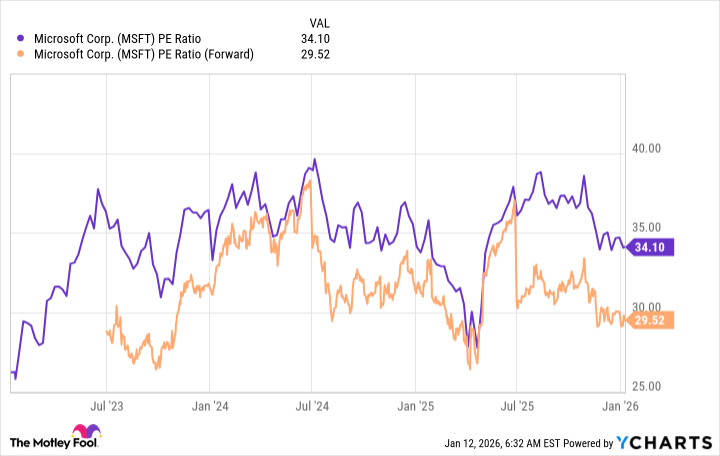
MSFT PE Ratio data by YCharts.
In other words, Microsoft stock would have to climb 15% between now and June 30 (when fiscal 2026 ends) just to maintain its current P/E of 34.1.
Given the rapid uptake of AI services like Copilot and the accelerating revenue growth at Azure, I think that is a completely realistic target return for investors over the next six months or so. Therefore, as long as these businesses continue to show momentum in Microsoft's upcoming report, I think Jan. 28 could be a turning point for its stock.