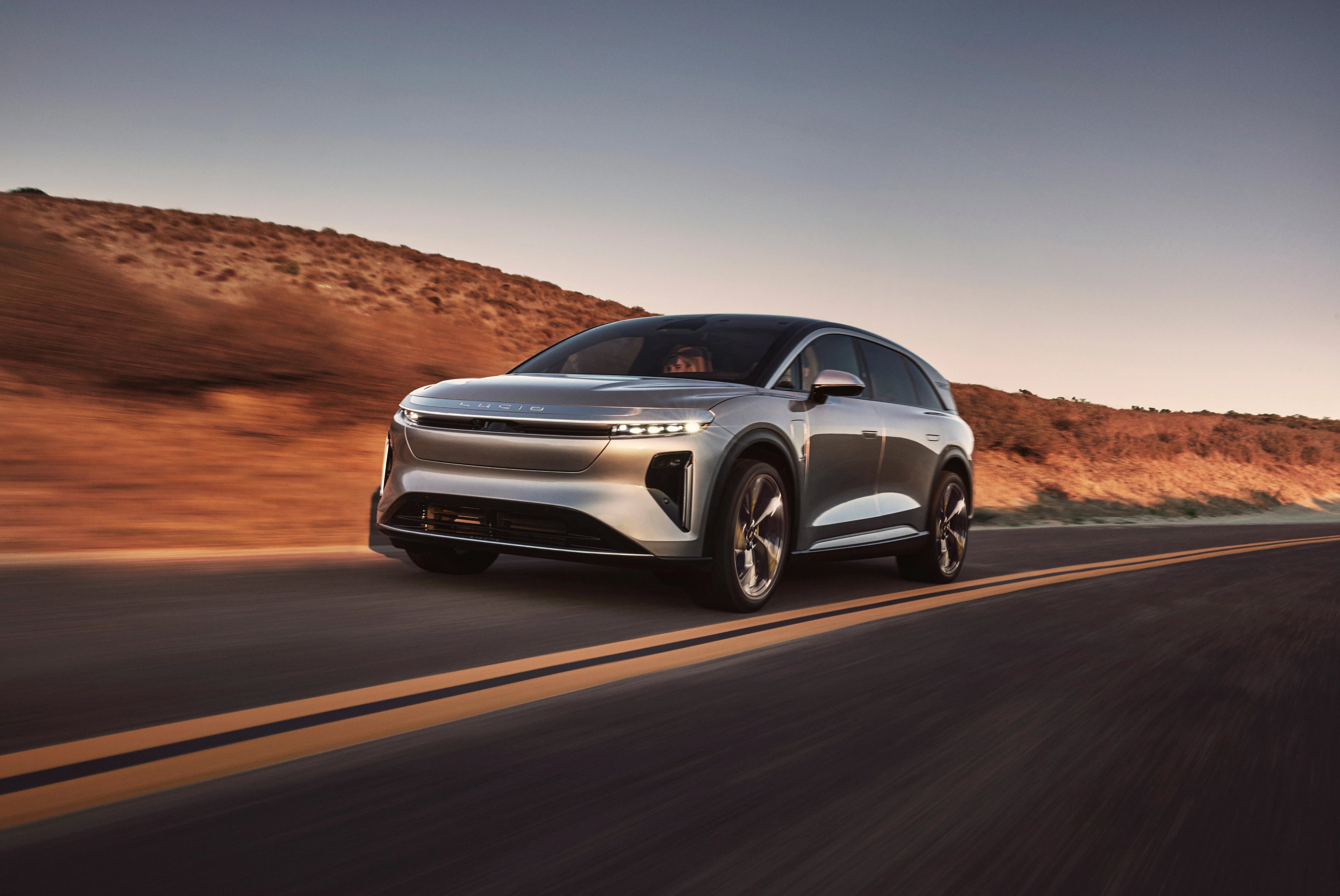
Lucid (LCID +1.13%) has made great achievements in its short history. For example, it has award-winning electric vehicles (EVs) and industry-leading battery technology. However, that's not enough. It still has more to do, with its 2025 production highlighting the problem it faces.

Image source: Getty Images.
How many cars did Lucid make in 2025?
In some ways, 2025 was a banner year for Lucid. It produced 18,378 all-electric vehicles in the year, an increase of 104% compared to 2024. That's a huge percentage increase, and it's important to understand how big an achievement that is.
Building cars is a capital-intensive business. There is a significant upfront capital investment required to design a car, secure regulatory approval to sell it, and build a factory to produce it. Then, a company has to grapple with ramping up production of the vehicle. Lucid is clearly in the ramp-up phase and executing well. That said, despite an eye-catching year-over-year percentage increase, the company's production isn't nearly large enough.
As a comparison, fellow EV start-up Rivian (RIVN 3.46%) has had to go through all the same basic steps as Lucid. Only Rivian's production in 2026 came in at 42,284 vehicles. That's more than twice as many vehicles as Lucid.
But don't stop there, because Rivian is also lagging its larger automotive peers. The granddaddy of the EV pack is Tesla (TSLA 0.30%). In 2025, Tesla produced 1,654,667 vehicles. Compared to that, the cars Lucid and Rivian produced were both little more than rounding errors. Then, of course, there are the traditional automakers that produce millions of their own vehicles.
The size issue is important
In the auto sector, scale brings important advantages. Notably, high utilization rates allow an auto company to spread costs over more vehicles. This makes it easier to turn a profit. Lucid has yet to generate positive earnings, and Wall Street is getting worried. What's notable here is that competitor and fellow EV industry upstart Rivian has twice managed to turn a gross profit, which shows it is moving closer to positive earnings. Lucid is still working on that intermediate goal.
The clearest sign of concern is the stock's ongoing decline. Over the past year, the stock has lost more than half of its value. However, that drop needs to be taken with a grain of salt. On Aug. 29, 2025, the company effected a 1-for-10 reverse stock split. The stock has lost 40% of its value since that reverse stock split.

NASDAQ: LCID
Key Data Points
Reverse stock splits are typically a bad sign, as they often occur when a company is worried about being delisted. The move is a way to ensure a company can continue to tap the capital markets for cash. Lucid appears to have plenty of access to money right now, with management stating that it has around $5.5 billion worth of liquidity. However, it still has a lot of growing to do if it hopes to compete in the highly competitive auto industry. It can't risk losing access to the stock and bond markets.
One year won't be enough
Even if Lucid managed to double its production again in 2026, it would still be making fewer than 40,000 vehicles. Tesla made 10 times that figure in the fourth quarter of 2025. In one year, Lucid will still be an "also-ran" in the EV race as it continues to play catch-up to its larger peers. Most investors should probably watch Lucid from the sidelines until it has turned a sustainable profit. That is highly unlikely to occur in the next 12 months, even if management executes at the highest level.