It has been an unfortunate past few years for one of the country's largest healthcare companies, UnitedHealth Group (UNH 2.91%). There has been no shortage of bad PR, a changing business landscape, and stock price struggles. In the past 12 months, UnitedHealth's stock is down over 46% (as of market close on Jan. 30).
Unfortunately, when it rains, it pours, and there could be more bad news heading UnitedHealth's way regarding Medicare. The Centers for Medicare & Medicaid Services (CMS) proposed increasing payments to private insurers by only 0.09% in 2027.
If you're wondering how the market reacted to the news, look no further than the roughly 20% single-day drop its stock experienced on Jan. 27. But stock performance aside, here's how that could have a real effect on UnitedHealth's business.

NYSE: UNH
Key Data Points
The relationship between UnitedHealth and Medicare
Medicare is a government program that provides health insurance for people age 65 and older, and it has four parts: Parts A through D. CMS' proposal affects Part C (Medicare Advantage), which is private insurance run by companies like UnitedHealth.
Medicare pays these companies a set monthly fee per enrolled member. And as the largest Medicare Advantage provider in the country -- with more than 8.4 million customers at the end of 2025 -- you can imagine a nice chunk of it goes to UnitedHealth.
Around 38% of UnitedHealth's 2025 revenue came from its Medicare and retirement segment ($171.3 billion). It was a 23% increase from 2024, outpacing its overall 16% revenue growth.
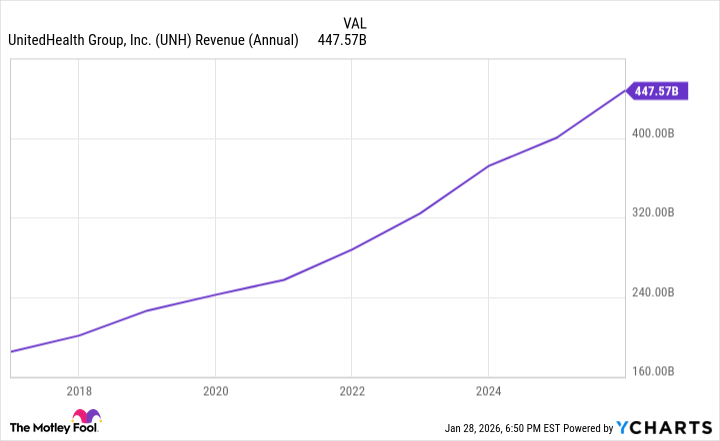
UNH Revenue (Annual) data by YCharts
If the 0.09% increase becomes set in stone, UnitedHealth's revenue growth would likely hit a major rough patch.
We won't know whether the proposal goes through before April 6, but you can be sure that UnitedHealth will put its lobbying muscle to use leading up to then.
Taking a positive from the negatives
The one positive from UnitedHealth's recent plunge is that its stock looks much more attractive on valuation grounds.
As of market close on Jan. 28, UnitedHealth was trading around 16.6 times its projected earnings, which is below its average for the past year and about 3.5 points below its level just a few days earlier on Jan. 23.
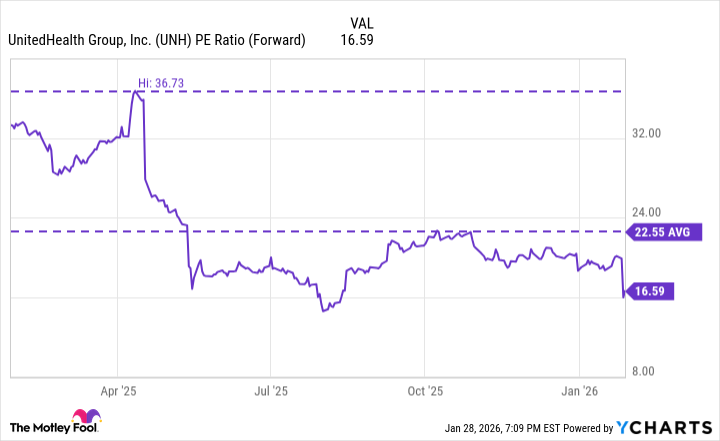
UNH PE Ratio (Forward) data by YCharts
The low valuation alone doesn't make UnitedHealth a buy, but the market's response seems like an overreaction. UnitedHealth has some kinks to work out, no doubt, but it's still one of the country's most essential businesses. If you're in it for the long haul, it's trading at a much more attractive entry point.