When OpenAI publicly released ChatGPT on Nov. 30, 2022, shares of Palantir Technologies (PLTR +3.44%) were trading for $6. Today, the stock hovers around $150 -- a nearly 2,000% gain in just three years.
With a market cap of $368 billion, Palantir is almost worth the combined value of legacy enterprise software stocks Salesforce and SAP. It's obvious by now that demand for artificial intelligence (AI) is the core tailwind fueling Palantir's parabolic rise.
The question some are asking is whether Palantir's soaring valuation is sustainable. Below, I'll break down why smart investors continue to buy the stock hand over fist -- despite the appearance of an overvalued name benefiting from AI-driven tailwinds.
Image source: Getty Images.
Why does Palantir stock look so expensive?
When I was an investment banking analyst, I spent countless hours putting together comparable company analyses. In layman's terms, this means that I benchmarked our client against a peer set of comparable businesses in the same industry to derive a valuation range.
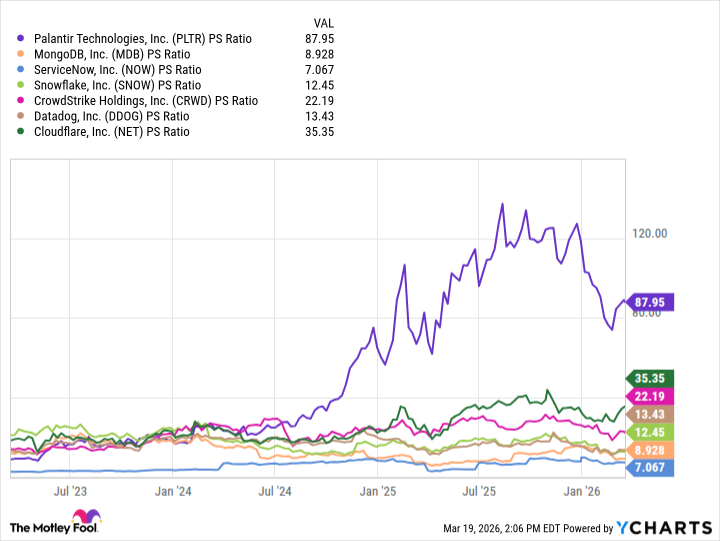
Broadly speaking, analysts will look at price-to-sales (P/S), price-to-earnings (P/E), or enterprise value-to-EBITDA multiples depending on the company and industry in question. As far as software stocks are concerned, the P/S ratio is a good metric to start with. Many SaaS businesses are not consistently profitable, and so measuring a cohort on a revenue basis levels the playing field.
PLTR PS Ratio data by YCharts
If you were to base an investment in Palantir purely off of the figures above, you'd come to the quick conclusion that Palantir stock is absurdly overvalued relative to other leading SaaS enterprises. While I understand that logic, it's flawed.
A once-in-a-generation opportunity: Palantir is actually dirt cheap
Smart investors understand that peer analysis has its shortcomings. While companies like Snowflake, ServiceNow, Databricks, and MongoDB each represent high-growth players in their respective software verticals, none are true, direct competitors to Palantir.
This raises the question: Why did I include these companies in my analysis at all? Well, I more or less had to. You see, data analytics, database management, and cybersecurity are relatively commoditized businesses.
While Palantir is often touted for its data-driven actionable insights, the company's Artificial Intelligence Platform (AIP) is far more complex. With its Foundry and Gotham suites, Palantir not only aggregates and synthesizes data, but allows decision-makers to simulate critical workflows in real time.
To get a sense of how important Palantir's services are, consider the company is currently working alongside the U.S. military in the Iran war. Moreover, the company has a $10 billion contract with the Army as well as a total backlog that's growing over 100% annually across accelerating commercial and public sector adoption.

NASDAQ: PLTR
Key Data Points
Bulls might say that the software industry hasn't seen a company with Palantir's potential since Microsoft in the mid 1980s. Just as Microsoft built a near-monopoly in personal computing, Palantir could be on its way to achieving a similar scale of domination across enterprise software workflows.
With annual revenue growth near 60%, consistent profitability, and its services spanning every major sector, I suspect Palantir has extremely low churn rates as its customers find AIP indispensable relative to other products in the market.
For this reason, some investors view Palantir stock as dirt cheap. Hence, they continue to pound the buy button.