Anthropic's launch of Claude CoWork marks a significant progression in agentic AI -- turning a large language model (LLM) into a proactive digital workforce that can plan, execute, and deliver complex workflows. By granting Claude access to local files, applications, and browsers, the artificial intelligence (AI) is capable of compressing multistep projects into a single, conversational interface.
CoWork's debut is making smart investors question whether general-purpose AI agents will eventually render specialized subscription tools redundant. I'm asking a deeper, more narrow question: Does Claude CoWork endanger Palantir Technologies' (PLTR +2.53%) Artificial Intelligence Platform (AIP), or is the company's domain-specific architecture insulated?
Image source: Getty Images.
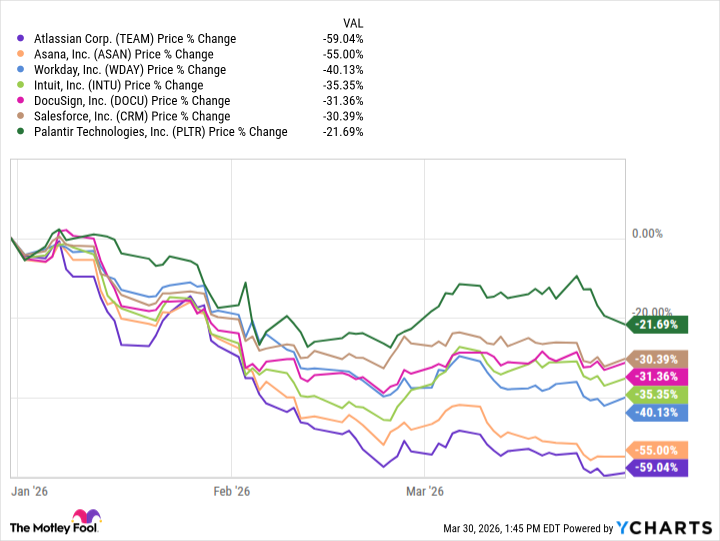
Claude CoWork has ignited a sell-off in SaaS stocks
SaaS companies have long boasted incremental productivity enhancements through niche modules -- analytics dashboards, people operations, budgeting, and customer relationship management (CRM).
The general thesis fueling cratering SaaS valuations is this: If AI can autonomously coordinate tasks across a host of separate interfaces, the economic case for maintaining and renewing contracts with these vendors becomes fractured.
Data by YCharts.
CoWork threatens to bypass these disparate layers entirely. Instead of building custom views across different apps, an AI workforce can analyze sales deal flow, flag risks, and summarize a probability-weighted pipeline that can be dropped seamlessly into a financial model.
The current price action in software stocks suggests that investors are heavily indexing on SaaS companies losing their pricing power as subscription sales could begin decelerating.
How does Claude CoWork jeopardize traditional SaaS tools?
This fear-driven selling is not purely rooted in hype or speculation. Some of CoWork's capabilities pose concrete threats to enterprise software incumbents.
Claude's agentic engine has the ability to read and synthesize data from spreadsheets, emails, and legal documentation without manual exports. From there, CoWork can generate a polished deliverable, such as project management timelines or compliance summaries for department leaders.
For companies like Atlassian, Workday, Asana, Intuit, or even Salesforce, the idea of AI labor forces has sparked a perception that the need for separate, dedicated project management layers is eroding. Agentic workers are not merely assistants; rather, this digital transformation can produce more sophisticated outputs -- from tracking dependencies and assigning reminders for subtasks in natural language, all while maintaining live data feeds.
Palantir AIP has structural resilience
Unlike general-purpose productivity widgets, Palantir's AIP is engineered for mission-critical environments. The company's Foundry and Gotham suites are used by the U.S. military in high-stakes battlefield operations as well as by numerous Fortune 500 corporations.
While Claude CoWork excels in desktop operations, its capabilities lack the governance, auditability, and integration depth required in navigating specialized applications such as orchestrating drone fleets or assessing supply chains.
At its core, AIP builds an ontology -- a visualization that maps messy data silos into a singular knowledge graph that commands domain expertise to digest. AIP is far from a commoditized SaaS tool. Instead, Foundry and Gotham are operational backbones that governments and large corporate enterprises trust only after Palantir has demonstrated rigorous customization and compliance requirements.

NASDAQ: PLTR
Key Data Points
While CoWork is becoming a game changer for routine office work, AIP's value proposition comes from transforming unstructured data into reliable, high-stakes intelligence. This differentiator is difficult to replicate at scale with out-of-the-box agents.
So Claude CoWork has not made a checkmate move against Palantir -- leaving the AIP business model durable for the foreseeable future.