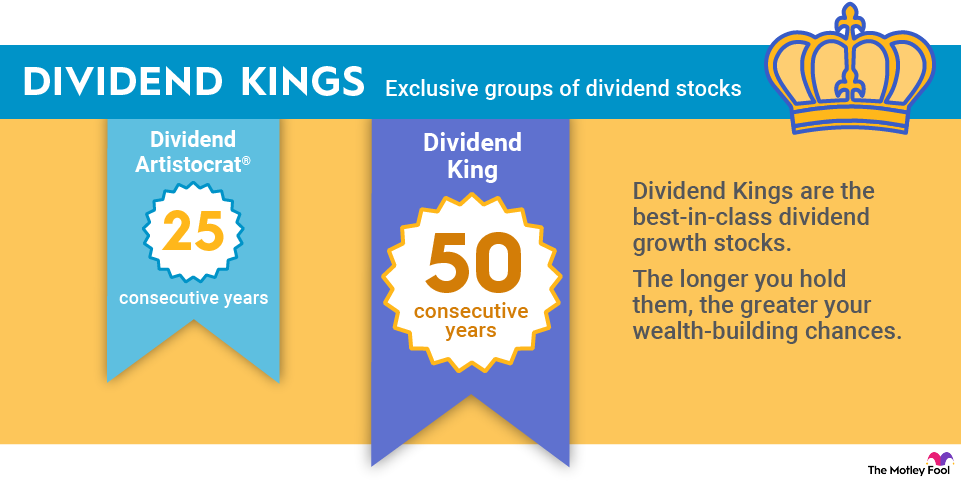
Dividend Kings have increased their dividends annually for at least 50 consecutive years. That is not an easy feat, and only companies with a strong business model that performs well in both good and bad markets can achieve Dividend King status. Which is why income investors are so fond of Dividend Kings.
If you are also fond of high yields, you may want to look at Altria (MO +0.35%), Universal Corporation (UVV 1.54%), and Kimberly Clark (KMB +0.49%) today, since they are the three highest-yielding Dividend Kings. Here's a quick look at each one.
1. Altria has problems, but also reliable cash flows
Altria's dividend yield is 6.3%, which is huge compared to the roughly 1.1% being paid by the S&P 500 index (^GSPC +1.18%). The Dividend King's primary product is cigarettes, which is both a positive and a negative.

Image source: Getty Images.
On the negative side, cigarette demand in the company's core North American market is in steady decline. On the positive side, Altria has been able to raise prices because smokers aren't particularly price-sensitive. That has allowed the company, which owns the industry-leading Marlboro brand, to steadily increase its dividend despite falling demand. The cash flows it generates are so robust that management has also been able to experiment with new products it hopes will someday replace cigarettes.
There have been some big missteps in that effort, resulting in billion-dollar write-offs. However, the dividend's resilience shows how reliable the company's business is over time. Still, Altria is only appropriate for more aggressive investors given the headwinds in its most important business.

NYSE: MO
Key Data Points
2. Universal Corporation sells tobacco, not cigarettes
Universal is another tobacco company and offers an impressive 6.1% dividend yield. However, there are two important differences here relative to Altria. For starters, Universal operates on a global scale while Altria does not. Second, Universal doesn't sell cigarettes; it sells tobacco to companies that make cigarettes and other smokable products. With demand for cigarettes still fairly strong outside of North America, its business is probably better positioned than Altria right now.
That said, Universal is a sin stock. If that's not OK with you, then you shouldn't own it, no matter how high its yield is. It is also important to note that tobacco is a commodity, so the company's revenue and earnings can be a bit volatile from year to year. While most investors will probably want to avoid Universal, it could be a good fit if you are considering Altria but are worried about declining cigarette demand in North America.

NYSE: UVV
Key Data Points
3. Kimberly Clark is making a big change
Kimberly Clark is a large consumer staples company that makes paper products like toilet paper. People buy the company's products in both good economies and bad ones, so its business is extremely resilient to economic and market adversity. That's how it has increased its dividend annually for over 50 years. But paper products aren't particularly growth-oriented in the consumer products space.
This is why Kimberly Clark has agreed to buy Kenvue (KVUE 0.31%), which makes healthcare and personal care products. Kenvue owns iconic brands like Tylenol, Band-Aid, and Listerine. Assuming the deal is consummated as planned, Kimberly Clark will become a more growth-oriented business and compete more directly with peer Procter & Gamble (PG 0.38%), one of the world's largest consumer staples companies. It is an expensive acquisition, and there are material integration risks to consider, which is part of the reason why Kimberly Clark's yield is 5.2%.

NASDAQ: KMB
Key Data Points
More aggressive investors willing to take on higher risk, however, could find that Kimberly Clark's business transformation is a winning move for the company. Just go in with a long-term view of this investment, since it could be a few years before the acquisition really starts to pay off.
Three maybes from the Dividend Kings list
Riskier investments often have high yields, and that's exactly what investors will find with Altria, Universal, and Kimberly Clark. They are all Dividend Kings, and that may be enough for you to be willing to accept the business risks inherent to each stock. However, conservative investors will probably be better off avoiding all three, no matter how tempting their lofty dividend yields are today.