Developing artificial intelligence (AI) software requires an astronomical amount of computing power, which is usually delivered by thousands of specialized chips housed inside large, centralized data centers. Most businesses don't have billions of dollars to build this infrastructure, nor do they have the in-house technical expertise to create AI models from scratch, so they often use third-party solutions instead.
C3.ai (AI 0.73%) developed a portfolio of 40 ready-made AI software applications that businesses can customize to suit their needs. These apps serve as a shortcut to AI adoption, and while they have been quite popular, C3.ai's business recently hit some serious turbulence.
Last September, the company's founder, Thomas Siebel, stepped down from his role as CEO due to health issues. He played a key role in closing new deals and maintaining existing client relationships, so his departure led to a collapse in C3.ai's revenue. As a result, the company's stock has plummeted by 40% already in 2026.
C3.ai is now under the leadership of a new, highly experienced CEO who is trying to right the ship. Therefore, should investors use this moment as a buying opportunity, or could the stock be destined for lower ground?
Image source: Getty Images.
Accelerating AI adoption
C3.ai's apps are pre-crafted for a variety of different industries, including financial services, manufacturing, transportation, and utilities, just to name a few. Businesses in those industries can consult with C3.ai to customize an app to meet their specific requirements, or they can use the company's no-code programming platform to make changes of their own.
As an example, companies in the utilities space can use the C3.ai Reliability app to monitor equipment health so they know when to conduct preventative maintenance. It also uses various parameters to predict when an asset might fail, so utility providers are always on guard. As a result, C3.ai Reliability claims to reduce asset downtime by up to 50% -- and less downtime means less lost revenue.
C3.ai's apps are highly accessible through all major cloud platforms. Therefore, a business can tap into the data center computing capacity offered by Amazon Web Services, Microsoft Azure, and Alphabet's Google Cloud, and use it to scale its AI software applications. This allows for unconstrained growth, without the business having to manage any hardware or develop any AI software from scratch.
Shrinking revenue and ballooning losses
During C3.ai's recent fiscal 2026 third quarter (ended Jan. 31), its revenue plummeted by 46% to just $53.3 million. The result caught everyone off guard, including management, who had forecast revenue of between $72 million and $80 million. This was the first full quarter without Siebel at the helm, so the result was very revealing of his impact on sales.
The sudden revenue drop didn't give C3.ai enough time to fully adjust its operating expenses, which grew by a modest 3% during the third quarter. As a result, the company wound up losing a whopping $133.4 million for the period on a generally accepted accounting principles (GAAP) basis, which was 66% larger than its year-ago loss.

NYSE: AI
Key Data Points
C3.ai's new CEO, Stephen Ehikian, is an experienced operator. He founded two AI companies that were both acquired by Salesforce, so he understands this industry very well. After taking control of C3.ai, one of his first moves was to restructure and flatten the sales department, which should lower costs and give upper management more oversight over new and existing deals going forward.
Only time will tell whether this will work, but with just $621.9 million in cash and equivalents on hand, C3.ai needs to reduce its losses very quickly or else it might need a cash injection within the next couple of years.
A record low valuation, but is C3.ai stock cheap?
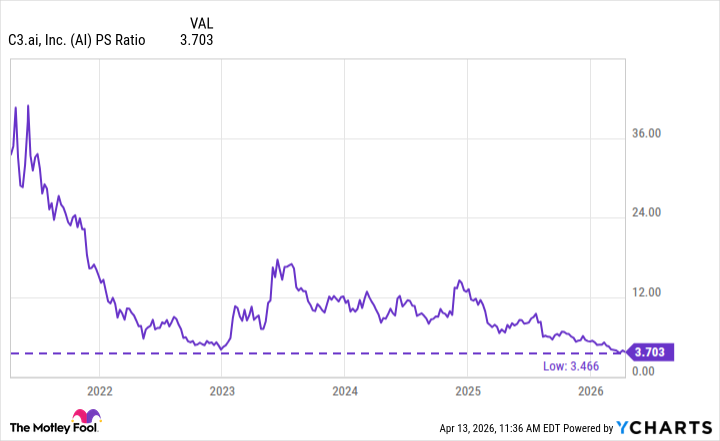
C3.ai stock might be down 40% in 2026, but it's also down 95% from its 2020 record high, when a frenzy in the tech market drove its price-to-sales (P/S) ratio to over 90. That valuation was completely unsustainable, but the sharp decline in the stock since then has reduced it to a more palatable level of just 3.7. In fact, that's close to the lowest valuation in C3.ai's history as a publicly traded company.
AI PS Ratio data by YCharts
But does that mean C3.ai stock is cheap? Not necessarily. Hypothetically, if the company's revenue declines by 50% over the next 12 months, its P/S ratio would double without any movement in its stock. That's why most investors avoid shrinking businesses -- they seem like a good value at first glance, but they can actually be very expensive when you dig beneath the surface.
According to Yahoo! Finance, Wall Street analysts currently expect C3.ai's revenue to shrink by 36% during fiscal 2026, and by a further 10% in fiscal 2027. Therefore, it might be way too soon to buy this stock, even for investors who believe Ehikian can turn the ship around in the long run. There is simply too much potential for further downside in the near term.