Robinhood Markets (HOOD +0.18%) stock dropped by more than 14% in early afternoon trading on April 29, a day after the company reported its first-quarter earnings that showed a slowdown in revenue growth and only 3% net income growth from last year.
While the stock is down big today, I think Robinhood's earnings report was entirely predictable. And now trading more than 50% from its all-time high, I think this innovative fintech is one of the most interesting rebound opportunities in the market today.
But Robinhood's turnaround will depend on one primary factor -- a recovery in cryptocurrency prices.

Image source: The Motley Fool.
Robinhood's earnings by the numbers
First, let's dig into the earnings report and see what happened. Revenue was $1.06 billion, up a solid 15% from a year ago, but down 17% on a sequential basis. Net income was $346 million, up from $336 million a year ago but down from $605 million in the fourth quarter of 2025.
Robinhood posted diluted earnings of $0.38 per share, just a penny better than the same quarter a year ago.
Analysts polled by Yahoo! Finance had expected revenue of $1.24 billion and earnings of $0.48 per share, so the final results were a disappointment, leading to a subsequent stock drop.
But I don't see it as bad as the market is making it out to be. When you dig into the numbers, it's clear that the biggest reason why Robinhood disappointed the Street was the continued poor performance in the cryptocurrency market. Here's how Robinhood's transaction-based revenue breaks down by segment:
|
Segment |
Revenue |
Year-Over-Year Change |
|---|---|---|
|
Equities |
$82 million |
+ 46% |
|
Options |
$260 million |
+8% |
|
Cryptocurrency |
$134 million |
-47% |
|
Other (includes event contracts) |
$147 million |
+320% |
|
Total Transaction-Based Revenue |
$623 million |
+7% |
Source: Robinhood
Robinhood makes money in many different ways. It offers commission-free stock trading by routing orders through market makers who execute them and pay Robinhood a commission. It makes 1 penny per event contract by offering access to prediction markets -- the biggest driver of Robinhood's growth in the last quarter. And it makes money on cryptocurrency trades on the spread, which is the tiny difference between what it charges customers for buying and selling crypto and the price of the asset.
But the cryptocurrency market, known for its volatility, is in an extended slump, with three of the biggest cryptocurrencies down 38% to 62% from their all-time highs. In short, fewer people are buying and selling crypto right now, which means Robinhood is getting less revenue from that segment.
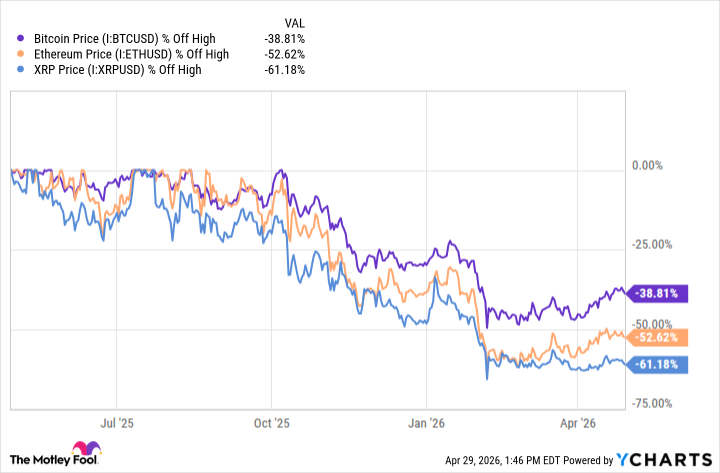
Bitcoin Price data by YCharts
When cryptocurrencies turn the corner, this segment will bounce back and become a growth segment for Robinhood again. But in the meantime, it still has excellent opportunities with stocks, options trading, and prediction markets.
"Equity and option trading volumes are on track to be the highest month of the year, and even with tax season, net deposits are approximately $5 billion month-to-date," Chief Financial Officer Shiv Verma said. "We believe there are massive opportunities ahead as we invest for the long term, ship products faster than ever to customers, and deliver value for shareholders."

NASDAQ: HOOD
Key Data Points
Robinhood still has a lot of promise
I think the market is overreacting to Robinhood's earnings report. This is not a broken company -- it's a company with multiple revenue streams that is seeing revenue growth despite a massive downturn in cryptocurrency prices.
For investors with an extended time horizon, Robinhood stock is extremely appealing right now -- assuming that you believe Bitcoin, Ethereum, and other cryptocurrencies will eventually recover.