The fact that streaming video is chipping away at cable television's customer base isn't anything new. That's been the case since 2013. But cable providers were able to count on their broadband internet business to offset this attrition.
Now, however, it seems even high-speed internet is no longer a defensible business. Comcast's (CMCSA +3.44%) Xfinity lost another 65,000 high-speed internet subscribers last quarter, while Charter Communications' (CHTR +4.21%) Spectrum shed 117,000 residential broadband customers in addition to a small handful of business customers. In both cases, this attrition extends what have become well-developed trends, too. Each company's internet customer count peaked in 2023, and each has since suffered losses in excess of 1 million subscribers.
But if streaming requires a high-speed connection, where are all these broadband customers going?As it turns out, there's a relatively new option that's getting some serious traction.
CMCSA Comcast
NASDAQ · As of 4:00 PM ET 10/22/26

A threat now too big to ignore
The top threat to the cable industry's high-speed internet business is no longer a rival cable name. It's wireless telecom names T-Mobile US (TMUS +3.28%) and Verizon Communications (VZ +3.77%). Leveraging their 5G mobile broadband networks' high-speed capabilities, consumers can now use this connectivity option -- called fixed wireless access, or FWA -- within their homes just as they would a traditional broadband service.
And they're using this option a lot! The graphic below tells the tale. T-Mobile and Verizon now serve a total of 15.5 million FWA customers after launching these services just a few years ago. It's no coincidence that Comcast's and Charter's high-speed internet customer base began shrinking around that same time.
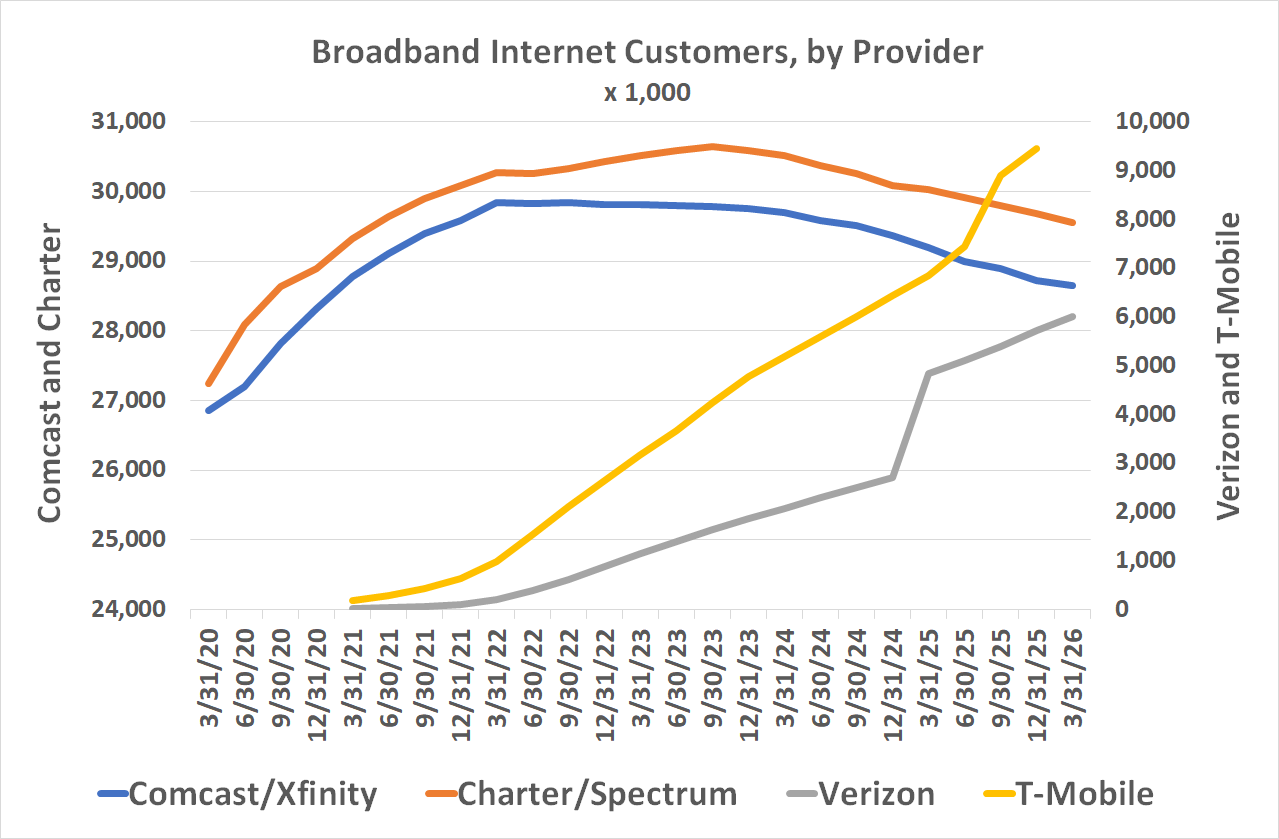
Data sources: Comcast, Charter, Verizon, and T-Mobile quarterly reports. Chart by author. Notes: Acquisitions and reclassifications resulted in a sharp increase in Verizon's 5G FWA broadband customer count in 2025. T-Mobile has not provided a FWA broadband customer count for Q1 of 2026.
Ignore at your own peril
Spectrum and Xfinity are still the nation's two biggest broadband internet service providers, for the record, and their high-speed internet operations are still important cash cows for both. Internet service accounts for roughly 20% of Comcast's revenue and roughly 40% of Charter's.
That's the problem for both outfits, however -- there's still a wide swath of business to lose to competition that's competitive in price and not necessarily limited by a lack of lines extending all the way to peoples' homes.
This evolution is, of course, a solid opportunity for Verizon and T-Mobile. But it's an even bigger risk for Charter and Comcast, both of which saw earnings before interest, taxes, depreciation, and amortization (EBITDA) tumble last quarter. Weak performances from their high-speed internet businesses were a key contributor to these declines.
Shareholders of either provider can't afford to ignore the fact that this customer migration could continue at this pace for a long, long time.