Inflation is creeping up again. In April, the Consumer Price Index rose 3.8%, up from 3.3% in March and 2.4% in February and January. Bond yields are going higher. The U.S. 10-year Treasury yield has climbed by about 40 basis points year to date. Bond investors seem to be getting nervous about the chances of higher inflation and more government borrowing.
If the economy goes through a period of "higher for longer" inflation, that will be painful for consumers, and it could bring losses to investors. Should you change your investment strategy to cope with higher inflation?

Image source: Getty Images.
How to invest for higher inflation
There are no guarantees that any type of investment will perform well during inflation. But one general way to invest for a higher-inflation environment is to buy dividend stocks. These companies tend to have strong balance sheets, steady profitability, and pricing power that enables them to keep paying high dividends even if inflation stays high.
Another strategy for high inflation in America could be to buy international stocks. In case the U.S. dollar weakens or the U.S. economy underperforms the rest of the world, international stocks will become more valuable in U.S. dollar terms. That's good news for American investors who want to earn returns in dollars.
The Vanguard International High Dividend Yield ETF (VYMI +0.47%) can be a good fit for both strategies. During the past six months, it has outperformed the S&P 500 index and the Vanguard Total International Stock ETF. Let's look at how this international stock ETF works and whether you should buy it.
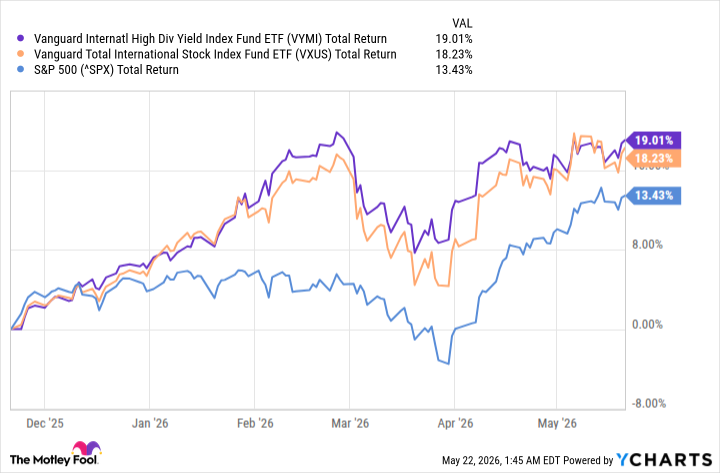
VYMI Total Return Level data by YCharts
VYMI: 1,582 stocks, three years of 21% annualized returns
The Vanguard International High Dividend Yield ETF has performed exceptionally well for investors in the past few years. Its average annual total returns (by net asset value) are 21% for the past three years, 13.2% for the past five years, and an impressive 35.7% return in the past year. Since the fund's inception in February 2016, it has delivered annualized returns of 11.35%.
The companies owned by this fund are reliable dividend payers, mostly from developed economies in Europe (44.1% of the fund) and the Pacific (23.8%). The top countries represented in the fund are Japan (11.3% of the fund), the United Kingdom (11.3%), Canada (8.9%), Australia (7.4%), and Switzerland (7.4%).
The ETF holds a total of 1,582 stocks (as of April 30). Its top stock holdings include major international financial stocks like HSBC Holdings and Royal Bank of Canada, pharmaceutical companies like Roche Holding AG and Novartis, and well-known names like food conglomerate Nestlé and energy major Shell PLC.
What about the actual dividends? They're impressive too. The fund's dividend yield is 3.47%, higher than some of the best dividend index funds. And this fund's fees are quite low. It charges an expense ratio of only 0.07%.

NASDAQ: VYMI
Key Data Points
Who should buy the Vanguard International High Dividend Yield Index Fund ETF
There are no guarantees that any investment will outperform or be "safe" during times of high inflation. But if you want a different mix of stocks than is offered in a tech-heavy S&P 500 ETF, if you want to diversify away from the U.S. market and the U.S. dollar, and if you want steady dividend income that might help your investments stay ahead of inflation, the Vanguard International High Dividend Yield Index Fund ETF could be a good choice.