Nvidia (NVDA +0.84%) has arguably been the quintessential growth stock over the past three years. The chipmaker has increased its revenue and earnings much faster than its similarly sized peers, while delivering extraordinary returns. That's why Nvidia's status as a high-growth company can hardly be denied, even by the bears. But what about the semiconductor specialist's dividend profile? Nvidia has historically not been the greatest dividend stock -- to say the least -- despite first initiating a payout in 2012.
However, recent changes to the company's dividend program could prompt some to wonder whether the stock is a great pick for income-seeking investors. Let's find out whether that's the case.
Image source: The Motley Fool.
Nvidia raises its dividend
Top dividend stocks typically increase their payouts regularly -- often annually -- while boasting dividend per share and forward yields that are fairly competitive relative to the market. These aren't all necessary conditions, to be clear. For instance, a relatively low yield can result from a stock rising dramatically over a short period. That applies to Nvidia, whose forward yield was rock bottom until recently, typically hovering around 0.02%, compared to the S&P 500's average of about 1.04% (which, by the way, isn't that high either).
Nvidia's dividend per share was also pretty unimpressive at $0.01, and it hadn't changed in two years. Here is how Nvidia compared with some of its similarly sized peers before recent announcements.
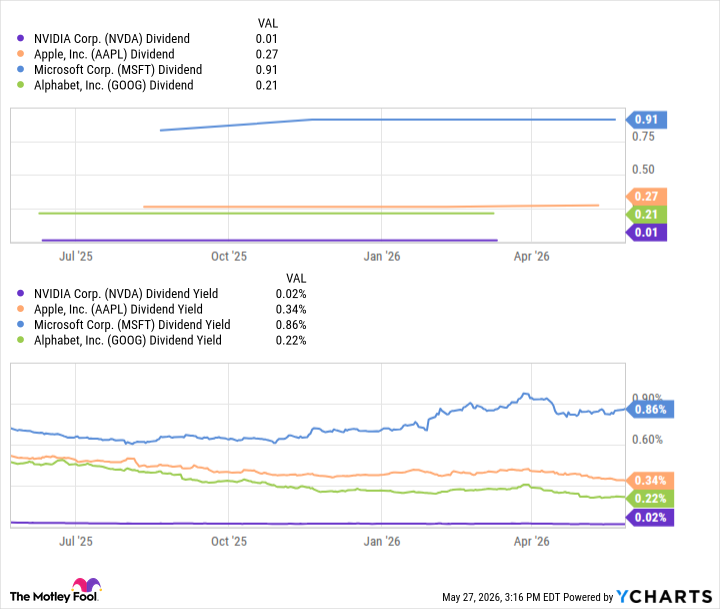
NVDA Dividend data by YCharts
In Nvidia's latest financial update for the first quarter of its fiscal year 2027, ending on April 26, the company announced it was increasing its dividend by a whopping 2,400%, to $0.25. At its current stock price, that amounts to a yield of about 0.5%, which is much more in line with those of Nvidia's large tech peers.
What can investors expect?
Nvidia is the leader in the GPU (Graphics Processing Unit) market and a key player in the artificial intelligence (AI) revolution. It generates substantial earnings and free cash flow. On paper, the semiconductor leader has the means to return significant (and growing) capital to shareholders via dividends, but that isn't Nvidia's priority right now. The company is pouring money into R&D to support its growth ambitions, especially as the AI tailwind remains hot. Competition is intensifying, which could eat into the company's market share and competitive advantage.

NASDAQ: NVDA
Key Data Points
For instance, Cerebras Systems, a direct competitor to Nvidia, recently went public. Further, as the AI industry shifts from training to inference and we move into the world of agentic AI -- with CPUs (Central Processing Units) handling the orchestration layer of AI agents -- Nvidia will increasingly have to compete with long-standing leaders in the CPU market such as Advanced Micro Devices. So, it is increasingly important for Nvidia to invest to stay ahead of the pack.
That means, even after raising its dividend substantially, Nvidia is still hardly a top dividend stock, as the company is very unlikely to make that aspect of the business a priority. It's also worth pointing out that even after its dividend increase, Nvidia's dividend profile -- from its forward yield, dividend per share, and track record of increase -- pales in comparison with more traditional dividend stocks that are the prize of income seekers, and often live in defensive sectors like healthcare or utilities.
Here's what that means: income seekers should probably look elsewhere. However, growth-oriented investors can still hardly do better than Nvidia. Even with more competition, the performance of its hardware, coupled with its CUDA ecosystem make its economic moat from switching costs challenging to break into. Nvidia has also prepared for the age of agentic AI by launching its Vera CPU, which will tap into a $200 billion total addressable market, according to management.
Importantly, Nvidia expects about $20 billion in CPU revenue through the end of the year, suggesting the company could make headway in this niche, even as it challenges established players. And with AI infrastructure spending projected to continue growing at a good clip through the end of the decade, Nvidia remains well positioned to capitalize on that tailwind. Nvidia may not be a top dividend stock, but it remains a highly attractive long-term growth stock.