As the stock market's most popular and invested-in index, it makes sense that the S&P 500 (^GSPC +0.70%) would get a lot of attention. In fact, the three largest ETFs on the market are all S&P 500 ETFs, and so far through July 8, the S&P 500 is up just over 9%.
Historically, the S&P 500 has averaged around 10% annual returns over the long haul, so being up by 9% through half the year is still a solid start. However, there is one overlooked ETF that has more than doubled the S&P 500's returns so far this year: the Vanguard Russell 2000 ETF (VTWO +0.45%). It's up just over 19%.
Image source: Getty Images.
The Vanguard Russell 2000 ETF covers a lot of ground
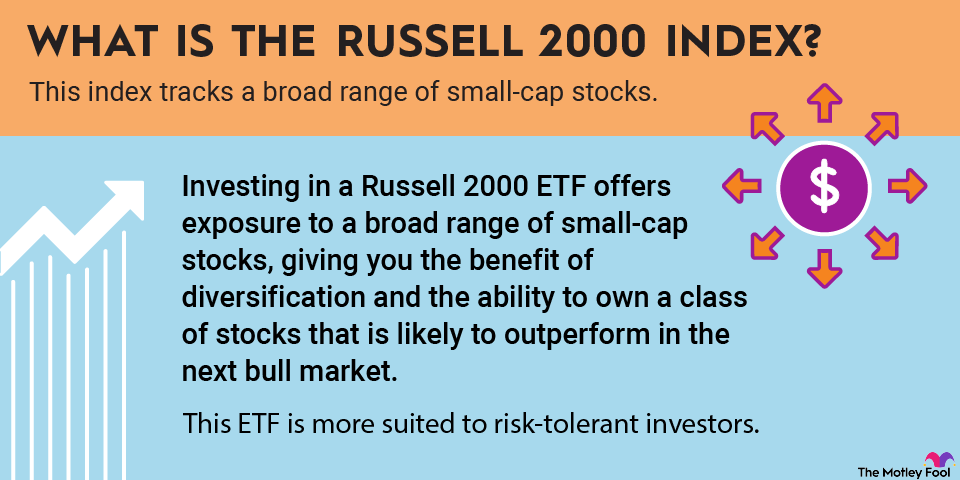
VTWO mirrors the Russell 2000 index, the primary index for small-cap stocks. As of May 31, it holds 1,951 stocks spanning all major sectors. Whereas the S&P 500 has become top-heavy and tech-heavy (nearly 39% of the index), VTWO is more diversified across sectors:
- Industrials: 19.8%
- Healthcare: 16.1%
- Financials: 15.6%
- Technology: 15.6%
- Consumer discretionary: 9.5%
- Energy: 6.3%
- Real estate: 5.3%
- Basic materials: 4.4%
- Utilities: 3.1%
- Telecommunications: 2.9%
- Consumer staples: 1.4%
Most of the companies won't be recognizable because they operate in niche industries (like biotech) or are regional (like many banks), but there are plenty of productive and flourishing companies in the ETF nonetheless.
VTWO Vanguard Russell 2000 ETF
NASDAQ · As of 4:00 PM ET 10/26/26
Why have small-cap stocks been outperforming large-cap stocks?
The performance gap between the Russell 2000 and the S&P 500 in the first half of the year is the largest in the past 25 years. There isn't one singular reason why, but a large reason is investors rotating away from megacap tech stocks, like the "Magnificent Seven" stocks, and into smaller, more niche players in the AI ecosystem.
Many megacap tech companies are responsible for much of the AI infrastructure, but investors are showing interest in other secondary beneficiaries of the AI boom, such as specialized tech hardware suppliers and more speculative industries. And with big tech valuations stretched after a huge run-up over the past few years, there was more value to be found in small-cap stocks.
One thing to keep an eye on, though, is the likelihood that interest rates will rise later this year. Many smaller companies operate with significant debt, so they're highly sensitive to interest rates. If interest rates increase, we'll likely see profits and margins squeezed.
VTWO isn't meant to replace the S&P 500
Even with its good performance so far this year, I wouldn't use VTWO as an S&P 500 replacement. An S&P 500 ETF can be the foundation of most investors' portfolios, but VTWO is better suited as a complementary addition.
VTWO is the one-stop shop for small-cap stocks, though. It's broad, diversified, and has an expense ratio of 0.06% -- $0.60 in annual fees per $1,000 invested -- making it one of the cheaper ETFs on the market. It's a trifecta.