It's easy to get caught up in the frenzy surrounding hot initial public offerings (IPOs), and want to buy shares as soon as possible. Investors should generally resist this urge, because the market will almost always soon -- within the first year -- allow you to buy shares for a lower price than their IPO price.
This dynamic has played out recently with Space Exploration Technologies (SPCX -3.15%), or SpaceX. And it also played out with five of the seven so-called Magnificent Seven stocks, which are dominant technology-focused stocks with large market capitalizations. Yes, that means there were two exceptions -- Microsoft (MSFT -1.64%) and Alphabet (GOOG -1.24%)(GOOGL -1.26%), then known as Google.
Image source: Getty Images.
SpaceX and Magnificent Seven Stocks IPO-Related Overview
| SpaceX + Magnificent Seven Stocks | Market Cap | IPO Date | Split-Adjusted IPO Price (Price at Time) | Profitable When IPO'd? | Split-Adjusted Price Range During Year After IPO* |
|---|---|---|---|---|---|
| SpaceX | $1.4 trillion | June 12, 2026 | $135 | No | $107.01-$225.64 |
| Nvidia (NVDA +0.57%) | $4.9 trillion | Jan. 1999 | $0.04 ($12) | Yes | $0.03-$0.10 |
| Apple (AAPL -0.52%) | $4.5 trillion | Dec. 1980 | $0.10 ($22) | Yes | $0.06-$0.16 |
| Alphabet | $4.4 trillion | Aug. 2004 | $2.13 ($85) | Yes | $2.13-$7.95 |
| Microsoft | $3.5 trillion | March 1986 | $0.07 ($21) | Yes | $0.07-$0.30 |
| Amazon (AMZN -2.02%) | $2.9 trillion | May 1997 | $0.075 ($18) | No | $0.07-$0.35 |
| Meta Platforms (META +0.70%) | $1.4 trillion | May 2012 | $38 ($38) | Yes | $17.55-$45 |
| Tesla (TSLA -0.67%) | $975 billion | June 2010 | $1.13 ($17) | No | $1.05-$2.43 |
Sources: Yahoo! Finance, YCharts, and select Securities and Exchange Commission (SEC) filings. *Price ranges include intra-day prices. Data to July 31, 2026.
Alphabet and Microsoft: The exceptions
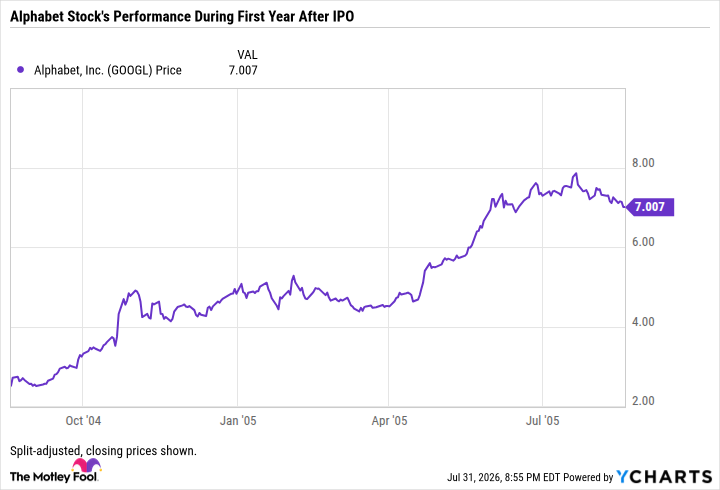
Search engine leader Alphabet -- then known as Google -- and software behemoth Microsoft are the only Magnificent Seven stocks that didn't sink below their IPO price during the year after their IPO.
Why? I think the primary reason is that, unlike many other tech companies in their periods, they were not only profitable at the time of their IPOs but had also been profitable for at least a few years. Moreover, their profits were growing like wildfire. So, it makes sense that investors wanted to pile in as soon as possible.
Data by YCharts.
YCharts' Microsoft data doesn't go back as far as its IPO, so I can't provide a similar chart for Microsoft.
The lesson from today's largest and most successful companies is that it's usually smart to wait until shortly after the IPO to buy shares. Of course, there will always be exceptions to this generalization. If you feel compelled to buy on an IPO date, at least dollar-cost average your way into your full position, as the early days of an IPO stock can be very volatile.