Lucid Group (LCID +1.74%) has always been an intriguing investment opportunity, but it has consistently disappointed investors in several ways.
The electric vehicle (EV) maker designs and produces some of the most advanced EVs globally but has a growing number of recalls and supplier issues and has struggled to lower costs and build scale to improve vehicle unit economics and gross profitability.
Now, another speed bump: The EV maker just announced that its upcoming Cosmos SUV is significantly delayed -- does this represent a red flag or a smart move?
What's going on?
Lucid originally planned to launch its midsize Cosmos SUV EV late this year, although it admitted that production volume would be low until production accelerates next year. To be fair, many investors and analysts were skeptical of this timeline, given that its Gravity SUV is still dealing with recalls, supply chain bottlenecks, and production shifts to align with consumer demand.
During Lucid's second-quarter earnings report last week, the company announced a wider-than-expected loss, high cash burn, and that, during an "operational reset," it would push the Cosmos SUV launch back until at least 2027.
According to CNBC, Lucid's new CEO Silvio Napoli said, "We're not going to make the mistake of the past, where products, great cars, were in fact tainted by launching before things were ready. I think it's going to be '27. ... Most likely the second half of '27."
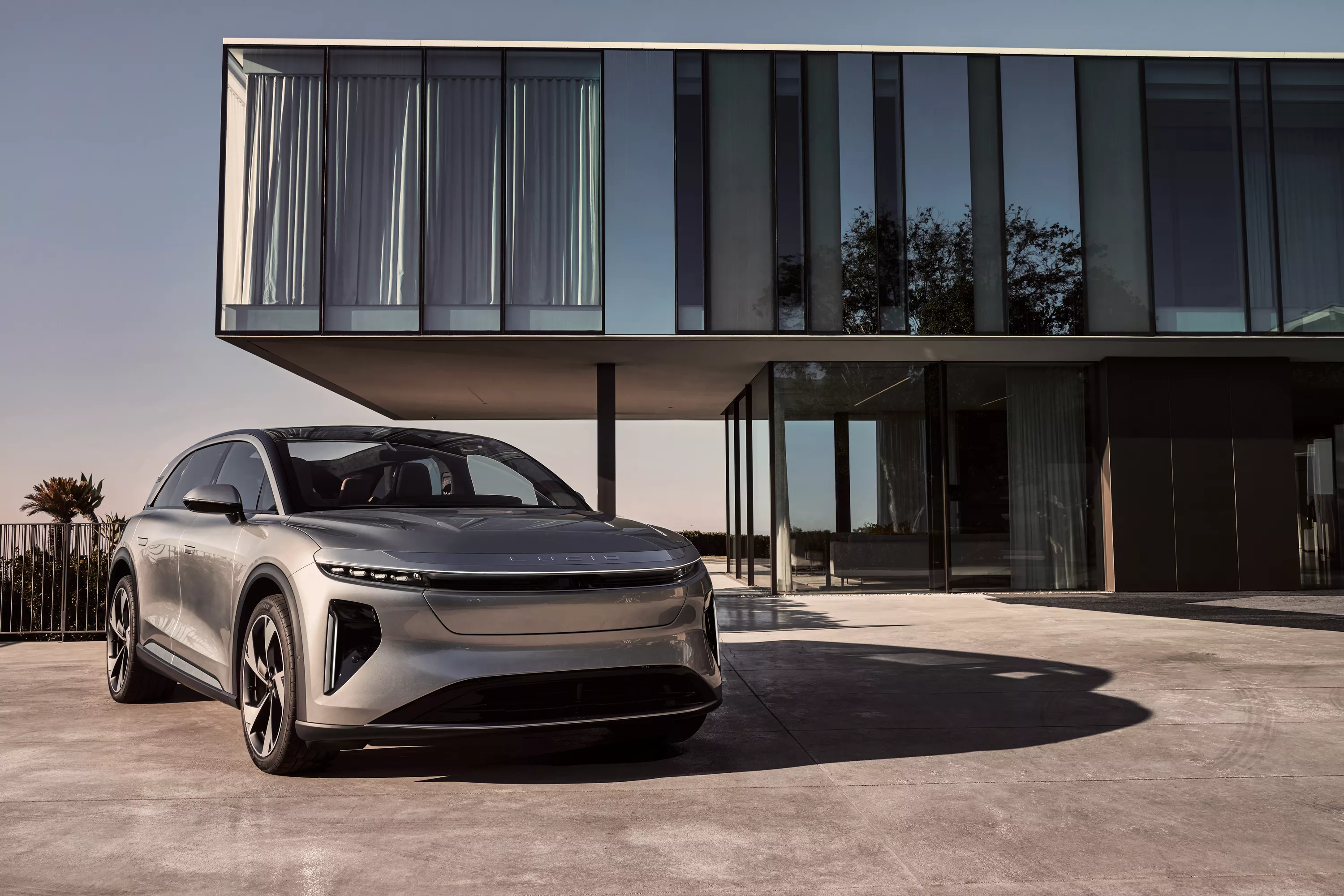
Lucid Gravity. Image source: Lucid.
Red flag or prudent move?
This move could certainly cause investors and analysts to raise an eyebrow in cynicism, because launches are expensive, especially early on, when production volumes are low and inventory is stacked before being distributed, further pressuring Lucid's liquidity.
There's some truth to that, as Lucid admitted it is focusing on $1.4 billion in cash flow improvement opportunities by reducing capital expenditures and vehicle inventory for the rest of 2026 -- largely the difference from delaying the Cosmos Launch. More specifically, Lucid is targeting inventory savings between $600 million and $800 million, capital expenditure savings of about $500 million, and operating expense savings of $200 million, which includes the company's two sizable rounds of layoffs (totaling about 20% of its U.S. staff).
That cash flow improvement is desperately needed for an automaker that has consistently relied on Saudi Arabia's Public Investment Fund (PIF) and has drastically diluted shareholders, compared with rival Rivian Automotive (RIVN -1.07%), which has used less dilutive strategies. Lucid should be commended for its decision to delay until it's ready for a smooth launch of the Cosmos, especially considering past production hiccups.
Still, in the wake of rumors that the automaker was considering bankruptcy or taking the company private (which Lucid denies), the optics aren't great. Lucid exited the second quarter with $3 billion in total liquidity, though only about $730 million was in cash and cash equivalents, which it believes will be sufficient "well into 2027." But what has investors understandably nervous is that Lucid's free cash flow was a negative $1.48 billion during the second quarter.

NASDAQ: LCID
Key Data Points
What it all means
Putting it bluntly, there are plenty of red flags for Lucid, whether you count this delay as yet another or not. Ultimately, with the Gravity still smoothing out its optimal production, recalls, and supplier bottlenecks, and cash burn remaining as high as it is, the last thing Lucid needed to do was apply more financial pressure to itself with another expensive launch before it begins reaping the rewards (ideally) of the Gravity SUV opening doors to a mainstream consumer.
For investors, it's wise to put the idea of the Cosmos on the back burner as well and focus on Lucid's ability to expand its liquidity, hopefully without extreme shareholder dilution and with lower costs to improve gross profitability, all while building scale as Gravity deliveries are optimized. Savvy investors should watch this investment opportunity from the sidelines, since Lucid has much to prove before it's worth its sizable risk.