Checking in on what the smart money is doing with stocks is a great way to source new ideas or challenge ideas that you have. One interesting move that billionaire Bill Ackman made at Pershing Square Capital Management was selling Amazon (AMZN +3.29%) and buying Microsoft (MSFT +2.38%) in the second quarter.
Pershing decreased its Amazon stake by over 25% in Q2, while increasing its Microsoft stake by nearly 10%.
That's a definitive rebalancing of his portfolio, but is that still the right move for investors? Let's take a look.

Pershing Square Capital Management CEO Bill Ackman. Image source: Getty Images.
The landscape has shifted since Q2 wrapped up
Investors only have access to Ackman's moves thanks to a Form 13F filing, which requires funds with more than $100 million in assets to file their end-of-quarter holdings with the SEC. That information is then given to the public 45 days later, so it could include some outdated information that's no longer accurate. That's why it's prudent to analyze what has happened over the past month and a half before blindly following a hedge fund's moves.

NASDAQ: MSFT
Key Data Points
Both Amazon's and Microsoft's stocks have done very well since Q2 ended, both boosted by strong earnings reports that sent shares skyrocketing the day after earnings. Since Q2 ended, Microsoft is up an impressive 30%, while Amazon is up around 10%. Those are big moves in just a few weeks, and completely change how investors view these two as investments.
So, just because Ackman bought Microsoft and sold Amazon during Q2 doesn't mean he isn't reversing that trade right now. Is Microsoft still the best buy between the two?
Q2 results favor Amazon
During Q2, Microsoft and Amazon each reported blowout quarters, but I think one company's results stand out above the other's.
Amazon's overall growth rate during Q2 was 20%, and its operating income increased by 43%. This was heavily influenced by Amazon Web Services (AWS) delivering better-than-expected results, but that trend will likely continue as Amazon is pouring $220 billion into data center capital expenditures in 2026.

NASDAQ: AMZN
Key Data Points
Microsoft operates on a different fiscal calendar, and its results for the fourth quarter of fiscal year 2026 (ended June 30) were also good, but not quite as strong. Microsoft's revenue rose 18% year over year, with earnings income rising the same 18%. Those results clearly favor Amazon, and it's likely that this differential will persist for some time.
Microsoft didn't adjust its capital expenditure guidance, but Amazon raised its outlook. Amazon is also spending far more than Microsoft on data centers, and if it can find clients for this increased demand, it will lead to further AWS revenue growth.
From a valuation perspective, both companies' price-to-earnings (P/E) ratios were influenced by one-time gains on investments. So, I'll value each company based on its operating income instead.
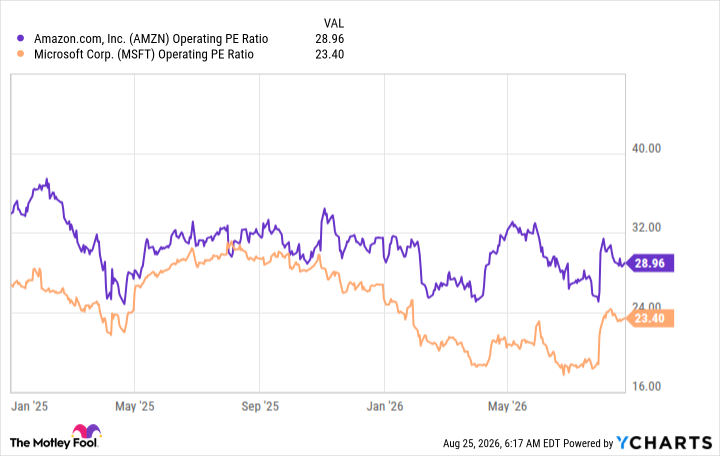
AMZN Operating PE Ratio data by YCharts
Amazon holds a decent premium to Microsoft, making it seem like the far better deal. However, this is only looking at trailing earnings and fails to factor in the growth rate.
Amazon's operating income is growing at a far faster rate because Amazon's cloud computing segment, Amazon Web Services (AWS), accounts for 60% of the company's operating income. In Q2, AWS' operating income rose at a 64% year-over-year pace. When a division's operating income is growing that fast and makes up the majority of the company's total, it leads to outsize growth that can send stocks soaring.
Because of this trend, I think Amazon's stock is actually cheaper than Microsoft's, as its growth will vault it ahead over the next few years. With that in mind, I think Amazon is the far better buy over Microsoft right now, as the data center build-out trend isn't going to wrap up anytime in the near future.