Rocket Lab (RKLB -0.28%), a developer of reusable orbital rockets, is usually considered SpaceX's (SPCX +1.25%) much smaller competitor in the launch services market. But over the past three years, it quietly carved out a niche with HASTE (Hypersonic Accelerator Suborbital Test Electron), a launch vehicle for testing hypersonic and suborbital technologies.
Unlike its Electron rockets, which enter Earth's orbit, HASTE acts as a testbed for accelerating payloads to hypersonic velocities in suborbital environments. Its primary customer is the Department of Defense (DoD), which uses HASTE to solve a major bottleneck in testing experimental systems at hypersonic speeds under real atmospheric conditions.
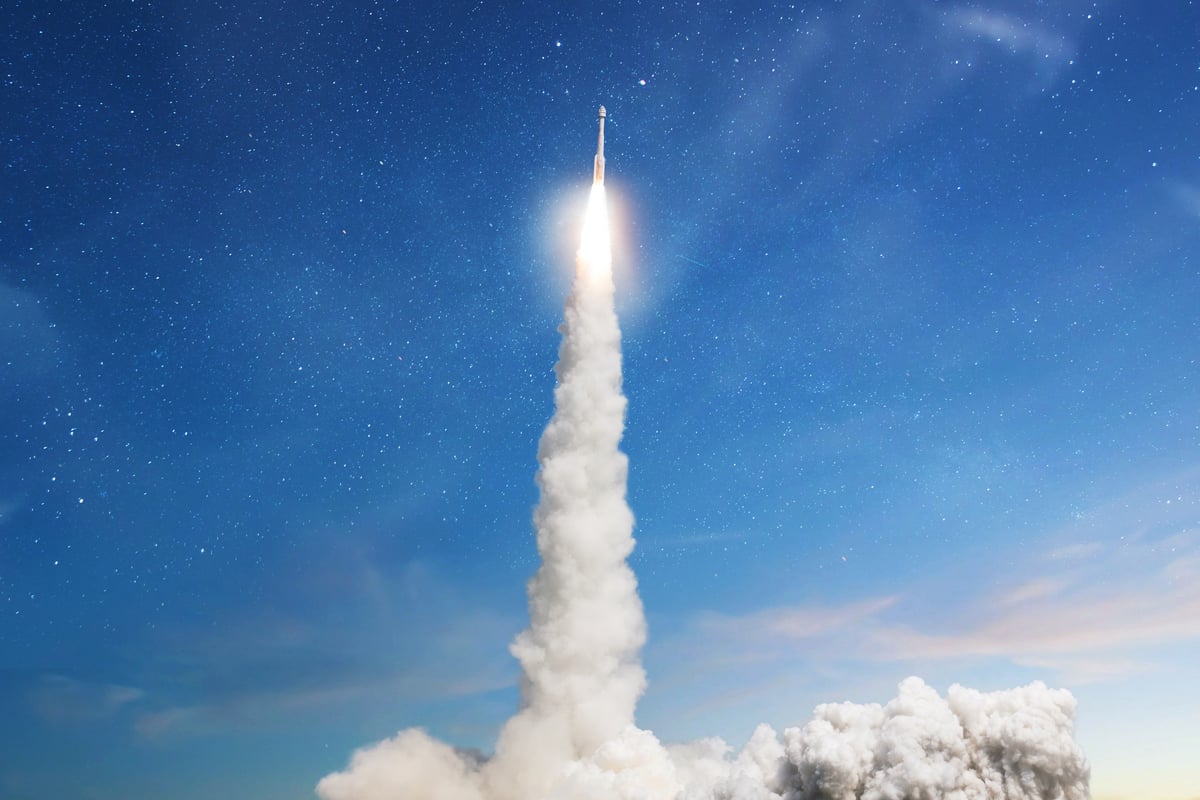
Image source: Getty Images.
Those tests cover scramjets (hypersonic jet engines), thermal protection materials, sensors, guidance systems, and missile defense systems. In the past, the DoD used repurposed military missiles, custom rockets, and ground-based wind tunnels to conduct these experiments. However, these methods were expensive, infrequent, and didn't fully simulate suborbital atmospheric conditions.
With HASTE, which is built on the same bones as Rocket Lab's Electron rockets, the DoD can conduct those tests at scale for a lower price. They can also be launched more frequently, customized for precise trajectories, and carry larger payloads than their legacy predecessors.

NASDAQ: RKLB
Key Data Points
How will HASTE help Rocket Lab?
Rocket Lab doesn't disclose exactly how much revenue it generates from its HASTE launches. But based on the value of its announced contracts, HASTE generates much more revenue per flight ($9.5 to $22 million) than its standard commercial Electron launches ($8 to $10 million).
HASTE launches cost more because they require customized trajectories, specialized suborbital payload integration, hardware modifications, and coordination with defense ranges. But by using the Electron's assembly lines and tools to build its HASTE vehicles, Rocket Lab can generate higher gross margins from those launches than its standard Electron launches.
Rocket Lab has secured around $500 million in HASTE contracts so far. It holds a $266 million contract with the DoD (Space Force) to launch 12 flights, a $190 million contract with the Navy to launch 20 flights, a $30 million contract with Anduril Industries for three launches, and about $15-$20 million in individual mission contracts with Leidos (LDOS +2.06%) and the DoD's DIU (Defense Innovation Unit) and DIT (Defense Innovation Transition) teams.
That backlog is equivalent to more than half of its projected 2026 revenue of $953 million. It also significantly widens its moat against SpaceX, which doesn't offer any hypersonic suborbital flights on its larger Falcon rockets. By locking in this niche market, it has secured a steady stream of revenue from the Pentagon that will likely continue to rise over the next few years.
Rocket Lab still has plenty of irons in the fire
Rocket Lab is best known for its Electron rockets, which have been launched 93 times to deploy over 264 satellites, and its upcoming, higher-capacity Neutron rocket. Those rockets, along with HASTE, generate most of Rocket Lab's Launch Services revenue.
However, Rocket Lab's Launch Services segment only accounts for about 25%-30% of its revenue. More than 70% of its revenue comes from its Space Systems segment, which builds satellite components, solar panels, and complete spacecraft buses. Its planned takeover of Iridium (IRDM -0.19%), expected to close in 2027, will further expand its Space Systems segment with a global satellite communication network.
In other words, Rocket Lab is expanding into an end-to-end services company that offers launch, manufacturing, and satellite services. It could face tough competition from SpaceX in those markets, but as long as it carves out defensible, growing niches -- as it did with HASTE -- it could continue to thrive in the shadow of the aerospace and AI behemoth.
That's why analysts still expect Rocket Lab's revenue to nearly triple from 2025 to 2028. It's still a speculative stock that isn't cheap at 42 times this year's sales, but it could still have plenty of upside potential as the nascent space industry expands.