Google’s parent company, Alphabet (NASDAQ: GOOG, GOOGL), is one of the world’s most valuable and influential technology companies. It dominates online search and digital advertising and continues expanding in artificial intelligence, cloud computing, and emerging technologies.
If you’re considering owning shares, this guide walks through how to buy Alphabet stock, the difference between GOOG and GOOGL, and what to evaluate before investing.
How to invest in Google
Here's a step-by-step guide to buying Alphabet:
- Open your brokerage account: Log in to your brokerage account where you handle your investments. If you don't have one yet, choose one of our top brokerage account picks and open one in minutes.
- Fund your account: Transfer money so you’re ready to invest.
- Search for the stock: Enter the ticker or company name into the search bar to bring up the stock's trading page.
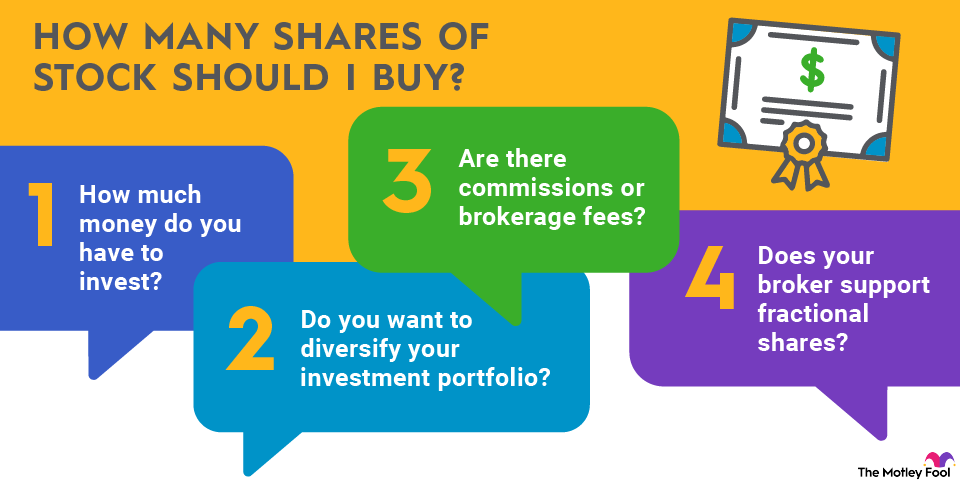
- Decide how many shares to buy: Consider your investment goals and how much of your portfolio you want to allocate to this stock.
- Select order type: Choose between a market order to buy at the current price or a limit order to specify the maximum price you're willing to pay.
- Submit your order: Confirm the details and submit your buy order.
- Review your purchase: Check your portfolio to ensure your order was filled as expected and adjust your investment strategy accordingly.
GOOG vs. GOOGL
GOOG vs. GOOGL: What investors should know
Google's parent company, Alphabet, trades on the Nasdaq Stock Market. It has three share classes and two stock tickers:
- Class A shares (GOOGL): The Class A shares carry one vote per share.alph
- Class B shares (non-traded): Each Class B share has 10 votes. Google's co-founders own these shares, giving them more voting power.
- Class C shares (GOOG): The Class C shares have no voting power.
Given their voting power, Class A shares (GOOGL) tend to trade at a slightly higher price than Class C stock (GOOG). Both represent ownership in Alphabet, and both perform similarly over time. The main difference is whether you want a shareholder vote. Some investors don’t consider voting rights essential and choose whichever trades at the better price.
Google stock split history
Google and its parent company, Alphabet, have completed two stock splits in its history. Google implemented a 2-for-1 split in 2004, giving each Class A holder one Class C share. The second split came in 2022 when Alphabet conducted a 20-for-1 split.

NASDAQ: GOOG
Key Data Points
Investing in Alphabet through ETFs
If you prefer a more hands-off approach, you can invest in Alphabet through an exchange-traded fund (ETF). Because Alphabet is one of the largest U.S. companies by market cap, it’s included in many major index funds including the Nasdaq Composite (^IXIC +0.31%) and S&P 500 (^GSPC +0.19%).
According to ETF.com, as of mid-2025, more than 348 ETFs hold Alphabet stock, totaling about 667.6 million shares, so there’s no shortage of options.
ETF | Why it matters | Alphabet weighting |
|---|---|---|
Vanguard Total Stock Market ETF (VTI) | Broad exposure to the entire U.S. stock market | ~3.1% total (1.7% GOOGL + 1.4% GOOG) |
SPDR S&P 500 ETF Trust (SPY) | Tracks the S&P 500 and includes Alphabet as a top holding | Included (weight varies with market cap) |
Invesco QQQ Trust (QQQ) | Tracks the Nasdaq-100 and has heavy exposure to tech companies | Included (weight varies with market cap) |
Vanguard Communication Services ETF (VOX) | Higher concentration in tech and digital media | 22%+ weighted to Alphabet |
Should you invest in Google?
Before investing in Google's parent company stock, you need to determine if Alphabet shares are a worthwhile investment. Here are some factors to consider before investing in Alphabet stock:
Profitability
Alphabet is a wildly profitable company. The technology titan produced almost $34.5 billion of net income in the first quarter of 2025, up from more than $23.7 billion in the year-ago period.
The company's investments in artificial intelligence (AI) were a big factor driving its earnings growth. Google saw strong search growth, powered in part by features like AI Overviews.
Revenue
Alphabet generated $90.2 billion of revenue in the first quarter of 2025, up 12% from the prior-year period. Google search remains the company's biggest revenue contributor. The company's search engine generated $50.7 billion of revenue in the quarter, 56% of Alphabet's total revenue for the period. YouTube ($8.9 billion) and Google Cloud ($12.3 billion) are two of the tech giant's other big revenue drivers.
Alphabet's valuation
Alphabet's valuation has increased over the past few months:
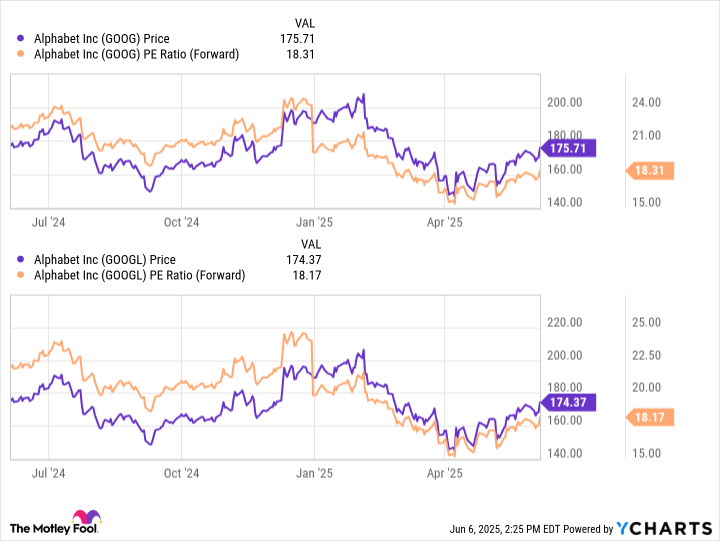
At more than 18 times earnings, the valuation of Google's parent company was lower than the major stock market indexes. As of mid-2025, the S&P 500 traded at more than 22 times its forward price-to-earnings (P/E) ratio, while the Nasdaq Composite traded at almost 28 times its forward P/E ratio.
Dividends
Google's parent company, Alphabet, initiated its first-ever dividend payment in April 2024. The technology giant set its quarterly rate at $0.20 per share. The next year, it raised its payment by 5% to $0.21 per share each quarter.
In addition to paying dividends, the technology titan uses its excess free cash flow to repurchase shares. It authorized another $70 billion buyback program in early 2025.
The bottom line
Google remains the dominant name in internet search. However, the company has grown beyond search over the years, leading it to change its corporate name to Alphabet. The company is highly profitable. Shares of Google's parent company could make a good long-term investment, especially if profits continue rising at a rapid rate.
Related investing topics
FAQ
About the Author