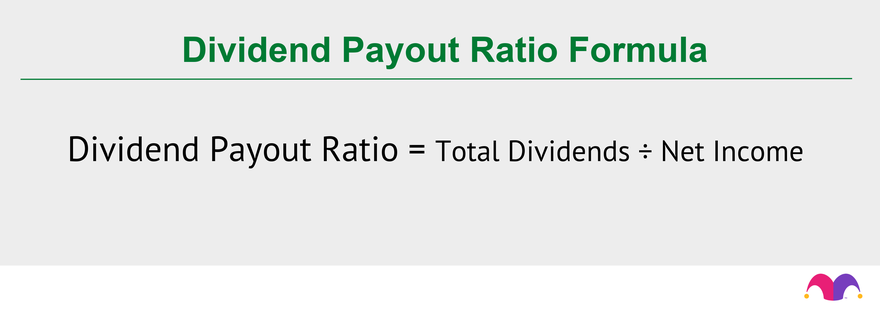
Take total dividends divided by net income, and you will get DPR.
This is useful in measuring a company's ability to keep paying or even increasing a dividend. The higher the payout ratio, the harder it may be to maintain it; the lower, the better.
Invest better with The Motley Fool. Get stock recommendations, portfolio guidance, and more from The Motley Fool's premium services.
Most companies report their dividends on a cash flow statement, in a separate accounting summary in their regular disclosures to investors, or in a stand-alone press release, but that's not always the case. If not, you can calculate dividends using a balance sheet and an income statement. You'll find these in a company's 10-K annual report.
Here is the formula for calculating dividends: Annual net income minus net change in retained earnings = dividends paid.
To figure out dividends when they're not explicitly stated, you have to look at two things. First, the balance sheet -- a record of a company's assets and liabilities -- will reveal how much a company has kept on its books in retained earnings. Retained earnings are the total earnings a company has earned in its history that haven't been returned to shareholders through dividends.
Second, the income statement in the annual report -- which measures a company's financial performance over a certain period of time -- will show you how much in net earnings that a company has brought in during a given year. That figure helps to establish what the change in retained earnings would have been if the company had chosen not to pay any dividends during a given year.
To calculate dividends for a given year, do the following:
The answer represents the total amount of dividends paid.
For example, say a company earned $100 million in a given year. It started with $50 million in retained earnings and ended the year with $70 million. The increase in retained earnings was $70 million minus $50 million, or $20 million.
Here's the math: $100 million net income-$20 million change in retained earnings = $80 million paid in dividends.
One of the most useful reasons to calculate a company's total dividend is to determine the dividend payout ratio, or DPR. This measures the percentage of a company's net income that is paid out in dividends.
Dividend Payout Ratio = Total Dividends ÷ Net Income

If a company has a consistent payout ratio, you can use the income statement to estimate what dividends it's likely to pay, without needing the balance sheet at all.
Example: A company has historically paid out 40%–46% of net income as dividends. Using the midpoint, 43%, as the typical payout ratio: if the company earned $10 million with five million shares outstanding, net income per share is $2.00. Multiply by 0.43 and you get an estimated dividend of $0.86 per share.
This approach only works reliably when a company's payout ratio is consistent. It won't be useful for companies with irregular dividend histories.
Once you have the total dividends, converting that to per-share is a matter of dividing it by shares outstanding, also found in the annual report.
Here is the formula for dividends per share: Total dividends ÷ shares outstanding = dividends per share.
Using this method to calculate dividends per share may not be 100% accurate because a company may increase or lower its dividends (they're usually paid quarterly) over the course of the year and may also issue or repurchase shares, changing the share count. These changes can affect the accuracy of this calculation.
The best way to find accurate dividend-per-share information is to read the most recent press release or filing with the Securities and Exchange Commission (SEC) when a company announces its next dividend. You can also seek help from a good online broker, which will show the per-share amount of the last dividend a company paid or announced it will pay soon.