If you want to diversify your portfolio through exposure to high-growth emerging markets but don't want your risk concentrated in a single economy or region, the Schwab Emerging Markets Equity ETF (SCHE -0.08%) may be a good fit. It tracks the FTSE Emerging Index, a collection of large- and mid-cap stocks in more than 20 developing countries.
The fund has more than 2,200 holdings, with the largest concentrations in China, India, Taiwan, Brazil, and South Africa. Its expense ratio is only 0.06%.
The stocks of companies in emerging markets have historically underperformed compared to U.S. stocks. In the past five years, as of September 2026, the Schwab emerging market fund had annualized returns of less than 7%. Meanwhile, the S&P 500 racked up annualized returns of about 14% during the same five-year period.
Still, given that about 85% of the world's population lives in developing countries, investors with a long-term focus who are comfortable with volatility may want to consider this fund.
How index funds work
An index fund tracks the performance of a market index, such as the S&P 500 or the Russell 2000, rather than having investment teams select investments. Unlike actively managed funds, index funds are passively managed. And rather than trying to outperform the market, they aim to replicate the benchmark index's performance.
If you invest in an index fund with a low tracking error (meaning the fund doesn't deviate much from its benchmark), your returns will be very similar to the performance of the underlying index, minus fees. For example, say you invested in an S&P 500 index fund in a year when the S&P 500 returned 10%, and the fund has a 0.1% expense ratio. You'd expect a return of approximately 9.9% for the year.
How to choose an index fund
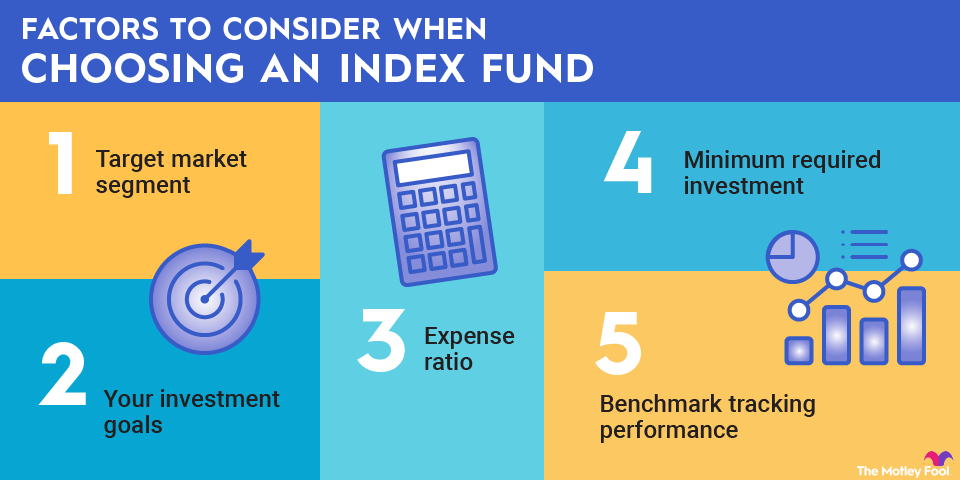
Consider the market segment you're targeting, any fees, and your investment goals (such as growth or reliable dividend income) when choosing an index fund.
- Target market segment: Some index funds confer portfolio exposure to the entire U.S. stock market by tracking indexes such as the S&P 500. Others track narrower indexes focused on specific stock market sectors, industries, countries, or company sizes.
- Your investment goals: Some stock market indexes and, by extension, some index funds track companies with specific characteristics, such as high growth potential, a history of reliable dividend payments, or adherence to environmental, social, and governance (ESG) standards.
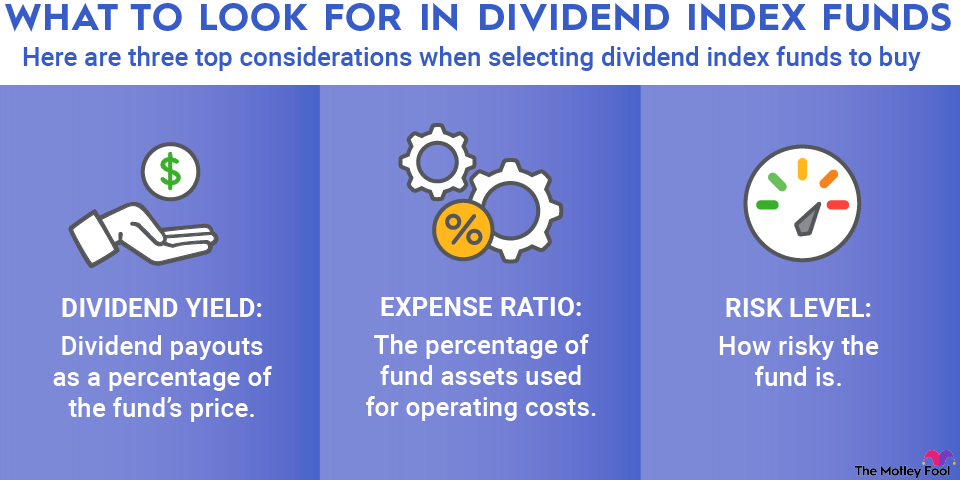
- Expense ratio: An index fund's expense ratio -- the percentage of your investment paid annually as a management fee to the fund's manager -- can vary significantly. A good expense ratio for a total stock market index fund is about 0.1% or less; a small number of index funds have 0% expense ratios. More specialized index funds tend to have higher expense ratios.
- Minimum required investment: Some mutual funds require an initial investment of $1,000 or more. ETF index funds are accessible for the cost of a single share. Many brokers also offer ETFs as fractional shares, allowing you to invest as little as $1.
- Benchmark tracking performance: The degree to which an index fund tracks its underlying index can vary. The performance of the best index funds is closely correlated with their benchmark indexes.
Benefits and risks of investing in index funds
The benefits of investing in index fees include the low costs and automatic diversification, but one downside is that you can't beat the market.
Benefits
- Low fees: Perhaps the biggest benefit of investing in a passively managed index fund is the low cost because you're not paying fund managers to handpick investments.
- Diversification: Because an index fund invests in many different companies, you get far more diversification than you can typically get by building a portfolio on your own, particularly if the fund tracks a major index like the S&P 500.
- Good tool for long-term investing: Shares of individual companies can shift dramatically based on rumors, speculation, or a single earnings call. Though the overall stock market isn't immune to investor sentiment, its highs and lows are less pronounced than those of individual stocks.
Risks
- You can't beat the market: Some investors hesitate to invest in index funds because they don't beat the market -- index funds aim to replicate an index's performance, so at best, your results will be on par with the underlying index's results, minus fees.
- Not all indexes are the same: Funds that track the entire stock market or a large segment of it, like the S&P 500, have been solid winners over time, but some indexes are incredibly niche and far more vulnerable to market hype.