Tax-deferred accounts like traditional individual retirement accounts (IRAs) and 401(k) plans let workers delay tax payments on qualified contributions in the present, allowing them to save pre-tax dollars in exchange for paying income tax on the contributions and any gains in the future.
However, you cannot delay the tax bill indefinitely. At a certain age, individuals with a tax-deferred account must begin taking required minimum distributions (RMDs) each year. RMDs are calculated as a percentage of the money held in the accounts at the end of the previous calendar year.
Here's what you need to know about RMDs, including how to calculate the RMD amount on $250,000.
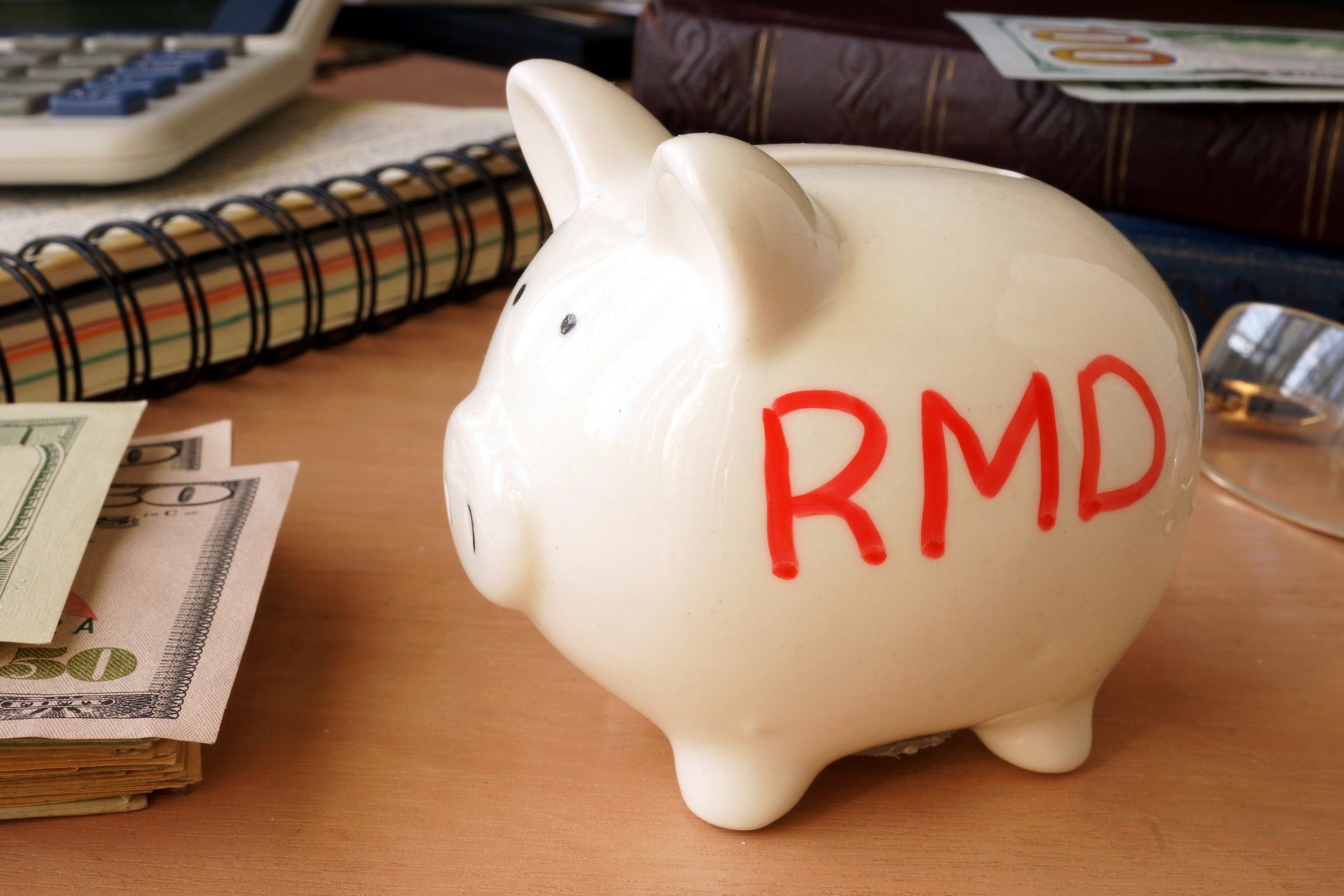
Image source: Getty Images.
What account types are subject to required minimum distributions (RMDs)?
A required minimum distribution (RMD) is the smallest amount of money that must be withdrawn from certain types of retirement accounts each year. The RMD rules apply to the original account holders and beneficiaries with the following plans:
Importantly, Roth accounts are not subject to RMDs while the original account holder is alive, but beneficiaries of Roth accounts must abide by RMD rules. RMDs must typically be completed by Dec. 31. The only exception is the first RMD, which can be postponed until April 1 of the following year.
At what age do required minimum distributions (RMDs) begin?
The Secure Acts of 2019 and 2022 gradually raised the age at which RMDs begin. This year, tax-deferred account holders aged 73 and older must take RMDs. The chart below provides more detail.
|
Account Holder's Birth Date |
Age When RMDs Begin |
|---|---|
|
Before July 1, 1949 |
70 1/2 |
|
July 1, 1949, to Dec. 31, 1950 |
72 |
|
Jan. 1, 1951, to Dec. 31, 1959 |
73 |
|
After Dec. 31, 1959 |
75 |
Data source: Internal Revenue Service.
The penalty for not completing the RMD on time is an additional 25% excise tax -- that is, you would owe the IRS 25% of the amount not withdrawn (and you must still complete the full RMD) -- but the penalty can be reduced to 10% if the problem is fixed within two years.
Alternatively, the penalty can be waived entirely if the shortfall was due to a reasonable error and the problem is fixed in a timely manner. To qualify, you must provide a statement of explanation as to why the RMD was missed. That statement must be attached to a Form 5329 and submitted to the IRS along with your tax return.
How much is the required minimum distribution (RMD) on a $250,000 retirement account?
Required minimum distribution amounts are calculated by dividing a life expectancy factor into the relevant account balance from Dec. 31 of the previous year. For instance, RMDs taken in 2026 will be based on account balances as of Dec. 31, 2025.
Individuals with multiple IRAs must calculate the RMD for each account separately, but the total sum can be withdrawn from a single account. Importantly, that rule does not extend to 401(k), 403(b), and profit-sharing plans. For those accounts, RMDs must be calculated and withdrawn separately.
The IRS publishes three life expectancy tables. Which table you use to calculate your RMD depends on the circumstances, as detailed below:
- Table I (Single Life Expectancy): Beneficiaries use this table.
- Table II (Joint and Last Survivor Life Expectancy): Account holders use this table if the sole beneficiary is a spouse who is more than 10 years younger.
- Table III (Uniform Lifetime): Account holders use this table if the sole beneficiary is a spouse not more than 10 years younger, or if they have multiple beneficiaries.
Shown below is an abbreviated reproduction of Table III (Uniform Lifetime) from the IRS. Below the table are three example RMD calculations involving accounts with $250,000.
|
Age in Current Year |
Distribution Period |
|---|---|
|
73 |
26.5 |
|
74 |
25.5 |
|
75 |
24.6 |
|
76 |
23.7 |
|
77 |
22.9 |
|
78 |
22.0 |
|
79 |
21.1 |
|
80 |
20.2 |
Data source: Internal Revenue Service. Uniform Lifetime Table.
Example 1: Kyle turns 73 in 2026 and has money in a traditional IRA. The balance was $250,000 as of Dec. 31, 2025. His 2026 RMD equals $250,000 divided by 26.5, which is $9,434. Kyle can delay the withdrawal until April 1, 2027, because this is his first RMD. However, all future RMDs must be taken by Dec. 31. To be clear, Kyle's second RMD must be completed by Dec. 31, 2027, regardless of when he takes his first RMD.
Example 2: Celina turns 74 in 2026 and has two traditional IRAs. The first IRA held $250,000, and the second IRA held $500,000 as of Dec. 31, 2025. The RMD on the first account is $9,804 (i.e., $250,000 divided by 25.5), and the RMD on the second account is $19,608 (i.e., $500,000 divided by 25.5). Celina can take the entire sum (i.e., $29,412) from a single account, or she can divide the RMD between the two accounts.
Example 3: Lara turns 77 in 2026 and has a traditional IRA and a traditional 401(k). Both accounts had a balance of $250,000 on Dec. 31, 2025, so the 2026 RMD for both accounts is $10,918 (i.e., $250,000 divided by 22.9). Lara must withdraw that sum from both accounts individually. Unlike the previous example, the amounts cannot be combined and withdrawn from a single account.