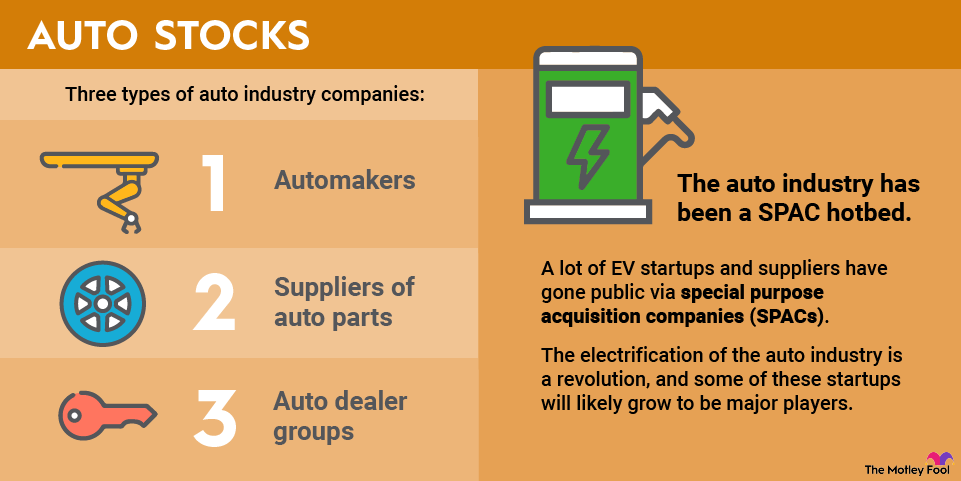
Automotive stocks include companies that design, manufacture, and distribute automotive vehicles and their components. This includes automakers, component markets, dealers, and auto parts retailers.
Top car stocks of 2026
Some of the best-known automotive stocks are:
How do you evaluate an automotive stock?
It's essential to understand how economic cycles affect automotive companies and how they work to maximize profits and stay competitive during both good and bad economic times. Additionally, investors should consider each auto company's strategy and relevance in the electric vehicle market.
- Valuation within the cycle.
- Financial health to invest capital in developing new cars -- a key issue in a capital-intensive industry subject to constant innovation.
- Electric vehicle and hybrid vehicle strategy.
Understanding the auto sales cycle
Automakers and their suppliers are cyclical stocks, meaning their profits fluctuate in line with consumer confidence. When businesses and consumers are worried about the economy, they postpone buying new vehicles. Auto sales' cyclicality matters to investors because:
- Automakers have high fixed costs, which include factories, tooling, logistics networks, and labor contracts. These bills must be paid, regardless of how many cars are sold.
- Automakers and suppliers also need to invest in product development to ensure a steady stream of competitive new products.
- High costs and steady spending mean profit margins in the automotive industry tend to be low, even during good economic times.
- When sales slump, as during a recession, automotive companies' profits fall sharply, putting future product development and competitiveness at risk.
One way to avoid the sector's cyclicality is to invest in stocks exposed to the replacement market, such as auto parts retailers or manufacturers that primarily sell to the secondary market.
How do you understand car companies' financial statements?
Here are three things to know:
- Auto investors tend to examine operating income (EBIT, earnings before interest and taxes), operating margins (EBIT divided by total revenue), and cash flow to assess an automotive company's financial performance.
- Automakers will often provide adjusted figures that exclude the impact of one-time charges and gains, such as write-offs and tax windfalls, which help understand the business's underlying performance.
- Many automakers have finance subsidiaries that offer loans and leases to customers and dealers. They can make automotive financial statements confusing for investors.
Competition in the car industry
Generally speaking, the automaker with the newest products tends to command the highest prices and achieve the greatest profits. Automakers must continually invest to be sure they have a steady flow of new products in the pipeline.
Virtually all automakers and many parts suppliers are also making significant investments in future technologies such as EVs, extra safety features, and autonomous driving systems.
Electric vehicles
Some exciting opportunities in the next few years will involve manufacturers of electric and hybrid electric vehicles. These are new and different, and most analysts expect them to eventually displace internal-combustion cars.
EV companies might see high growth, which is also exciting for investors. However, it's essential to note that the processes involved in developing and manufacturing EVs aren't significantly different from those employed by traditional internal-combustion vehicle manufacturers. That means EV manufacturers face the same high costs as conventional automakers.
It's also important to remember that all the major traditional automakers are introducing their own electric vehicles. However, Ford and Stellantis have both had to take huge charges as they restructure failing EV strategies.
The future of the auto industry
One vision of the future of the industry lies in EV and autonomous vehicles, with an increasing part of the value in the car coming from its software component. In addition, many believe the industry is headed more towards ride sharing, notably via robotaxis.
It's a vision held by Tesla, but other automakers have pared their EV investments in response to weak sales, and ICE and hybrid vehicles are set to be major parts of the industry for the foreseeable future.
That said, Tesla's robotaxi rollout and its aim of having unsupervised full self-driving (FSD) available (so Tesla drivers can transform their vehicles into robotaxis and Tesla can launch its dedicated robotaxi, the Cybercab) are not risk-free. If Tesla can get it right, the stock's upside potential is significant.
Benefits and risks of investing in automotive stocks
It's an industry in the throes of transformation. If Tesla's vision of a future of transportation dominated by autonomous vehicles and robotaxis comes to pass, then traditional automakers could face significant challenges. At the same time, there's no guarantee that Tesla will prevail.
It's a fundamental schism that could take time to resolve, and is far from clear which way it will go. The benefits of winning are significant to Tesla, as robotaxis will generate a mammoth amount of recurring income. Alternatively, if Tesla's vision fails, then traditional automakers will have an opportunity to grow.
How to invest in automotive stocks
- Open your brokerage app and log in to your brokerage account where you manage your investments.
- Search for the stock: Enter the ticker or company name into the search bar to bring up the stock's trading page.
- Decide how many shares to buy: Consider your investment goals and how much of your portfolio you want to allocate to this stock.
- Select order type: Choose between a market order to buy at the current price or a limit order to specify the maximum price you're willing to pay.
- Submit your order: Confirm the details and submit your buy order.
- Review your purchase: Check your portfolio to ensure your order was filled as expected and adjust your investment strategy accordingly.
Are automotive stocks for you?
Automotive stocks can be important contributors to your investment portfolio. And because they rise and fall with consumer confidence, they can be useful indicators that economic trouble -- or a recovery -- may be on the way.
In addition, investing in an automotive manufacturer means taking a positive view of the company's long-term hybrid and electric vehicle strategy. That's become harder to judge as relatively high interest rates have slowed the growth rate of EV unit sales, dropped pricing, and intensified competition.
Related investing topics
FAQ
Automotive Stocks FAQ
About the Author

Lee Samaha has no position in any of the stocks mentioned. The Motley Fool has positions in and recommends Tesla. The Motley Fool recommends General Motors, Stellantis, and Volkswagen Ag and recommends the following options: long January 2025 $25 calls on General Motors. The Motley Fool has a disclosure policy.