Loading paragraph...
Loading image...
Loading paragraph...
Loading paragraph...
Loading hub_pages...
Loading paragraph...
Loading faq...
The Motley Fool has a disclosure policy.


Invest better with The Motley Fool. Get stock recommendations, portfolio guidance, and more from The Motley Fool's premium services.
A convertible bond is a type of debt security that allows investors to exchange their bonds for a specific number of common shares. Convertible bonds can be a good addition to a diversified portfolio, but they come with unique terminology and calculations. Here, we’ll define convertible bonds and explain the different types, as well as the pros and cons of owning them. We’ll also answer some frequently asked questions about convertible bonds.
Convertible bonds are fixed income securities that can be converted into common stock shares. (Sometimes they’re just called “convertibles.”) This conversion can take place at the discretion of the investor, i.e., the bondholder, or it may be mandatory. Conversion can happen at various times over the bond’s life.
Convertibles provide an interesting option to bondholders if the corporation’s equity shares significantly increase in price.
A convertible bond’s conversion price is specified in the bond’s indenture agreement, which is released at bond origination. The conversion price is the price at which an investor can convert their bond into stock shares. It’s typically set higher than the current equity share price.
A convertible bond’s conversion ratio is the number of stock shares an investor will receive should they choose to convert their bond. A bond with a face value of $1,000 and a conversion price of $20 has a conversion ratio of 50, meaning it could be exchanged for 50 stock shares.
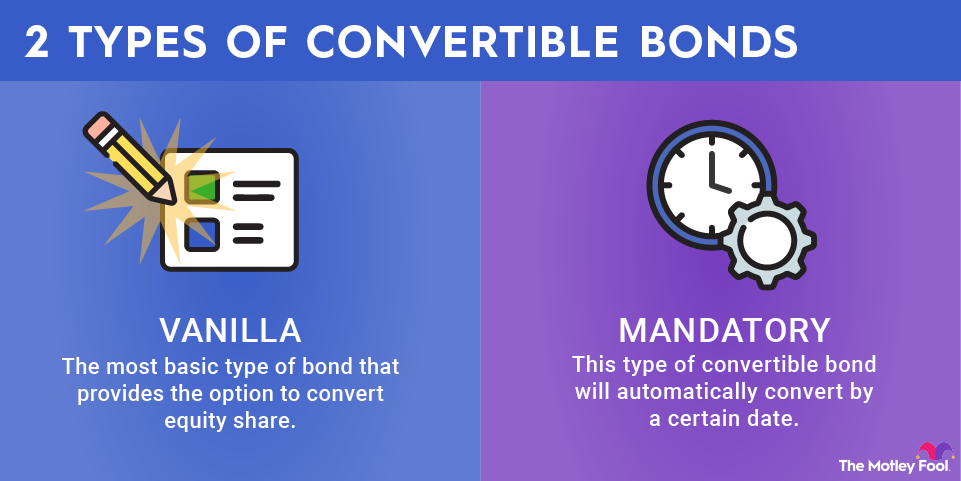
There are a few different types of convertible bonds to review, including the vanilla convertible bond and the mandatory convertible bond.
Owning convertible bonds comes with various advantages and disadvantages. Here are the basic pros and cons:
Say an investor were to purchase a convertible bond with a face value of $1,000 and a coupon rate of 2%. As long as the investor holds the bond, they’ll receive a coupon payment of $20 annually, or $10 semi-annually. The investor, while guaranteed a modest stream of income, is likely to have purchased the bond not for the interest payments but for a potential rise in the issuer’s equity share price.
Imagine that, at the same time, the investor is also able to convert the bond to equity shares at a conversion price of $15. This implies a conversion ratio of 66.67 ($1,000/$15). In other words, if the investor chooses to convert the bond to equity shares, they’d receive 66 shares (plus a fraction) in exchange.
It will only make sense for the investor to convert the bond to stock shares if the market price of the issuer’s equity exceeds the conversion price. If the price is less than the conversion price, converting the bond will result in a loss; above the conversion price, the investor will see unrealized profit. Unless the bond is a mandatory convertible bond, there is no guarantee that the investor will ever convert the bond.
Convertible bonds are unique securities that can play a role in an investor’s diversified portfolio. Convertibles are usually appealing to investors who are willing to accept lower returns in the short run in the hope of striking it big down the line. From a company’s perspective, convertible bond issuances are a way of lowering its cost of debt in a tax-efficient manner.
As with any investment, there is a risk of loss with convertible bonds. Before investing, be sure to understand what you’re signing up for, and realize that losses are possible. If the risks are worth the rewards in your scenario, convertible bonds might be worth a second look.