Few tools are as important for investors making buy, sell, or hold decisions as an earnings report. Often known by the names of the most common forms, the 10-Q or 10-K, earnings reports are at the heart of every investment decision. Read on to learn more about these vital forms.

What is an earnings report?
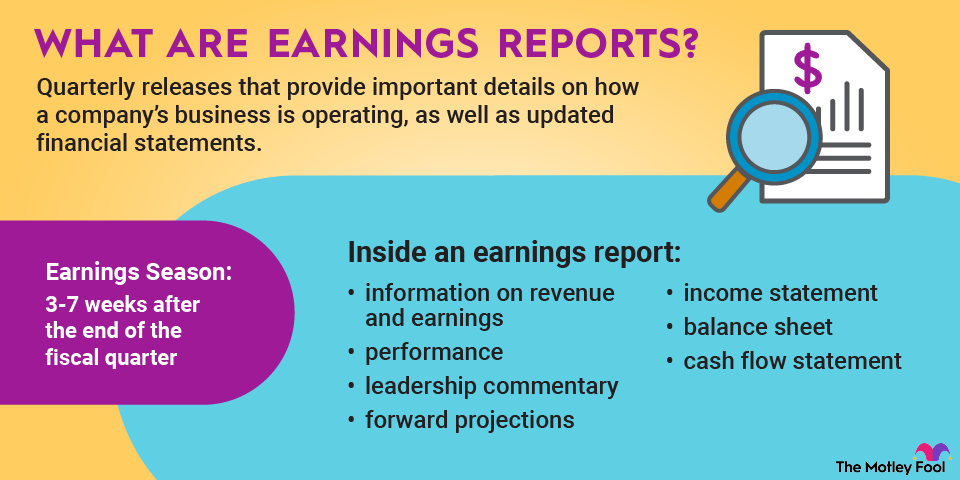
Earnings reports are legal filings that the Securities and Exchange Commission (SEC) requires of public companies every quarter. They're known as 10-Qs (quarterly reports) and 10-Ks (annual reports) within the investing world.
These reports are often quite long, but it's because they contain extremely detailed records of a company's financial dealings for that period (either quarterly or annually). That tends to require a significant paper trail.
These are not optional filings. Indeed, they are required of every publicly traded company in the United States and many foreign companies traded on U.S. exchanges. Foreign companies often file other forms, such as 20-Fs or 6-Ks, but they're just less common.
What information is contained in an earnings report?
Earnings reports are significant filings and, thus, have a lot of information inside. Very little space is wasted, despite the fact that they may run 100 or more pages (often more, even for a quarterly report). There are five main types of information inside:
- Management discussion and recommendations
- Market risk disclosures
- Balance sheet
- Income statement
- Cash flow statement
Often, the balance sheet, income statement, and cash flow statement appear as both generally accepted accounting principles (GAAP) earnings and non-GAAP earnings. GAAP earnings are based on a standardized set of accounting rules that help make earnings reports more consistent across companies.
Non-GAAP earnings reporting is used to show something that is hard to account for in GAAP accounting, like asset write-downs. Non-GAAP figures may include information that the company's management believes does not actually reflect the core business performance.
Metrics to watch in an earnings report
There are many metrics that people like to watch on earnings reports, but here are a few that you should always keep in mind:
- Revenue growth
- Gross margin
- Operating margin
- Net margin
- Diluted earnings per share (EPS)
- EPS growth
- Operating cash flow
- Free cash flow
- Free-cash-flow margin
- Cash & equivalents
- Net cash
- Net debt
Some specific sectors have their own powerful metrics to track, such as funds from operations and occupancy percentage for real estate investment trusts (REITs), customer churn for subscription-based companies, or same-store sales for retail.
Related investing topics
Why earnings reports matter to investors
Investors not only deserve but demand transparency in their investments. If you don't know what your company is doing, why would you even own it? Buying out of hype, which is not the way Foolish investors go about doing things, means you're buying blind. You should always look at the earnings reports when they come out and then compare them to older reports to see how the company is progressing.
Earnings reports can also speak to the state of the industry as a whole. That's especially the case if you have several companies you follow in a sector.
If all the companies are seeing slowing sales or a loss in occupancy, you can possibly write off any drop in earnings as a seasonal or cyclical issue that will eventually right itself, unless the entire industry is contracting. If it's just one company, your Spidey Sense may tingle and tell you that there's danger nearby.
Most importantly, earnings reports are our basis for buying and selling stocks. For long-term investors, solid earnings with long-term potential are ideal.
We don't want to see earnings that are too high or a sudden pivot into something new. Slow and steady is what gets you there. If a company is suddenly seeing massive growth that could be unsustainable in the long run, it could be a signal that it's time to be cautious or even time to sell.