If you're looking to increase your returns on your cryptocurrency investments, you may be interested in yield farming. Yield farming is the process of using decentralized finance (DeFi) protocols to generate additional earnings on your crypto holdings.
This article will cover what yield farming is, how it works, and the benefits and risks of using yield farming to boost your cryptocurrency returns.
Yield farming
When people talk about yield farming, they discuss it in terms of annual percentage yield (APY). This often invites a comparison to the interest rate you might earn on a savings account at a bank. And while bank interest rates are extremely low, yield farming can produce APYs in the triple digits in some cases (although those returns come with considerable risks and are unlikely to last long).
There are several ways to generate yields from your crypto holdings. One way is to stake your tokens on a blockchain. Blockchains that use a proof-of-stake system -- such as Solana (SOL -0.31%), Cardano (ADA -1.43%), and Polkadot (DOT +0.67%) -- reward stakeholders for confirming transactions on the blockchain. Ethereum (ETH -0.16%) is also moving toward a proof-of-stake system with Ethereum 2.0 and will provide rewards for those staking its Ether cryptocurrency.
The proof-of-stake system is an alternative to the energy-intensive proof-of-work system, which rewards cryptocurrency miners.
The second way is to use a lending protocol to become a lender. Borrowers can use lending protocols -- such as Compound (COMP -1.06%) or Aave (AAVE -0.66%) -- to take out loans against their crypto assets. The interest is provided to the individuals depositing capital. So, if you're a depositor, you'll earn interest from borrowers.
The last way we'll discuss is becoming a liquidity provider for a decentralized exchange -- such as Uniswap (UNI +0.42%) or Pancakeswap (CAKE -1.12%). Providing a pair of crypto tokens in equal amounts to a decentralized exchange allows it to perform swaps for investors looking to exchange one cryptocurrency for another. As a liquidity provider, you'll earn a portion of the fees collected by the exchange in return.
How yield farming works with staking
If you believe in the long-term potential of a blockchain project using the proof-of-stake system, you may be interested in buying the native token and staking it to earn additional rewards.
The way cryptocurrency staking works is that you pledge your tokens to a blockchain protocol such as Solana. The protocol will then select one person from those staking to confirm the next block in the blockchain. The more you stake, the more likely you are to get selected. The person who is selected receives a reward for confirming the block.
In practice, the easiest way to start earning staking rewards is by staking through your exchange like Coinbase (COIN -7.06%). The exchange will take care of all the technical details and add any rewards you earn to your balance.
How yield farming works with lending
If you decide to put your crypto assets into a lending protocol, you can earn even higher yields. Several lending protocols have emerged to offer crypto holders the ability to access the value of their cryptocurrency holding without having to liquidate their assets and incur taxes. They do so by offering over-collateralized loans. So, to get a loan for $100 worth of a crypto, a borrower may need to put down $200 worth of collateral.
If you become a lender on one of these protocols, you'll earn the interest paid by borrowers of your asset. The interest rate is determined by supply and demand and can vary from minute to minute. Some protocols will work to stabilize interest rates for lenders seeking more consistent returns.
Interest Rate
Yield farming as a lender will require you to use a DeFi protocol such as Compound or Aave. When you want to lend, you exchange the tokens you want to lend for their equivalent tokens. The exchange rate on those tokens is constantly improving as loans collect interest from borrowers. When you go to exchange your tokens back to your original cryptocurrency, you'll receive more than what you originally exchanged.
Here's a simplified example: If you deposit 100 DAI (DAI +0.01%) worth $100 with Compound, you'll receive $100 worth of cDAI in return. Let's say the exchange rate was 1:1 when you made your deposit. If the interest rate for DAI is 10% and remains there for a year, the exchange rate of DAI to cDAI will be 1.1:1 after one year. When you go to remove your DAI from the protocol, you'll receive 110 DAI back, worth $110.
How yield farming works with liquidity pools
Yet another way to generate extra returns on your crypto assets is by becoming a liquidity provider for a decentralized exchange. When someone goes to Uniswap to exchange their Ether for DAI, for example, Uniswap will take some DAI from the liquidity pool and add the Ether the user is exchanging. That allows Uniswap to offer exchanges for just about any cryptocurrency pair you can imagine without having to hold any crypto itself.
Uniswap pays out the fee it collects from exchanges to liquidity providers. The amount each provider receives is proportionate to their share of the total liquidity pool on the protocol.
For example, let's say you provide $100 of Ether and $100 of DAI ($200 total) to the liquidity pool, which has a total value of $20,000. Your share of the pool is 1%. If the amount of fees collected on exchanges between Ether and DAI for the day are $100, you'll earn $1.
Note that you may see the proportion of your trading pair shift over time, especially with more volatile cryptocurrencies. This can lead to impermanent loss, which is the decrease in value of your holdings compared to if you had simply kept your cryptocurrency out of the liquidity pool.
Why is yield farming popular?
With interest rates on traditional bank savings accounts remaining extremely low, yield farming offers a way for those participating in the decentralized finance ecosystem to generate better returns on their holdings. Furthermore, using yield farming techniques also strengthens many of the systems used in cryptocurrency and DeFi by improving the blockchain, increasing liquidity through lending, and ensuring decentralized exchanges can perform currency swaps efficiently.
Benefits of yield farming
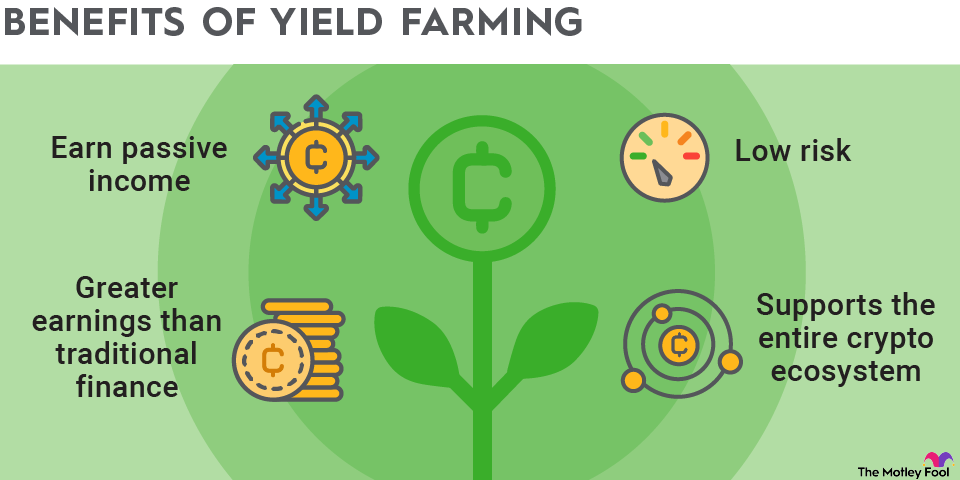
The benefits of yield farming are pretty straightforward. If you're already planning to hold a cryptocurrency long term, you may as well look to increase the return you can get on those holdings. Staking and lending provide a low-risk way to generate extra returns, earned in the same cryptocurrency you already hold. Participating in a liquidity pool can produce even greater earnings, but it carries more risk.
As mentioned above, participating in yield farming activities also supports the entire crypto ecosystem.
Related investing topics
Yield farming risks
There are a few risks to be aware of when yield farming.
Impermanent loss as a liquidity provider is a key concept to understand. If the price of one part of the pair moves significantly relative to the other part, you will face impermanent loss. This occurs when the proportion of assets in a liquidity pool is forced to shift by market demand, and you receive less value out of the pool than you would have if you hadn't deposited assets in the first place.
Another risk to be aware of is the potential for lending interest rates to change. Since interest rates are determined based on supply and demand, a sudden spike in supply for an asset can result in a big drop in the interest you receive as a lender.
And, as always, there's a risk to holding cryptocurrencies since their price is generally more volatile than other asset classes.
Is yield farming safe?
While yield farming may be seen as an alternative to holding cash on deposit in a savings account, it's far less safe. Here are a few reasons why:
- There's no insurance on your assets. Banks in the United States include federal deposit insurance up to $250,000 per account.
- The smart contracts used in yield farming could be susceptible to bugs or to getting hacked by bad actors.
- If you use a less reputable protocol, you could find yourself a victim of fraud or a scam without any recourse due to minimal regulation of the industry.
The safety of yield farming ranges, but if you stick with reputable providers and understand what you're getting into, you should be able to manage the risks accordingly.
Is yield farming for you?
If you're a long-term buy-and-hold crypto investor, you may want to look into yield farming. You can keep your risks low with simple staking, or you can enter the world of DeFi by participating in lending or liquidity pools. There are a lot of options to explore, and it's possible for you to benefit greatly by boosting the returns on your crypto holdings.
About the Author