Yield farming as a lender will require you to use a DeFi protocol such as Compound or Aave. When you want to lend, you exchange the tokens you want to lend for their equivalent tokens. The exchange rate on those tokens is constantly improving as loans collect interest from borrowers. When you go to exchange your tokens back to your original cryptocurrency, you'll receive more than what you originally exchanged.
Here's a simplified example: If you deposit 100 DAI (DAI +0.02%) worth $100 with Compound, you'll receive $100 worth of cDAI in return. Let's say the exchange rate was 1:1 when you made your deposit. If the interest rate for DAI is 10% and remains there for a year, the exchange rate of DAI to cDAI will be 1.1:1 after one year. When you go to remove your DAI from the protocol, you'll receive 110 DAI back, worth $110.
How yield farming works with liquidity pools
Yet another way to generate extra returns on your crypto assets is by becoming a liquidity provider for a decentralized exchange. When someone goes to Uniswap to exchange their Ether for DAI, for example, Uniswap will take some DAI from the liquidity pool and add the Ether the user is exchanging. That allows Uniswap to offer exchanges for just about any cryptocurrency pair you can imagine without having to hold any crypto itself.
Uniswap pays out the fee it collects from exchanges to liquidity providers. The amount each provider receives is proportionate to their share of the total liquidity pool on the protocol.
For example, let's say you provide $100 of Ether and $100 of DAI ($200 total) to the liquidity pool, which has a total value of $20,000. Your share of the pool is 1%. If the amount of fees collected on exchanges between Ether and DAI for the day are $100, you'll earn $1.
Note that you may see the proportion of your trading pair shift over time, especially with more volatile cryptocurrencies. This can lead to impermanent loss, which is the decrease in value of your holdings compared to if you had simply kept your cryptocurrency out of the liquidity pool.
Why is yield farming popular?
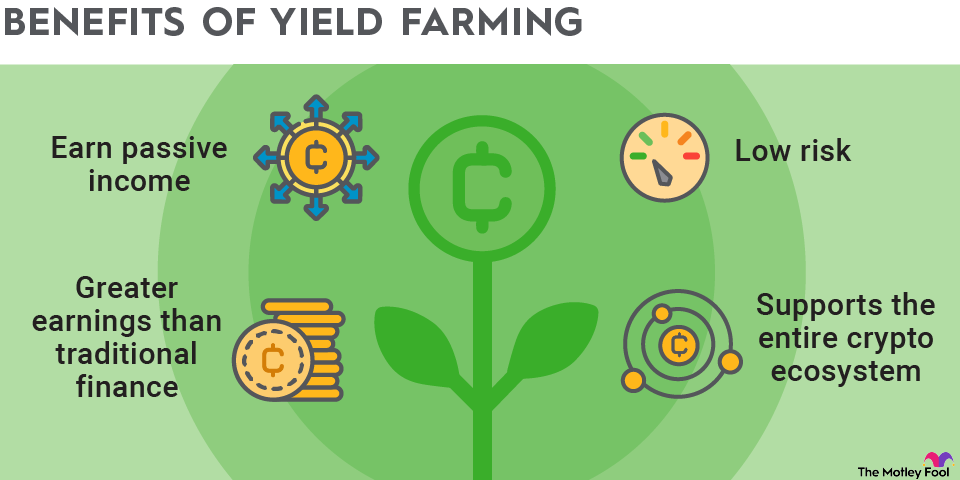
With interest rates on traditional bank savings accounts remaining extremely low, yield farming offers a way for those participating in the decentralized finance ecosystem to generate better returns on their holdings. Furthermore, using yield farming techniques also strengthens many of the systems used in cryptocurrency and DeFi by improving the blockchain, increasing liquidity through lending, and ensuring decentralized exchanges can perform currency swaps efficiently.
Benefits of yield farming
The benefits of yield farming are pretty straightforward. If you're already planning to hold a cryptocurrency long term, you may as well look to increase the return you can get on those holdings. Staking and lending provide a low-risk way to generate extra returns, earned in the same cryptocurrency you already hold. Participating in a liquidity pool can produce even greater earnings, but it carries more risk.
As mentioned above, participating in yield farming activities also supports the entire crypto ecosystem.
Related investing topics