About the Author
Robin Hartill, CFP has positions in Vanguard Real Estate ETF. The Motley Fool has positions in and recommends S&P Global, Vanguard Growth ETF, and Vanguard Real Estate ETF. The Motley Fool has a disclosure policy.
Invest better with The Motley Fool. Get stock recommendations, portfolio guidance, and more from The Motley Fool's premium services.

The best index funds diversify your investments and have low fees. Unlike investing in individual stocks or bonds, index funds spread your risk across hundreds of securities, meaning your returns aren't tied to the fate of any single company.
Our picks for the eight best cost-effective index funds for this year can help you accomplish a variety of investment goals. Many of the funds listed below have had solid gains in the first seven months of 2026, despite substantial volatility driven by uncertainties about AI and rising oil prices sparked by the war in Iran.
However, index investing is about building wealth for the long haul, not short-term gains or losses.
All the companies owned by the ETF have increased their dividend payments annually for at least 25 consecutive years.
Dividend-paying stocks tend to be less volatile compared to the overall stock market. Uncertainty often prompts a resurgence in safer, dividend-paying stocks -- which is why the SDY ETF has slightly outperformed the S&P 500 so far in 2026, particularly during the summer months, as investors grew anxious about the AI stock boom.
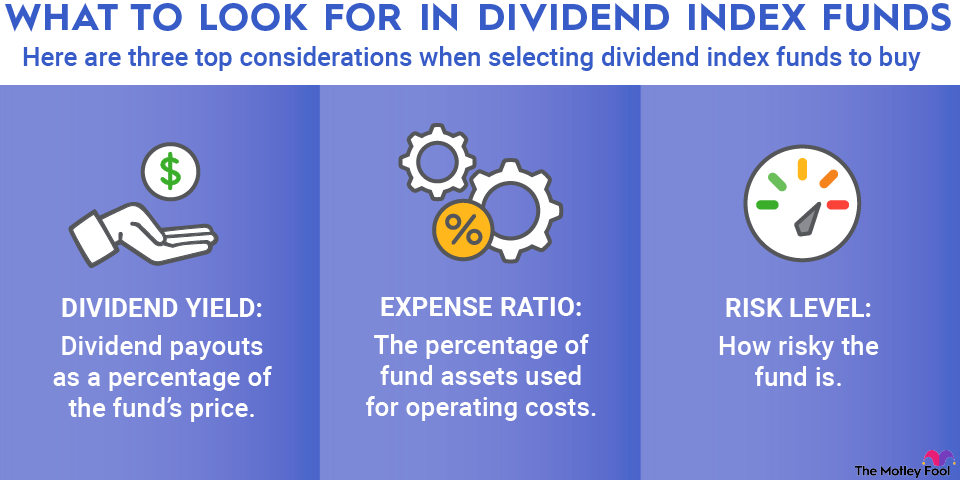
The fund's 30-day SEC yield in August 2026 was 2.35% -- significantly higher than the S&P 500's 1%. The expense ratio is also somewhat higher at 0.35%.
Several real estate investment trusts (REITs) are represented in this fund. REITs typically pay high dividends because they're required to disburse at least 90% of their taxable income. The ETF is underweight for tech stocks, which generally don't pay generous dividends.
The ETF offers investors a way to capture the growth of several booming trends. Robotics offers huge cost savings to companies; the industry is forecast to have a compound annual growth rate of almost 20% through 2031. Interest in artificial intelligence (AI) stocks has surged since late 2022, when ChatGPT launched.
However, the ETF has still underperformed the stock market since then, posting a three-year average annualized return of less than 15% through the end of 2025, compared to about 21% for the S&P 500 over the same period. The fund was up over 15% in the first seven months of 2026, though, reflecting investors' overall bullishness on automation and AI despite some pullback in June and July.
An index fund works by tracking the performance of a market index like the S&P 500 or the Russell 2000 instead of having investment teams selecting investments. Unlike actively managed funds, index funds are passively managed; rather than trying to outperform the market, they aim to replicate the benchmark index's performance.
If you invest in an index fund with a low tracking error (meaning the fund doesn't deviate much from its benchmark), your returns will be very similar to the performance of the underlying index, minus fees. For example, say you invested in an S&P 500 index fund in a year when the S&P 500 returned 10%, and the fund has a 0.1% expense ratio. You'd expect a return of approximately 9.9% for the year.
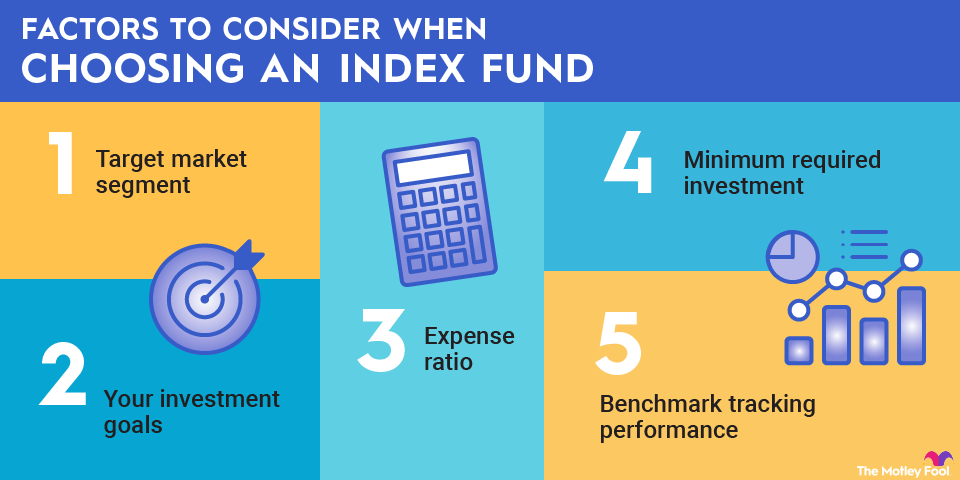
Consider the market segment you're targeting, fees, and your investment goals (such as growth or reliable dividend income) when choosing an index fund.
The benefits of investing in index fees include the low costs and automatic diversification, but one downside is that you can't beat the market.
Benefits of investing in index funds:
Risks of investing in index funds:
Investing in S&P 500 index funds is one of the closest things to a nearly guaranteed way to build wealth over time. The Fidelity ZERO Large Cap Index Fund (FNIL.X +0.00%) tracks an index of more than 500 U.S. large-cap stocks and performs very similarly to an S&P 500 index fund.
However, because this fund is not an official S&P 500 index fund, it avoids paying expensive licensing fees to S&P Global (SPGI -0.25%), the index's parent company. The fund tracks the Fidelity U.S. Large Cap Index as its benchmark.
The "ZERO" in the fund's name denotes that its expense ratio is 0%. There's also no minimum investment, making the fund a good choice for beginning investors.
During the first eight months of 2026, the fund had risen almost 12%, similar to the S&P 500's gain during the same period.

Index fund fees are expressed as the expense ratio. If you invest $10,000 in an index fund with a 0.1% expense ratio, $10 of your investment goes toward fees, and the remaining $9,990 is invested. Expense ratio fees cover costs of management, administration, and marketing.
Because they're passively managed and have low overhead, most index funds have extremely low fees. The average index fund expense ratio is 0.06%, according to Morningstar research. By comparison, the average actively managed fund fee is 10 times higher at 0.6%.
There are two ways to make money from index funds: Sell the investment for a gain or earn dividends. A growth-focused index fund, such as the Vanguard Growth ETF, has the potential for significant gains.
However, higher rewards come with greater risk, and dividend payments will likely be minimal. If you want investment income, a dividend fund like the SPDR S&P Dividend ETF is a good choice. There's less potential for big gains, but you can earn reliable dividend income.
Although there's no single best index fund to invest in, a couple of good options are an S&P 500 index fund, which tracks about 80% of the U.S. stock market, or a total stock market fund, which tracks the entire U.S. stock market. These tend to be good choices because they're well diversified and allow you to lock in the historical growth of the domestic stock market.
All investments carry some risk, but S&P 500 index funds have historically been safe long-term investments, as the S&P 500 has delivered positive returns over long periods. The S&P 500's average annual returns are about 10%.
If you want to invest in an official S&P 500 index fund, the Schwab S&P 500 Index Fund (SWPP.X +0.00%) is about the cheapest you'll find. Its expense ratio is 0.02%, meaning you'll pay just $0.20 per $1,000 invested annually.
Because the investment fee is so low, your returns are virtually identical to the S&P 500's performance. There's no minimum investment amount, so you can start investing with as little as $1.
The fund had year-to-date gains of about 11% through July 2026, almost identical to that of the S&P 500.
If you want to assume more investment risk in the pursuit of higher rewards, the Vanguard Growth ETF (VUG +1.70%) is a solid choice. The fund tracks the CRSP US Large Cap Growth Index, which performs similarly to the S&P 500 Growth Index. The ETF invests in about 150 U.S. large-cap growth stocks. The fund is most heavily concentrated in tech stocks, which make up about two-thirds of its holdings.
The ETF has a minuscule 0.03% expense ratio.
Through the end of 2025, the fund's average annual return over five years (before taxes) was almost 15%, similar to the S&P 500's return during the same period. The VUG's year-to-date gains have significantly lagged the S&P 500's in 2026, reflecting marketwide AI jitters.
The SPDR S&P Dividend ETF (SDY -0.62%) is a top-performing index fund for income-oriented investors. The dividend-weighted fund's benchmark is the S&P High Yield Dividend Aristocrats® Index, which tracks about 150 stocks with the highest dividend yields in the S&P Composite 1500 Index. (Dividend Aristocrats® is a registered trademark of Standard & Poor's Financial Services LLC.)
If you want to invest across the real estate market, the Vanguard Real Estate ETF (VNQ -0.97%) is a solid, low-cost option. With an expense ratio of 0.13%, it's also the largest real estate index fund by far, with total net assets of just above $73 billion.
Although its benchmark index includes a few real estate management and development companies, it is mostly composed of equity REITs that own and operate income-producing real estate.
Because it invests primarily in REITs, the ETF is also attractive to dividend investors. The fund's adjusted effective yield through July 2026 was about 2.6%. The Vanguard ETF may also appeal to investors concerned about inflation since real estate is traditionally seen as a hedge against rising prices elsewhere.
The Vanguard Russell 2000 ETF (VTWO +0.31%), which tracks the Russell 2000, is a good place to start for investors looking to capitalize on the potential upside of investing in small-cap companies. The fund invests in about 2,000 small- and mid-cap companies, with assets under management of about $17.5 billion.
At 0.06%, its expense ratio is relatively low, especially for a fund offering exposure to the companies with the most growth potential.
Through July 2026, the fund outperformed the S&P 500 index, with a year-to-date return of almost 19%, reflecting the recent outperformance of small-cap stocks.
Thematic investors wanting to capitalize on a long-term secular trend should check out the ROBO Global Robotics and Automation Index ETF (ROBO +1.24%). The index fund's benchmark is the Robo Global Robotics and Automation Index, which tracks 79 companies in robotics, automation, and artificial intelligence (AI). It has almost $2 billion in total net assets and a 0.95% expense ratio, higher than any fund on this list.
If you want to diversify your portfolio through exposure to high-growth emerging markets but don't want your risk concentrated in a single economy or region, the Schwab Emerging Markets Equity ETF (SCHE +0.46%) may be a good fit. It tracks the FTSE Emerging Index, a collection of large- and mid-cap stocks in more than 20 developing countries.
The fund has more than 2,200 holdings, with the largest concentrations in China, India, Taiwan, Brazil, and South Africa. Its expense ratio is only 0.06%.
The stocks of companies in emerging markets have historically underperformed compared to U.S. stocks. In the past five years as of July 2026, the Schwab emerging market fund had annualized returns of about 6%. Meanwhile, the S&P 500 racked up annualized returns of about 17% during the same five-year period.
Still, given that about 85% of the world's population lives in developing countries, investors with a long-term focus and who are comfortable with volatility may want to consider this fund.