While the S&P 500 (^GSPC +0.30%) and Nasdaq Composite (^IXIC +0.17%) have each posted double-digit gains so far this year, cryptocurrency seems to have lost its momentum. As of this writing (Dec. 2), prices across Bitcoin, Ethereum, and XRP have underperformed the broader stock market in 2025.
Adding to the list of crypto laggards is Dogecoin (DOGE 0.14%), whose price has plummeted by 54% this year. At just $0.15 per token, Dogecoin is now trading at its lowest price in a year.
But as 2026 draws close, could Dogecoin become a darling of a Santa Claus rally and ride the wave to a $1 price point?
Let's dig into how Dogecoin works and what makes it different from other popular cryptocurrencies. From there, I'll explore what it would take for the meme coin to reach $1 and whether such a price target is realistic.

Image source: Getty Images.
What is Dogecoin and how does it work?
Dogecoin was created by a pair of software engineers from IBM and Adobe named Billy Markus and Jackson Palmer. The coin's origins are rooted in satire -- poking fun at the rise of digital assets.
Dogecoin's fun and charming mascot -- a Shiba Inu dog -- combined with enthusiasm for crypto-based peer-to-peer payments helped fuel some interest in the altcoin.
Nevertheless, Dogecoin remains largely niche. Beyond microtransactions, Dogecoin lacks deeper utility in the world of decentralized finance (DeFi) when compared to more established cryptocurrencies or blockchain networks.

CRYPTO: DOGE
Key Data Points
Moreover, 5 billion new coins enter circulation each year. This structure makes Dogecoin fundamentally different from Bitcoin, which has a fixed supply of 21 million coins.
Although a growing supply base theoretically makes Dogecoin more accessible to investors, it also makes it harder for the coin to sustain price appreciation. Unlike Bitcoin, Dogecoin is the opposite of a store of value -- lacking a true value proposition and serving as more of a speculative opportunity.
What is Dogecoin's all-time high price?
Back in 2021, Dogecoin reached an all-time high of roughly $0.70. Since then, the token has lost about 80% of its value.
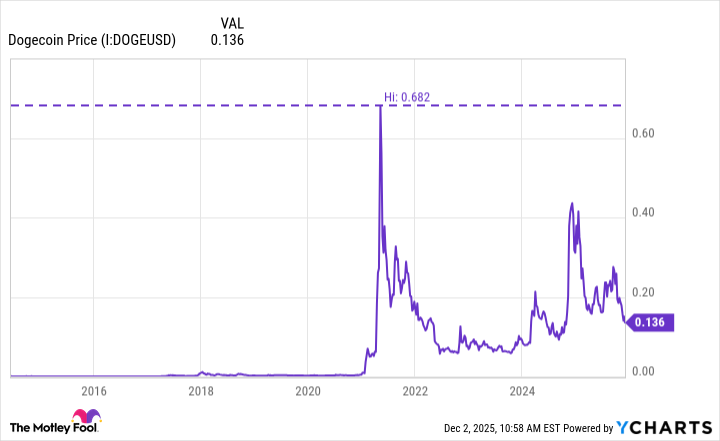
Dogecoin Price data by YCharts
Dogecoin's rise from a few years ago can be boiled down to a few factors. A number of celebrities, including Elon Musk and Mark Cuban, frequently took to social media and spoke highly of Dogecoin.
Although these endorsements shouldn't have carried much weight, bored retail investors stuck at home were intrigued by Dogecoin's virality and began dumping their COVID-19 stimulus checks into the crypto. This buying frenzy overlapped with the rise of meme stock trading in GameStop and AMC.
In essence, there was an unprecedented amount of liquidity flowing through the capital markets that gave rise to inflated prices in alternative asset classes such as cryptocurrency.
Could Dogecoin reach $1 before 2026?
Although Dogecoin has never reached its prior highs from 2021, investors should note that the coin experienced a brief spike about a year ago.
The main catalyst behind this surge was the creation of the Department of Government Efficiency (DOGE) -- led by none other than Elon Musk. Some investors bought into a narrative that Musk's inclusion in the Trump administration and his deliberate usage of the "DOGE" moniker gave Dogecoin some extra legitimacy. In reality, the creation of the DOGE did nothing to explicitly enhance Dogecoin's developer network or utility.
I bring all of these details up to drive home one main theme: Dogecoin's price does not follow business fundamentals or even technical analysis trends. Rather, the token is highly sensitive to hype-driven narratives that are drummed up on social media.
Looking at Dogecoin through the lens of its recent price and convincing yourself it could reach $1 isn't how valuation really works. If Dogecoin reached a price of $1, its market cap would be north of $120 billion -- making it more valuable than cryptocurrency stocks like Robinhood Markets or Coinbase.
In my eyes, this is unrealistic given how limited Dogecoin's usage is compared to these diversified trading platforms. Smart investors know that buying into unit bias is ultimately a losing proposition.
Given the token has never surpassed prior highs and is meaningfully lower since its last rally about a year ago, in combination with the structure of Dogecoin's growing supply and its lack of utility, I feel confident in saying it will not reach $1 by the end of December.