Ever since its 2018 initial public offering, Spotify Technologies (SPOT 1.08%) has produced strong returns for its shareholders, well above those of the S&P 500. It has recorded an average compound annual growth rate of 19.3% through this period.
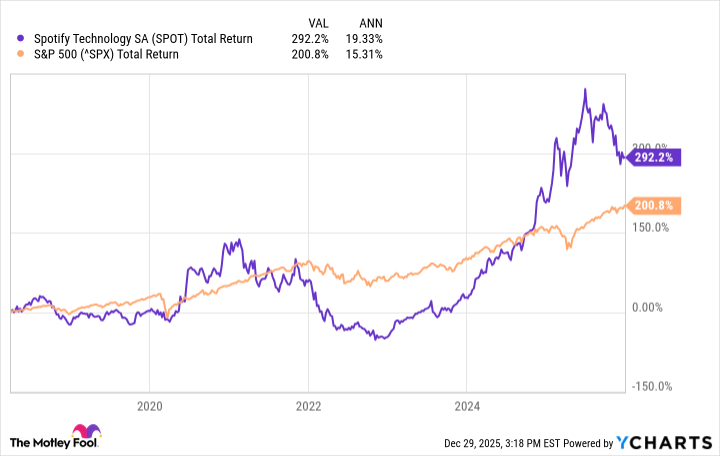
SPOT Total Return Level data by YCharts.
However, for an investment in the streaming powerhouse to turn average investors into millionaires will take similarly impressive stock market performances across the next couple of decades. Can Spotify pull it off?
What Spotify has going for it
Spotify is the leader in the music streaming industry. This is impressive, considering it competes against tech giants such as Amazon, Alphabet, and Apple, all of which can afford to operate their music streaming businesses at a loss due to their large and profitable operations elsewhere. Still, Spotify's strategy has proven highly successful. It has a vast library of artists from record labels with which it has signed deals, so it benefits from strong network effects. The larger its music library, the more attractive its service is to consumers, and the more listeners its platform has, the more appealing it will be to musicians.

Image source: Getty Images.
Spotify has continued to post strong revenue growth, thanks to an increasing number of users, a rising number of paid subscribers, and growing ad revenue, which tends to improve as engagement does. All of these are still potential growth avenues. For instance, its premium subscribers are still less than 40% of its total users -- but those paying listeners account for close to 90% of its revenues. Although it is nearing its goal of 1 million monthly active users, it's not there yet.

NYSE: SPOT
Key Data Points
Further, Spotify's podcast strategy could pay off in the long run. Although it has spent a small fortune acquiring exclusive rights to famous podcasters' shows, the company is betting that this will attract a larger audience, leading to substantial monetization (through engagement and ads) over the long run. Lastly, Spotify is embracing new technologies such as artificial intelligence (AI), and has implemented AI features across its business, which have helped boost engagement.
Spotify could remain the dominant player in music (and audio) streaming for a long time and deliver excellent returns along the way.
Make sure to diversify
Someone starting with an initial investment of $30,000 and a 30-year horizon would need a compound annual growth rate of 12.4% to turn that into $1 million. Can Spotify maintain that pace over the next three decades? It would be a tough task for any company. It assumes near-perfect execution for Spotify in a market for music streaming that, although fast growing, is still relatively small. Moreover, from its current market cap of around $119 billion, such gains would turn it into a $3.9 trillion company -- around the same size as Alphabet and Apple. It's hard to imagine the global music industry supporting that kind of valuation for a streamer, even if Spotify came to be the dominant way music and podcasts were delivered. And the reality is that competition from Apple, Amazon, Alphabet, and others is likely to persist, which will weigh on the stock.
Additionally, although Spotify has been profitable more often than not over the past two years, it still occasionally turns in a quarterly net loss, which is far from ideal.
All of these factors could somewhat limit Spotify's upside. But the good news is that near-perfect execution from one company isn't necessary for investors. Turning relatively small investments into a $1 million nest egg is best attempted with a well-diversified portfolio, and even accounting for potential threats, Spotify can contribute to that, as it could generate solid returns over the long run.