Silver delivered a whopping 144% return last year, and its momentum flowed into 2026, culminating in a record high of over $120 per ounce on Jan. 30. Some investors treat silver like gold, as a store of value, which they buy during times of heightened political and economic uncertainty. However, silver also has vast industrial uses that soak up a significant amount of supply each year.
Many investors choose to own the iShares Silver Trust (SLV +3.36%) as an alternative to physical metal. It's an exchange-traded fund (ETF) that directly tracks the price of silver and can be bought and sold instantly through any investment platform with just a few clicks.
Unfortunately, the ETF plunged by as much as 38% over the past week, in line with the sharp decline in the price of silver, as the blistering run over the last 12 months came to an abrupt halt. History says this could happen next.
Image source: Getty Images.
The supply of silver is artificially low right now
Silver isn't quite as popular as gold as a safe-haven asset, mainly because it's far more abundant, with miners extracting around eight times more of it from the ground each year. However, gold isn't widely used in industrial settings because of its scarcity and high price per ounce, whereas almost half of silver's annual supply is used up in areas like electronics manufacturing.
China is the world's second-largest exporter of silver behind Hong Kong. In December, it announced a fresh set of restrictions to limit how much of the metal producers could ship out of the country, which sent the price per ounce soaring. China is one of the world's top electronics manufacturers, so it's trying to protect its domestic supply chains, but the new restrictions also give the country leverage in trade negotiations with rivals like Europe and the U.S.
With all of that said, silver's 2025 rally kicked off long before December. Investors were piling into precious metals to hedge against a surge in government spending, which stoked fears of a significant increase in money supply. During fiscal 2025 (ended Sept. 30), the U.S. government ran a budget deficit of $1.8 trillion, taking the national debt to a record high of $38.5 trillion.
Even though metals don't grow organically by producing revenue or earnings, they do rise in value as paper currencies depreciate. An old mechanism called the gold standard used to prevent the U.S. government from printing additional currency unless it had an equal amount of physical gold on hand to match.
Since abandoning the gold standard in 1971, money supply has unsurprisingly exploded, reducing the purchasing power of the U.S. dollar by around 90%. Therefore, gold and silver has rocketed in value in dollar terms.
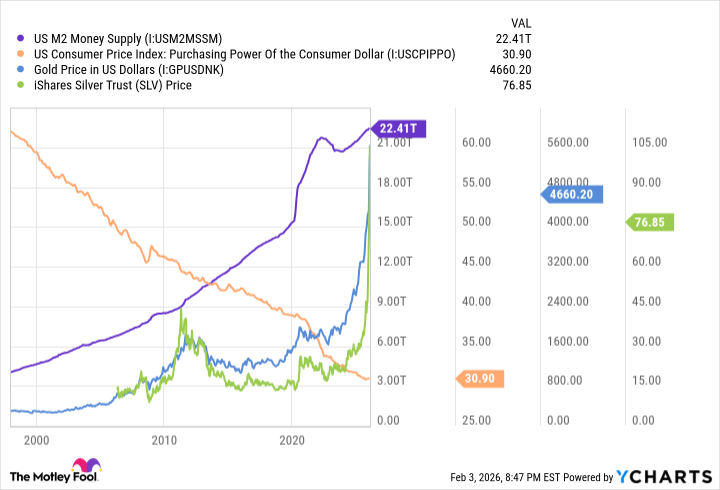
US M2 Money Supply data by YCharts.
History points to a challenging period ahead for silver
The U.S. government is on track for another trillion-dollar deficit in 2026, so the favorable conditions that sent precious metals soaring last year will probably remain in place. However, investors need to be mindful that an industrial metal like silver is vulnerable to supply/demand shifts, especially those triggered by sudden changes in policy (as was the case last December).
Moreover, returns of 144% in a single year certainly aren't normal. In fact, silver has produced a compound annual return of just 6.3% over the last 50 years, so it has woefully underperformed the S&P 500 stock market index, which climbed by 11.8% annually over the same period.

NYSEMKT: SLV
Key Data Points
Plus, history suggests silver's recent 38% plunge might be the start of an even deeper rout. Its 2025 rally was much stronger than anything we've seen in the past, but the metal also staged ferociously sharp gains in 1980 and in 2011. Following both occasions, it proceeded to lose between 70% and 90% of its peak value.
On that note, had you bought silver near its previous peak in 2011, you would have been in the red for 14 years until it eventually set a new high in 2025. Therefore, investors who buy it today need to adopt a very long-term view and mentally prepare themselves for volatility.
The iShares Silver ETF is a good alternative to buying physical silver because it doesn't require costly storage or insurance and can be sold quickly, if necessary. It does have an expense ratio of 0.5%, which is the proportion of the fund deducted each year to cover management costs, so a $10,000 investment would incur an annual fee of around $50. However, that's almost certainly cheaper than the costs associated with holding physical metal.