With over $85 billion in net assets and a 3.3% yield, the Schwab U.S. Dividend Equity ETF (SCHD 0.50%) is one of the most popular high-yield dividend exchange-traded funds (ETFs). It's up 10.8% year to date, compared to a 5% decline in the S&P 500 (^GSPC +1.18%).
The ETF's exposure to the scorching hot energy sector is contributing to its outperformance. But energy stocks have run up so much that they now make up 23.9% of the ETF.
Here's why that concentration can be a red flag for risk-averse investors who prefer more diversification, and whether the ETF is still a good buy now.

Image source: Getty Images.
This ETF benefits from higher oil prices
The ETF has 101 holdings, 12 of which are energy stocks.
|
Company |
Weighting (as of 3/20/2026) |
|---|---|
|
ConocoPhillips (COP 1.66%) |
5% |
|
Chevron (CVX 1.51%) |
4.8% |
|
EOG Resources (EOG 0.51%) |
2.8% |
|
Valero Energy (VLO +2.68%) |
2.8% |
|
SLB (SLB 1.32%) |
2.7% |
|
ONEOK (OKE 0.55%) |
2.1% |
|
Halliburton (HAL 0.35%) |
1.1% |
|
Coterra Energy (CTRA +0.00%) |
1% |
|
Ovintiv (OVV +0.11%) |
0.5% |
|
APA (APA 0.15%) |
0.5% |
|
HF Sinclair (DINO +3.69%) |
0.4% |
|
Murphy Oil (MUR 2.08%) |
0.2% |
Data source: Charles Schwab (SCHW 0.20%).
The largest holding in the ETF is exploration and production (E&P) company ConocoPhillips, and the third-largest is Chevron. The fund, uniquely, doesn't hold ExxonMobil (XOM 0.29%), even though it's the most valuable U.S. energy company by market cap.
E&Ps like ConocoPhillips, EOG Resources, Coterra Energy, Ovintiv, APA, and Murphy Oil -- as well as oilfield services companies like SLB and Halliburton -- are very sensitive to changes in oil and gas prices. They have outsized upside potential when prices rise, which increases E&Ps' profit margins and often coincides with greater drilling and completion demand for oilfield services players. But there's also downside risk when oil and gas prices fall.
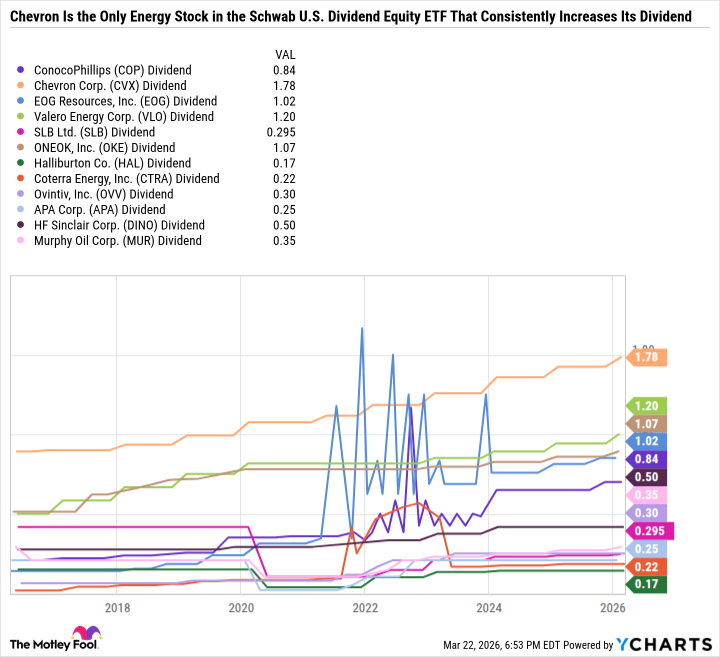
COP Dividend data by YCharts.
Aside from Chevron, which has increased its dividend for 39 consecutive years, none of the other energy stocks in this list have reliable streaks of boosting their payouts -- either due to inconsistent dividend raises, dividend cuts, or fluctuating variable dividends.

NYSEMKT: SCHD
Key Data Points
Choosing the high-yield ETF that's best for you
The Schwab U.S. Dividend Equity ETF would be less vulnerable to swings in oil prices if it were more concentrated in majors like Chevron and ExxonMobil or midstream pipeline and transportation companies. Many midstream companies have predictable cash flows due to contract structures that guarantee minimum volumes and fees regardless of commodity prices, which reduces market risk.
Still, investors don't necessarily need to be concerned that so much of the Schwab U.S. Dividend Equity ETF is energy stocks. Importantly, no single stock accounts for more than 5% of the fund. 34.7% of the ETF is invested in value-heavy sectors like consumer staples and healthcare.
Investors who want an ETF yielding over 3% with less exposure to the energy sector may want to take a closer look at the iShares Select Dividend ETF (DVY 0.16%), which has a less than 10% weighting in energy stocks and includes a lot more utilities and financial stocks.