Corning (GLW +3.27%) was founded in 1851, and it quickly became one of America's leading innovators in the glassmaking industry. In fact, by 1880, the company was working with Thomas Edison to commercialize the lightbulb.
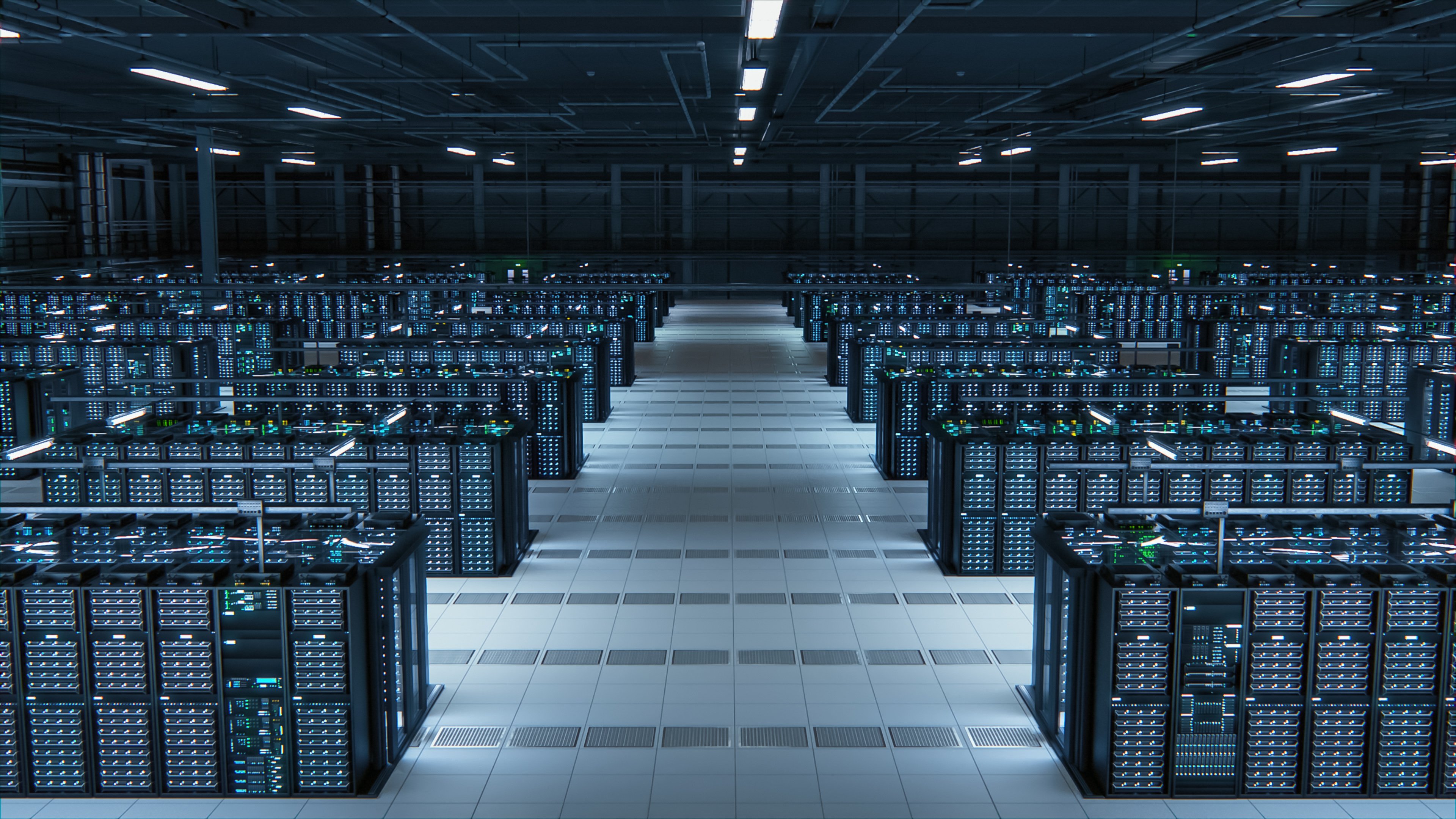
The modern Corning is best known as the glass supplier for Apple's iPhone, but the company is in the spotlight for a different reason right now. It developed a range of fiber-optic cables for data centers, which transmit information at a much faster rate than traditional copper cables, and demand is surging from the artificial intelligence (AI) industry, where transfer speeds are sacred.
Corning's stock price has exploded higher by more than 321% over the last 12 months, making it one of the best performers in the entire semiconductor industry. It has crushed shares of Nvidia, Broadcom, and Advanced Micro Devices, which are up 70%, 107%, and 164%, respectively, over the same period. Can Corning keep up this incredible winning streak?
Image source: Getty Images.
Corning's new fiber products are a game-changer
The AI industry's most advanced models now use a concept called reasoning, which involves "thinking" in the background to weed out errors before responding to prompts. They process far more data per query than older models, so transfer speeds are more important than ever -- if a model can't produce timely responses, users will simply abandon it.
Optical fiber is proven to transmit information faster and over longer distances than copper, with minimal data loss. There is an important cost advantage to this, too, because most AI developers pay for cloud computing capacity by the minute, so any increase in processing speed can yield substantial savings over the long term.
Corning recently launched a new product called Multicore Fiber (MCF), which packs four cores into a typical 125-micron strand of fiber. That is four times the density of a traditional single-core fiber solution, which means it can accomplish the same job with 75% less cable.
That is a huge development. For example, Nvidia's latest graphics processing units (GPUs) are often configured using the company's NV-Link racks, with 2 miles of copper cable connecting 72 GPUs, 36 CPUs, and several networking components. Data center operators are quickly switching to fiber for its clear advantages, and highly efficient products like Corning's MCF could accelerate the transition.
Corning's AI business is experiencing explosive growth
Corning delivered $16.4 billion in core revenue in 2025, up 13% year over year. Its optical communications business accounted for $6.2 billion of that revenue, and it grew at a much faster 35% pace.
The enterprise segment of the optical communications segment specifically contributed $3 billion in revenue, up 61%. But if we zoom in even further, the revenue attributed to hyperscale customers more than doubled, suggesting substantial demand for optical fiber from some of the world's largest AI data center operators.
Corning was also extremely profitable in 2025, with its adjusted non-GAAP (generally accepted accounting principles) net income growing by 29% year over year to $2.2 billion. The optical communications segment was responsible for $1 billion of that profit on its own. The surging demand for data center fiber gave Corning significant pricing power, which boosted its margins.
Looking forward, Corning plans to add $11 billion in annualized revenue by 2028, with $6.5 billion potentially coming before the end of 2026. That implies the company's core revenue growth could accelerate this year, which bodes well for its stock.
Corning stock isn't cheap, but it might be a long-term buy
Based on Corning's 2025 adjusted earnings of $2.52 per share and its stock price of $171.24 as of market close on Friday, April 10, its price-to-earnings (P/E) ratio is 67.9. That is more than twice the P/E ratio of the Nasdaq-100 technology index, which is currently 30.8.
Corning is also more expensive than Nvidia, AMD, and Broadcom, which trade at P/E ratios of 39.5, 58.7, and 51.1, respectively. In other words, it doesn't look like a good value after its blistering 300% gain over the last 12 months.
GLW Corning
NYSE · As of 4:00 PM ET 10/26/26

But in January, Facebook parent Meta Platforms signed a deal to purchase $6 billion worth of fiber-optic cables from Corning over the next few years, which it will use in its AI data centers. Corning says it has several more deals like this in the pipeline, which could drive significant earnings growth in 2026 (and beyond). Therefore, its stock might actually be cheaper than it appears at face value.
Further, Corning CEO Wendell Weeks believes the market for data center fiber could triple over the long term, driven by AI-related demand, which will bolster the company's deal pipeline. Simply put, investors who are willing to hold Corning stock for a long-term period of three to five years could still earn a strong return, despite its elevated valuation today.