Long before the certainty of a SpaceX initial public offering (IPO) existed, Rocket Lab (RKLB +16.23%) had glowed brightly on my radar. In fact, it had recently made its way onto my buy list, and I had been waiting for the right time to click the buy button on the space stock.
But with SpaceX proceeding with plans for an IPO, investors gained better insight into the company's financials than the mere speculation that had circulated about its financial health. One metric leaped out at me, and Rocket Lab stock is no longer an imminent buy for me.

Image source: Getty Images.
I was on board to head to the final frontier with Rocket Lab
The allure of Rocket Lab stock was clear. Providing launch services with Electron, the second most frequently launched U.S. rocket annually, Rocket Lab is an early leader in the growing space economy. And its leadership position will likely continue as operations commence with Neutron, a rocket capable of delivering larger payloads to low Earth orbit than Electron.

NASDAQ: RKLB
Key Data Points
Regarding its financials, Rocket Lab's revenue growth is impressive.
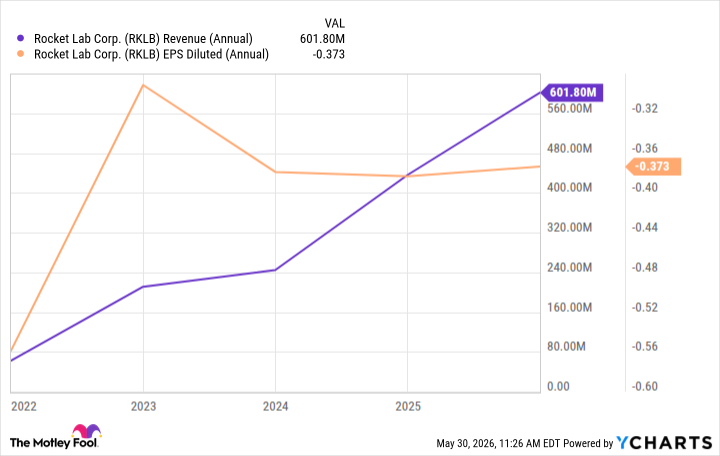
RKLB Revenue (Annual) data by YCharts
Although the company isn't profitable, I felt confident that profit would soon come, and I planned to start with a modest position to account for the risk that it might not generate profit in the future.
SpaceX is operating an out-of-this-world business
Before SpaceX submitted Form S-1, investors knew little about the business. While it was clear that the company held a dominant position -- research from The Motley Fool found that SpaceX conducted 161 launches in 2025 -- it's the company's cash flow that struck me as exceptionally impressive.
Unlike Rocket Lab, SpaceX has steadily grown its operating cash flow, from $4.5 billion in 2023 to $5.8 billion in 2024 and $6.8 billion in 2025. Rocket Lab, on the other hand, has been drifting farther away from achieving such a feat. After reporting an operating cash flow of negative $48.9 million in 2024, Rocket Lab reported negative $165.5 million for 2025.
Although Space doesn't break down cash flows by segment, it's likely Starlink is the primary source since SpaceX's adjusted earnings before interest, taxes, depreciation, and amortization (EBITDA) was $7.2 billion in 2025 compared to $653 million and negative $1.2 billion for the space segment and AI segment, respectively. While it's an apples-to-oranges comparison, it does provide insight into the profitability of the company's business.
Where I'm setting my sights now
While I don't plan to buy Rocket Lab stock in the foreseeable future, that could change if the company starts generating positive operating cash flow -- or moving swiftly in that direction. Granted, the company isn't in significant financial jeopardy over its lack of positive operating cash flow. At the end of Q1 2026, it had a net cash position of over $1 billion, but its lack of progress toward generating organic cash seems more worrisome when juxtaposed with SpaceX's prowess.
Although I'm interested in buying SpaceX stock, I'm reluctant to do so immediately after its IPO. My plan has now shifted to either investing in an exchange-traded fund (ETF) that includes SpaceX among its holdings or in the Ark Space & Defense Innovation ETF, which will likely acquire SpaceX stock after the IPO.