The artificial intelligence (AI) revolution has ignited an unprecedented surge in demand for advanced memory technologies. Training and running large language models (LLMs) requires enormous amounts of high bandwidth memory (HBM) to feed data to GPUs at extremely low latency, alongside DRAM for system performance and NAND flash for storing data sets.
The expansion of hyperscale data centers has created a memory bottleneck as it takes producers years to bring new capacity online. This mismatch is fueling a supercycle in HBM, DRAM, and NAND pricing and volumes.
Two pure-play memory and storage beneficiaries stand out: Micron Technology (MU +2.46%) and Sandisk (SNDK -1.82%). So far this year, Micron shares have surged 223% while Sandisk stock has rocketed by 505%, reflecting the market's recognition of their central roles in the AI chip stack.
Image source: The Motley Fool.
Analyzing the AI memory boom's explosive growth
Over the last year, both Micron and Sandisk have delivered extraordinary financial results -- underscoring how indispensable memory has become for AI development.
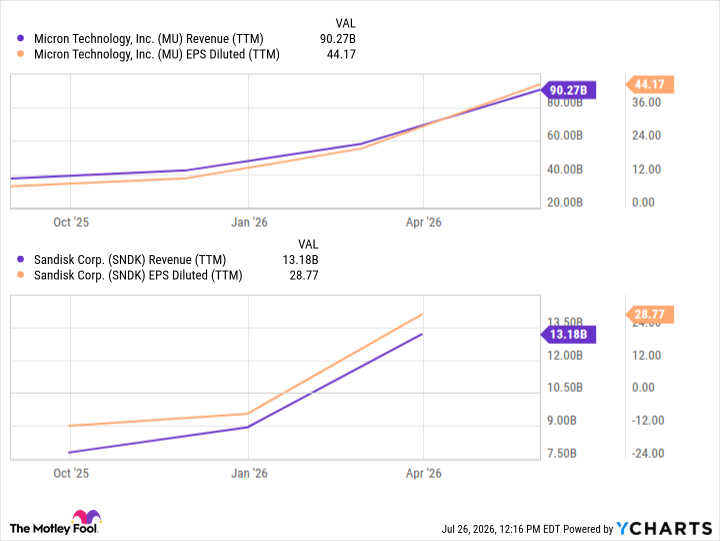
MU Revenue (TTM) data by YCharts
Micron supplies HBM stacks that sit directly alongside AI accelerators from Nvidia and Advanced Micro Devices. Essentially, Micron's business is directly benefiting from the insatiable demand for new GPU architectures. Meanwhile, Sandisk's enterprise solid-state drives (SSDs) and high-density NAND provide the storage layer that every AI chip cluster requires.
Taken together, Micron and Sandisk form foundation layers of the broader AI hardware stack, turning what was once a commodity business into a strategic enabler of next-generation models.
Isn't the memory market cyclical?
Indeed, the memory market has long been notoriously cyclical -- swinging between oversupply gluts and fleeting shortages. I think the AI-driven upswing breaks this pattern, making demand secular rather than speculative. The reason is simple: Every new data center rack needs fixed quantities of HBM, DRAM, and NAND, and hyperscalers can't easily substitute or delay procurement of this hardware.
Both Micron and Sandisk are responding by locking in multi-year supply agreements with their customers. These contracts cover meaningful portions of future production with built-in volume guarantees and prepayment structures.
The arrangements provide both companies with revenue visibility and stable pricing, while reducing the risk of a sudden inventory correction. By shifting their business models from spot-market volatility to contracted demand, Micron and Sandisk are evolving a historically boom-and-bust memory industry into one with more durable earnings power.
MU Micron Technology
NASDAQ · As of 4:00 PM ET 10/23/26

Micron and Sandisk trade at reasonable valuations
While both Micron and Sandisk have witnessed meaningful valuation expansion over 2026, both stocks remain attractive based on forward price-to-earnings (P/E) multiples. For fiscal 2027, consensus earnings estimates among Wall Street analysts are $153.74 and $212.95 for Micron and Sandisk, respectively. Given their current stock prices, this equates to a forward P/E of roughly 6 and 5.6, respectively, for Micron and Sandisk.
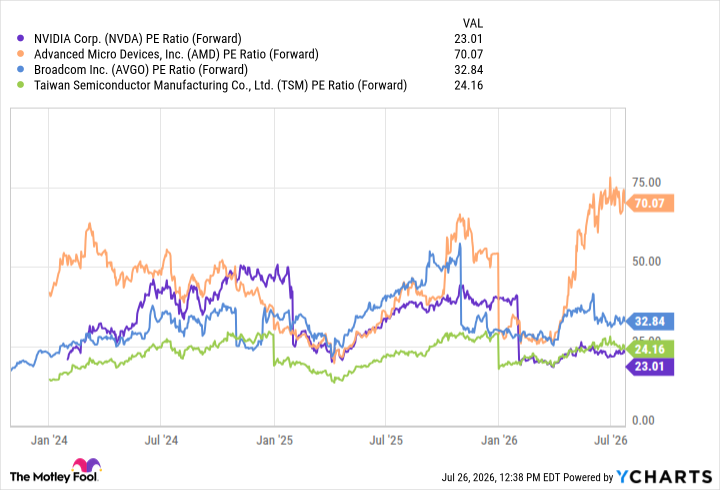
NVDA PE Ratio (Forward) data by YCharts
As the chart above illustrates, Micron and Sandisk's forward P/E ratios are both well below the peaks seen in other category-leading AI chip stocks during earlier cycles of the AI revolution. Their reasonable valuation profile, combined with continued earnings momentum, creates a compelling case for owning both stocks.
In my eyes, holding Micron and Sandisk provides diversified exposure across HBM, DRAM, and NAND, spreading risk while capturing the full breadth of the memory chapter of the AI infrastructure era. All told, pairing Micron and Sandisk adds a critical complementary layer that pure compute names cannot replicate.