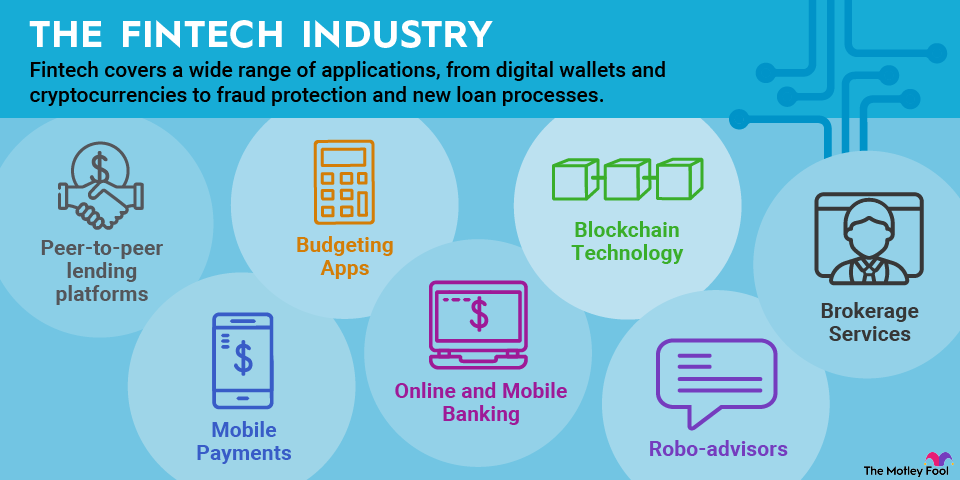
Outlook on the fintech sector
The fintech industry is evolving rapidly. And despite the massive growth we've seen in fintech, there is still an incredible opportunity ahead for fintech firms of all sizes. Here's what to know about the opportunities that remain in fintech, and the industry trends that we've been seeing in mergers and acquisitions, initial public offerings, and more.
A massive opportunity lies ahead
It might seem as if society has become fairly cashless over the past decade or so, and it's not surprising that many investors (especially in the U.S.) feel this way. After all, cashless payments are more widely accepted than ever before. It wasn't too long ago that you couldn't go to a local craft market, festival, or even sporting event without making a stop at an ATM on the way, and now that simply isn't the case.
However, you might be surprised at how many transactions around the world still involve cash, especially outside the United States. Mastercard has estimated that over 80% of payment transactions around the world were still cash-based as of 2017, and while this percentage has certainly fallen somewhat since then, it's still a huge market opportunity for payment processors, money-transfer apps, and more. In Latin America, for example, just 9% of payment transactions are cashless, and this number is even lower in the emerging markets in the Asia-Pacific region. And don't think there isn't any opportunity here -- in North America, about 70% of people say they still use cash at least weekly.
In all, card payments alone are expected to reach $45 trillion in annualized volume by 2025. And if you include things like person-to-person (P2P) and business-to-business (B2B) payments, as well as cross-border money transfers, the worldwide payments market is about $185 trillion in size already, according to Visa. That's a huge market that fintech companies can go after.
Fintech industry trends
The fintech sector has undergone a great deal of growth and disruption, and it's being funded more from venture capital (VC) investment rounds than initial public offerings (IPOs). In 2018, according to CB Insights, VC-backed fintech companies raised a record $39.75 billion over 1,707 deals, more than twice the amount that was raised through similar deals in 2017. Because venture capital has played such a large role in early investing for these fintech companies, investors can likely expect that companies will be much larger, on average, when they eventually go public, leaving less upside for individual investors. This influx of private capital has created a number of unicorns (private companies valued at $1 billion or more) in this space.
But that's not to say that there hasn't been significant IPO activity in fintech. In 2020 alone, business payments solutions company Bill.com (BILL +0.06%), insurance technology company Lemonade (LMND -1.08%), and Rocket (RKT -0.09%), parent company of the largest U.S. mortgage lender, have all entered the public markets.
There's also been quite a bit of M&A activity in the fintech space, and this is likely to continue. In 2019, two of the three largest fintech deals ever have occurred, with Fiserv (FISV -1.89%) acquiring First Data for approximately $21.8 billion and Fidelity National Information Services (FIS -1.98%), commonly referred to as FIS, acquiring Worldpay for $35.3 billion. In addition, Ultimate Software Group, a company that provides a cloud-based, software-as-a-service (SaaS) human capital management platform, was gobbled up by a private investment group for just under $11 billion. Major fintechs like PayPal, Mastercard, Visa, and more have all made several bolt-on acquisitions in the past few years as well. And it would be surprising if we didn't see significant consolidation in the fintech industry continue for years to come.
In short, the outlook for fintech is that this will be a rapidly evolving industry over the next few decades. Smaller disruptors will continue to shake up the industry, IPOs and M&A activity will likely continue at elevated levels, and existing fintechs will race to grow their market share and capitalize on untapped opportunities.
Top fintech stocks
There are dozens of excellent fintech stocks you might want to put on your radar, and here are 10 of our favorites.